
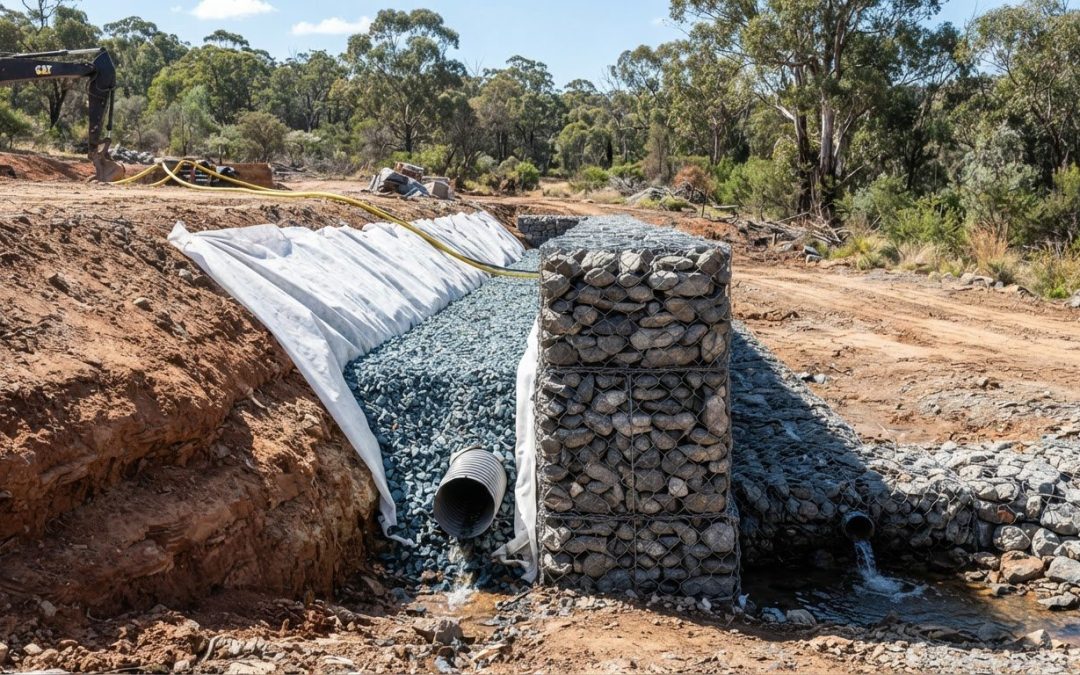
Where will water go once it reaches the back of a gabion wall? Rock fill allows water to pass through, but without a planned route and outlet, water can still collect in the ground. Moving soil may also clog the voids or wash through the wall. Effective gabion wall drainage solutions need to address both water flow and soil movement.
It’s reasonable to want clarity on how water will be filtered, where it will flow and where it will discharge. These details depend on ground conditions, water sources and the wall’s design, so one drainage detail won’t suit every project. This article explains how filtration, drainage paths and outlets work together, and what to compare for different site conditions. You’ll also find practical questions to raise with the project team, including how gabion baskets, reno mattresses and earthworks fit within a coordinated civil works scope.
Key Takeaways
- Effective gabion wall drainage solutions coordinate filtration, a defined path for water and a suitable outlet to help manage soil movement and water pressure.
- Assess rainfall, groundwater, runoff and ground conditions before comparing filter fabric, granular filters, drainage aggregate and perforated pipes.
- Check what each drainage component does, where it may be unsuitable and what inspection or maintenance it could require on your site.
- Use a site checklist to trace where water comes from, where it will flow and where it will discharge, then confirm responsibilities in the project documents.
- Consider gabion baskets, reno mattresses, earthworks and drainage interfaces as connected parts of the civil works scope.
Gabion wall drainage solutions: why managing water matters
Gabion wall drainage solutions are the planned measures that guide water away from retained ground while limiting soil movement and pressure build-up behind the wall. That means looking beyond the rock-filled baskets. Water needs a route through or around the structure and a suitable place to discharge, while the surrounding soil must be retained.
The spaces between the rocks let water pass through the gabion structure, but they don’t automatically filter fine soil or provide a safe outlet. For a general introduction to gabions and their civil engineering uses, see Gabion walls. Drainage still needs to be considered in relation to site conditions and the wall’s design.
Rainfall can saturate retained soil, groundwater may reach the wall from below or behind, and surface runoff can collect at the top or along the ends. Each source can affect how much water reaches the structure and which direction it takes. A drainage plan should identify where water comes from, how it moves and where it can discharge without creating problems elsewhere.
What happens when water is not managed behind a gabion wall?
If water cannot drain as intended, it may increase pressure in the retained ground. Flowing water can also carry fine soil towards or through gaps in the rock fill. Over time, soil loss may contribute to localised settlement or changes in the ground near the wall.
These signs don’t, on their own, prove that a wall is failing. The cause and level of risk depend on the soil, groundwater, wall design and wider site conditions. Assess visible changes in context rather than diagnosing a problem from one symptom.
When should a project team review gabion wall drainage?
Review drainage during early project planning, especially where the site has known runoff paths or groundwater concerns. Revisit the details if changes to the surrounding site alter runoff, or if water begins seeping through or collecting behind the wall.
Persistent wet areas, visible sediment movement or emerging ground changes are reasons to investigate further, though each can have different causes. If water behaviour or wall performance is uncertain, arrange a qualified site assessment. Coordinating the wall, earthworks and drainage details helps the project team address site conditions before construction.
How gabion wall drainage works: filtration, flow paths and outlets
A drainage arrangement needs to guide water from the retained ground, through a suitable filter and along a defined route to an appropriate discharge point. Each part has a different role. The details should reflect the site’s soil grading, groundwater conditions and expected water flows.
Filtration retains soil, conveyance carries water towards the outlet, and discharge releases it at a suitable location. If any part is missing or unsuitable, water may collect, carry soil with it or emerge where it causes problems. Check design choices against site conditions and project requirements.
Filter fabric and granular filter layers: what do they do?
A geotextile or graded granular layer can separate retained soil from coarser drainage material while allowing water to pass. The filter needs to suit the soil it contacts. If it’s poorly matched, fine particles may migrate through it, or particles may accumulate and restrict flow. These risks are sometimes described as soil piping and clogging.
There’s no universal fabric or layer arrangement for every site. Soil grading, groundwater and expected flow all matter. Confirm the filter type, continuity and placement in the project details rather than assuming a material will perform as intended in every ground condition.
Drainage aggregate, pipes and outlets behind gabion walls
Free-draining aggregate behind a wall can provide a route for water to move down towards a collection point. A perforated drainage pipe may form part of that route, depending on project requirements. Its position, connection and capacity need to be considered alongside the filter and drainage material.
The route must end somewhere suitable. An outlet should discharge where the ground can accept the water without causing erosion or transferring the problem to adjoining ground. Where required, it should also be accessible for inspection or maintenance. Don’t assume an outlet exists simply because a pipe is shown or the gabion rock is permeable. Trace the proposed route to its discharge point and confirm who is responsible for coordinating it.
These interfaces are worth discussing alongside the construction scope. Project teams coordinating gabion basket and earthworks services with McMahons Civil and Contracting PTY LTD can discuss how site conditions, drainage paths and construction details fit together.
Comparing gabion wall drainage solutions for different site conditions
The right drainage arrangement depends on how water and soil behave at the site. Free-draining ground may call for different measures from fine-grained or water-sensitive soil, where moving water could carry particles towards the wall. Groundwater, concentrated runoff and water arriving from uphill can also affect which components are suitable. Don’t assume one detail suits every Australian site.
Use the comparison below to frame project discussions. It isn’t a specification. Confirm material selection, arrangement and discharge requirements against site conditions and project documentation.
| Site condition or component | Function and considerations | Maintenance and verification |
|---|---|---|
| Free-draining ground | Granular filter material or drainage aggregate may provide a path for water, subject to compatibility with the surrounding soil. | Check that water has a defined route and outlet. Verify the material arrangement against the ground conditions. |
| Fine-grained or water-sensitive soil | Filter fabric or a graded granular filter may help limit soil migration while allowing water through. Poor compatibility can lead to clogging or soil loss. | Confirm filter selection, placement and continuity through a project-specific assessment. Consider whether the filter can be inspected where practical. |
| Groundwater or concentrated runoff | A drainage aggregate path may be combined with a perforated pipe to collect and convey water, if the design calls for it. | Trace the route to a suitable discharge location. Confirm expected flows, outlet access and responsibility for maintaining the route. |
Which drainage details suit different ground and water conditions?
Where conditions are uncertain, soil investigation and drainage assessment can help the project team understand what the ground will allow and where water may enter. For example, uphill runoff directed towards a wall presents a different consideration from water moving slowly through relatively free-draining ground. The response should follow site-specific evidence, not a standard detail selected in isolation.
Gabion walls, reno mattresses and adjacent drainage systems
A gabion retaining wall and a reno mattress may sit within the same civil works, but they have different roles. A wall retains ground, while a reno mattress can be used for erosion protection. Consider their drainage interfaces alongside nearby culverts, channels and earthworks so that water is managed across the connected site, not just at one structure. Explore the gabion basket and reno mattress guide for more on these applications.
Choosing gabion wall drainage solutions means matching filtration, conveyance and discharge to the ground and water conditions, then confirming those interfaces with the project team.

Planning gabion wall drainage: a practical site-assessment checklist
Before selecting gabion wall drainage solutions, gather enough site and project information to trace water from its source to its intended discharge point. Use this checklist with the project team, and record unknowns that need further assessment.
- Identify water sources. Note surface runoff paths, visible seepage, groundwater information and any water entering from uphill areas.
- Review ground conditions. Record ground levels and available soil information, including geotechnical reports. List any gaps that may need assessment by a qualified professional.
- Locate existing infrastructure. Map nearby drains, pipes, culverts or channels that may affect the wall or connect with its drainage route.
- Trace the proposed route. Follow water from behind the wall to the intended discharge point. Confirm that the location is suitable and identify site or project constraints before construction.
- Agree responsibilities and access. Check project documents to establish who is responsible for drainage details and interfaces. Discuss inspection access, outlet protection and maintenance planning.
What information should be gathered before selecting drainage details?
Site observations can show where further information is needed, but they don’t replace a qualified assessment when ground or water behaviour is uncertain. Compare observations with available geotechnical information and project drawings. Resolve unclear discharge arrangements before work begins. Where wider site preparation affects levels or runoff, the structural earthworks reference may help place the wall within the broader earthworks context.
How can drainage be checked during construction and maintenance?
Before components are covered, check that filters, drainage aggregate, any pipework and outlets align with approved project documentation. Keep them clear of construction debris, and document concealed work where the project requires it. Confirm who will inspect accessible outlets and how maintenance is to be recorded.
Inspection timing should suit the site and project plan. The team may discuss checks after relevant weather events and what to do if an outlet appears blocked or water patterns change. These are planning considerations, not a guarantee that every issue will be visible or prevented.
For project teams coordinating gabion baskets and earthworks, discuss your project requirements with McMahons Civil and Contracting PTY LTD as part of clarifying construction scope and interfaces.
Delivering gabion wall drainage as part of a civil works package
Consider gabion wall drainage alongside the work that shapes and supports the wall. Basket placement, earthworks, filter layers and the route to an outlet can affect one another. Treating them as separate tasks may leave gaps in scope or unclear construction interfaces. Establish how the elements fit together before work begins, without assuming one drainage detail will suit every site.
Clear responsibilities matter. The contractor’s construction scope, project documentation and advice from relevant design or geotechnical professionals should align, so site conditions and drainage requirements are understood by the people responsible for each part of the work.
What to clarify when engaging a gabion contractor
Before appointing a contractor, use the project documents to confirm the scope and identify unresolved interfaces. In particular, ask:
- How will basket work, earthworks and drainage interfaces be sequenced and coordinated?
- Which drawings or approved documents should guide construction, and how will changes or site conditions be recorded?
- Who is responsible for design decisions, geotechnical advice and any required approvals?
- What inspection access, outlet protection and maintenance expectations should be considered once the work is complete?
These questions help distinguish construction responsibilities from professional design and approval responsibilities. Confirm the answers with the relevant project parties rather than relying on assumptions.
How McMahons Civil and Contracting PTY LTD can contribute to gabion and civil works
McMahons Civil and Contracting PTY LTD provides gabion baskets, reno mattresses and earthworks, alongside civil, mining and rail infrastructure services. Where these activities form part of a wider project, discussing the scope together can help clarify construction sequencing, site conditions and interfaces that need to be documented. This does not replace project-specific drainage design or advice from the professionals responsible for those decisions.
For gabion wall drainage solutions, include the drainage route and responsibilities in the project discussion, not just the visible wall components. A clear brief can help the project team identify what information is available, what needs confirmation and how the different work packages connect.
Discuss gabion basket and drainage requirements with McMahons Civil and Contracting PTY LTD as part of your project planning.
Plan the drainage details before construction begins
Reliable gabion wall drainage solutions depend on the whole water path: filtration must limit soil movement, drainage routes must carry water, and outlets need a suitable discharge point. The right arrangement varies with ground conditions, groundwater and runoff, so confirm the details with the relevant project professionals rather than relying on a standard approach.
Bring drainage interfaces into the wider civil works discussion. McMahons Civil and Contracting PTY LTD provides gabion baskets, reno mattresses and earthworks, alongside civil, mining and rail infrastructure services. Clear project documentation can help coordinate these work packages and clarify responsibilities before construction.
Ready to discuss how gabion work fits your project scope? Discuss your gabion basket and drainage requirements with McMahons Civil and Contracting PTY LTD. Bring your site information and project scope to start the conversation.
Frequently Asked Questions
Do gabion walls need drainage behind them?
Drainage should be assessed for every gabion wall, but the required arrangement depends on the site and wall design. Water may pass through the rock fill, yet that alone doesn’t filter fine soil or establish where water will discharge. Consider rainfall, groundwater, runoff and ground conditions, then confirm how water will be managed with the relevant project professionals before construction.
What is the best drainage solution for a gabion wall?
There’s no single best drainage detail for every gabion wall. A project may use a filter layer, free-draining aggregate, a perforated pipe or a combination, depending on soil grading, groundwater, expected water flows and the available discharge point. Compare options by their function, compatibility with site conditions and maintenance needs, then have the proposed arrangement checked against project requirements.
Can water drain through gabion baskets without a drainage pipe?
Water can pass through the voids in gabion rock fill, but that doesn’t mean a pipe is never needed. The wall’s permeability won’t, by itself, collect water behind the structure or direct it to a suitable outlet. Whether a pipe is appropriate depends on the ground, water sources, wall design and drainage route. Confirm the need for one as part of a site-specific assessment.
How does geotextile help with gabion wall drainage?
Geotextile can act as a filter between retained soil and coarser drainage material, allowing water to pass while helping limit soil migration. Its performance depends on compatibility with the surrounding soil and correct selection and placement. A filter that’s unsuitable for the ground may clog or allow particles to move through. Confirm the fabric and installation details for the project rather than assuming one type suits every site.
What happens if a gabion wall drainage outlet becomes blocked?
A blocked outlet may restrict water discharge, allowing water to collect along the drainage route or behind the wall. Depending on the site, this could contribute to increased water pressure, seepage or soil movement. Check for visible blockage only where it’s safe and accessible, and seek qualified advice if water patterns change or wall performance is uncertain. Don’t assume one symptom identifies the cause.
Can gabion wall drainage prevent soil from washing through the rock fill?
A suitable filter layer can help limit soil particles moving from retained ground into the rock fill while still allowing water to pass. However, performance depends on the filter’s compatibility with the soil, its placement and the complete drainage arrangement. No single component should be treated as a guarantee against soil loss. If sediment appears near the wall, arrange an assessment to establish the cause.
When should I get professional advice about gabion wall drainage?
Seek qualified advice during early project planning if groundwater, runoff or soil conditions are unclear, and before changing drainage details. An assessment is also sensible if you observe persistent wet areas, seepage, sediment movement, changed water patterns or changes around the wall. These signs don’t prove structural failure, but they warrant attention in context. Confirm which project professionals are responsible for drainage and ground-condition advice.