
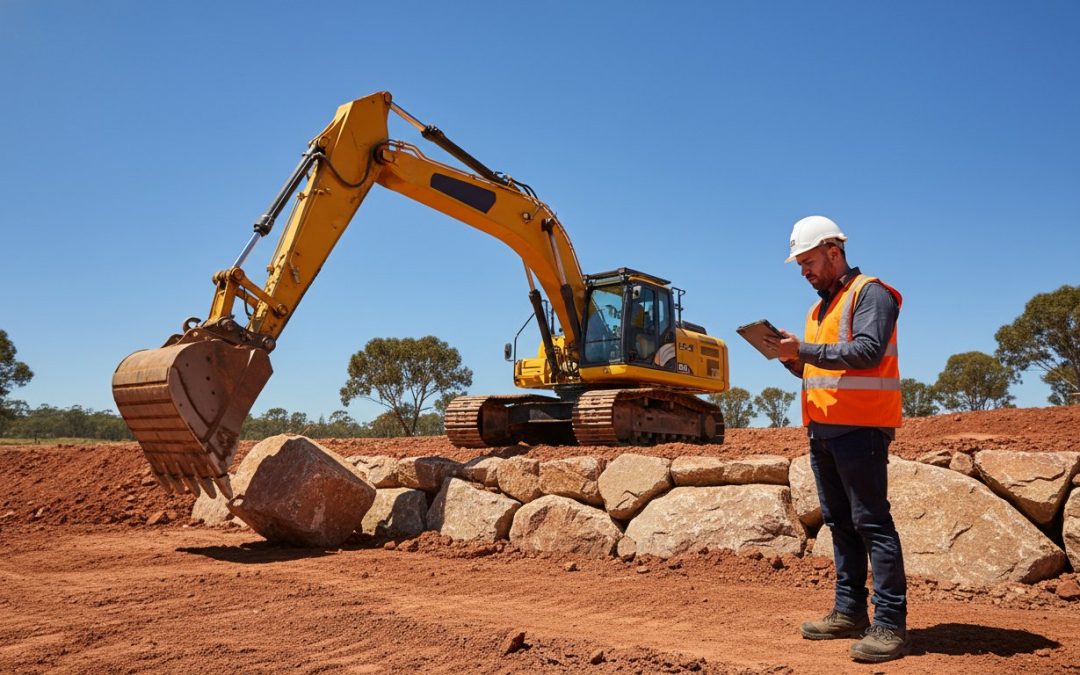
A project’s ultimate success isn’t determined by the structure that rises above the ground, but by the engineering precision of the earth works hidden beneath it. It’s a fundamental truth that every seasoned site supervisor understands. You likely recognise that even a minor inaccuracy in site levels can quickly lead to spiralling cost overruns or compromised structural integrity. When you’re managing large-scale civil or mining developments, the margin for error is non-existent.
This guide serves as a comprehensive reference for professional standards and methodologies tailored specifically to the Australian landscape. We’ll help you navigate the complexities of site preparation by clarifying the differences between bulk and detailed earthworks. You’ll also learn how to maintain long-term stability and identify the right erosion control measures for difficult terrains. By aligning your operations with AS 3798-2007 and the updated 2026 Austroads specifications, you can ensure your project remains compliant and structurally sound from the first cut to the final level.
Key Takeaways
- Master the structural requirements of AS 3798-2007 to ensure every site foundation meets rigorous Australian engineering standards.
- Explore the distinct methodologies required for rail and mining projects, focusing on precision drainage and the stability of heavy plant pads.
- Learn how high-quality earth works act as the critical first step in mitigating the risks of soil instability and regulatory non-compliance.
- Evaluate advanced erosion management techniques, including the use of rock pitching for durable batter protection in challenging environments.
- Understand how an integrated approach to site preparation, from rock breaking to final landscaping, reduces project friction and improves delivery timelines.
Defining Earthworks in the Australian Civil Landscape
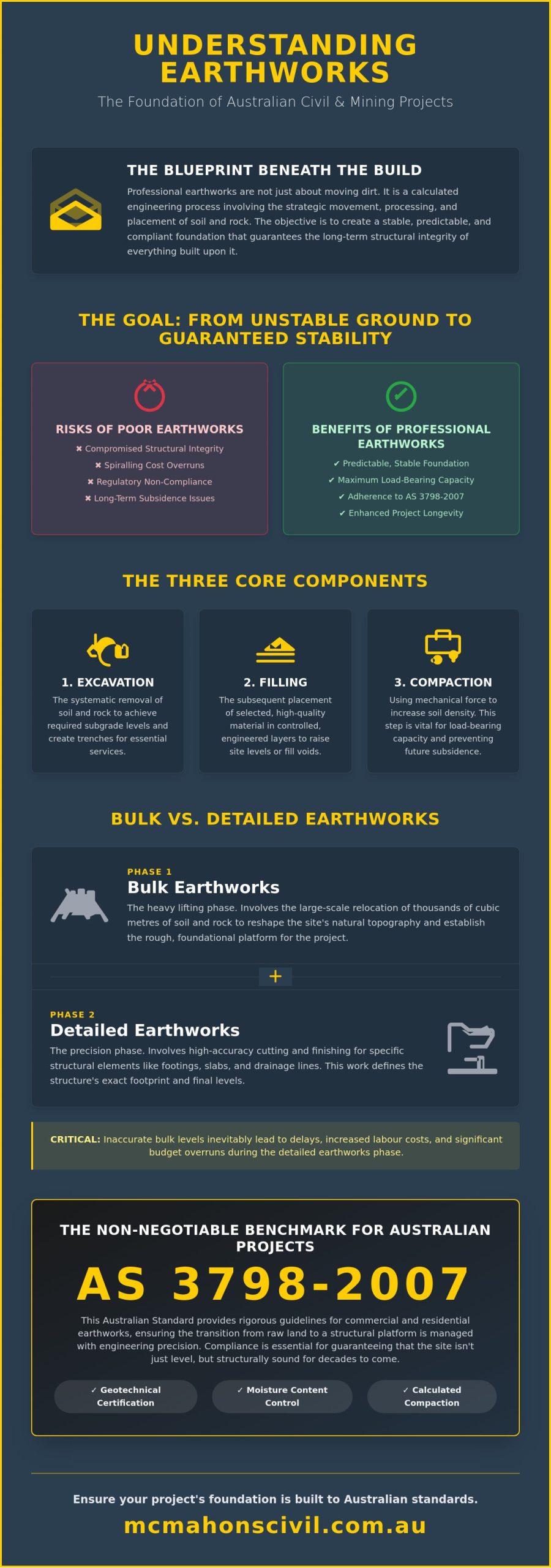
Earthworks represent the foundational stage of any civil or mining project, serving as the literal and metaphorical base upon which all subsequent infrastructure is built. In a professional context, Earthworks (engineering) involves the strategic movement, processing, and placement of soil and rock to achieve a specific design profile. It isn’t merely a matter of shifting material from one point to another. It’s a calculated engineering process designed to ensure long-term stability and load-bearing capacity for structures ranging from haul roads to commercial foundations. Without this initial precision, even the most advanced architectural designs are at risk of failure.
The primary goal of professional earth works is to create a stable, predictable foundation. In the Australian landscape, where soil conditions can vary from reactive clays to unstable sands, this process requires a deep understanding of geology and moisture control. When earthworks are executed correctly, they mitigate the risk of soil instability, preventing the structural failures and regulatory non-compliance that often plague poorly managed sites. It’s the most critical phase of any development because errors made here are often impossible or prohibitively expensive to fix once the concrete is poured.
The Core Components of Professional Earthworks
Success on a site depends on three fundamental processes. Excavation involves the systematic removal of material to reach required subgrade levels or to create trenches for essential services. Filling is the subsequent placement of selected, high-quality material in controlled layers to raise site levels or fill existing voids. Finally, compaction uses mechanical force to increase soil density. This step is vital for increasing load-bearing capacity, ensuring the ground can support heavy machinery or permanent structures without future subsidence. Each component must be monitored closely to meet the specific engineering requirements of the project.
Bulk vs. Detailed Earthworks: Understanding the Difference
Distinguishing between bulk and detailed phases is essential for effective project management and budgeting. Bulk earthworks focus on the large-scale relocation of soil and rock to reshape the site’s natural topography. This phase handles the heavy lifting, moving thousands of cubic metres to establish the rough platform of the site. In contrast, detailed earthworks involve high-precision cutting for footings, slabs, and drainage lines. While bulk works define the landscape, detailed works define the structure’s footprint. Synchronising these two phases is essential. If the bulk levels are inaccurate, the detailed earth works will inevitably face delays, leading to increased labour costs and potential equipment standby charges.
Core Methodologies and Australian Structural Standards
Adhering to AS 3798-2007 is the non-negotiable benchmark for any professional development in Australia. These guidelines for earth works in commercial and residential settings ensure that the transition from raw land to a structural platform is managed with engineering rigour. A geotechnical engineer plays a central role in this process, providing the necessary certification that the subgrade and fill meet the specific load-bearing requirements of the project. Their oversight ensures that the site isn’t just level, but structurally sound for decades to come.
Moisture content control is perhaps the most critical technical factor in achieving maximum dry density. If the soil is too dry, the particles cannot be effectively rearranged into a dense state. Conversely, excessive moisture leads to water-logged voids that cause the ground to become unstable or “spongy” under load. Achieving the “optimum moisture content” is a precise science that requires constant monitoring during the layering process. It’s also a common misconception that more compaction passes always yield better results. In reality, over-compacting certain soil types can lead to shear failure, where the soil structure actually breaks down and loses its integrity. Success lies in the disciplined application of calculated layer thicknesses and specific equipment passes.
Soil Testing and Geotechnical Analysis
Before the first machine arrives, a thorough analysis of the soil profile is mandatory. In many Australian regions, we encounter reactive clays that expand and contract significantly with moisture fluctuations. These require different handling compared to granular sands, which present challenges related to confinement and drainage. The Proctor Compaction Test is the industry standard for determining how a specific soil sample will behave under mechanical pressure. On complex brownfield sites, we also address the remediation of contaminated fill, ensuring that all material handled on-site complies with environmental health and safety regulations.
Compaction Standards and Verification
Verification is the final step in the quality assurance chain. Most civil infrastructure projects demand a Relative Compaction of 95% to 98% Standard Compaction. We verify these results using nuclear density gauges for rapid on-site data or sand replacement tests for specific geotechnical requirements. This rigorous documentation creates a permanent record of the site’s structural integrity, which is vital for the final handover. If you are preparing for a project that requires this level of technical precision, it is essential to work with a team that prioritises professional earthworks standards.
Specialised Earthworks: Rail, Mining, and Infrastructure
While standard site preparation focuses on residential and commercial footprints, specialised sectors like rail and mining require a distinct engineering approach. These projects often take place in remote Australian environments where extreme weather and geological volatility are the norm rather than the exception. In these contexts, earth works are not just about creating a level surface; they’re about constructing high-performance infrastructure capable of withstanding immense mechanical stress and environmental pressure. Success in these fields depends on a contractor’s ability to adapt proven methodologies to the unique demands of the site.
Civil infrastructure projects, such as road subgrades and bridge abutments, also demand rigorous structural standards. These elements must support constant traffic loads and manage thermal expansion without shifting. Whether it’s an industrial pad for a large-scale warehouse or a complex intersection, the subgrade must be perfectly uniform. Inconsistent compaction leads to differential settlement, which is the primary cause of pavement cracking and structural failure in civil works. Achieving this level of uniformity requires a methodical approach and a commitment to precision from the initial cut to the final trim.
Mining Site Preparation and Haul Road Construction
Mining operations rely on the integrity of their haul roads to maintain production cycles without interruption. These roads must be engineered to support the weight of ultra-class trucks, which often exceed 400-tonne GVM (Gross Vehicle Mass). Achieving this requires specific material selection and deep-lift compaction techniques that prevent surface deformation under repetitive, heavy loading. Beyond the road surface, we manage the stability of benches and slopes in open-cut environments to ensure the safety of all personnel. In arid regions, dust suppression and water binding become critical logistical components of the earthworks phase, requiring a steady supply of non-potable water to maintain soil cohesion and visibility for operators.
Rail Corridor Earthworks and Structural Integrity
Rail infrastructure demands a level of precision that few other civil projects require. The vertical and horizontal tolerances for grading are exceptionally tight to ensure the ballast sits correctly and the tracks remain aligned. A primary focus in rail earth works is the management of corridor drainage. If water is allowed to pool, it can lead to subgrade saturation and a phenomenon known as “pumping,” where fine soil particles are forced up into the ballast, compromising the track’s stability. Successfully delivering these projects often involves a seamless integration of services, including precision rock breaking for cuttings and the placement of concrete for structural culverts and abutments. Managing these complex interactions is what ensures the longevity of the rail network.
Erosion Control and Site Stabilisation Strategies
The integrity of professional earth works is often tested not during construction, but during the first significant weather event. Erosion control is the strategic bridge between temporary site preparation and permanent structural stability. Without a robust stabilisation plan, the precision grading achieved during the bulk phase can be quickly undone by surface runoff and soil migration. This is particularly true on complex terrains where steep batters and high-velocity drainage channels are required. Adhering to the 2026 Austroads specifications, specifically ATS-2240-25 for stormwater infrastructure, ensures that the subgrade remains protected from the elements throughout the project’s lifecycle.
Limestone retaining walls also play a vital role in managing elevation changes on industrial and civil sites. These walls provide a clean, structural finish that is capable of supporting significant lateral loads while maintaining a professional aesthetic. By addressing height transitions with engineered walling, developers can maximise the usable footprint of a site without compromising the safety of the surrounding embankments. Integrating these structures early in the site preparation phase prevents the need for costly remedial works after the primary infrastructure is in place.
Rock Pitching for Structural Protection
Vegetation is often insufficient for protecting batters in high-flow areas where water velocity can quickly strip away topsoil. Rock pitching provides a premium, hard-armoured solution that withstands the sheer force of moving water in drainage channels and around culvert headwalls. The process involves the meticulous placement of stone, either by hand for precision or by machine for larger areas, to create a dense, interlocking surface. This method effectively dissipates energy and prevents the scouring that typically occurs at bridge pylons and pipe outlets. When properly integrated with the initial earth works, rock pitching creates a permanent, low-maintenance barrier that protects the site’s structural profile.
Gabions and Reno Mattresses in Civil Engineering
For sites with unstable slopes or significant height transitions, gabion baskets offer a flexible and reliable alternative to rigid concrete structures. These wire-mesh cages are filled with durable stone to create gravity retaining walls that can accommodate minor ground movements without cracking. Reno mattresses, which are thinner and broader, are specifically designed to line large drainage basins and spillways. Their primary advantage is permeability. By allowing water to pass through the structure, they manage hydrostatic pressure naturally, reducing the risk of wall failure during heavy rain events. Whether you require massive soil retention or precision batter protection, our team provides the technical expertise to deliver integrated erosion control and earthworks solutions.
The McMahons Approach: Professional Civil and Mining Contracting
With over 18 years of experience delivering complex civil and mining earth works across Australia, McMahons Civil and Contracting PTY LTD has built a reputation grounded in quiet confidence and technical proficiency. We understand that the integrity of any infrastructure development depends on the quality of the initial site preparation. Our team doesn’t simply move material. We provide a methodical, engineered approach to every cubic metre of soil and rock we handle during professional earth works. By maintaining an integrated service model that encompasses everything from initial rock breaking to final rock pitching, we ensure that every stage of the project is synchronised for maximum efficiency and structural reliability.
Our track record includes significant contributions to rail infrastructure and remote mining site support, where the demands for precision and safety are at their highest. We’ve successfully navigated the logistical challenges of the Australian outback and the rigorous compliance requirements of major metropolitan rail corridors. This history of performance allows us to act as a dedicated partner rather than just a contractor. We take a hands-on, responsible approach to every project, ensuring that the results we deliver meet exactly what was promised during the consultation phase.
Why Partner with a Specialised Earthworks Contractor?
Engaging a specialist provides access to a level of expertise that general hire firms cannot match. Professional earth works require more than just heavy machinery. They require highly skilled operators who understand the nuances of Australian geological conditions, from reactive clays to hard rock. Our fleet of specialised plant is maintained to the highest standards, ensuring that we can manage large-scale bulk projects alongside the intricate structural work required for footings and drainage. This dual capability allows us to maintain the site schedule and budget by eliminating the need for multiple subcontractors on a single site.
Contact McMahons for Your Next Infrastructure Project
Every project presents a unique set of challenges that require a tailored engineering solution. Our technical team is available to discuss your specific requirements, whether you’re managing a complex rail cutting or preparing a heavy plant pad for a mining operation. We pride ourselves on clear communication and a transparent process that prioritises safety and structural integrity above all else. If you are looking for a partner with deep-seated knowledge and a commitment to exceeding expectations, we invite you to reach out. Enquire about our professional earthworks services today to learn how we can support your next infrastructure development.
Securing the Structural Foundation of Your Next Project
The success of any major civil or mining development depends on the technical precision applied during the initial site preparation. By adhering to rigorous standards like AS 3798-2007 and implementing advanced compaction methodologies, you eliminate the risks of soil instability and costly structural failure. We’ve explored how professional earth works serve as the invisible backbone of our national infrastructure, from remote haul roads to high-tolerance rail corridors. Integrating these foundational works with specialised erosion control solutions, such as rock pitching, ensures your site remains resilient against the harsh Australian climate.
McMahons brings over 18 years of industry experience to every project, specialising in comprehensive civil, rail, and mining capabilities. Our expertise in structural landscaping and rock pitching provides the integrated approach needed to manage complex site requirements with certainty. We’re committed to delivering safety and structural integrity in every cubic metre moved, ensuring your project starts on the right ground. Partner with McMahons for reliable civil and mining earthworks. We look forward to helping you build a stable future for your next infrastructure project.
Frequently Asked Questions
What is the difference between bulk and detailed earthworks?
Bulk earthworks involve the large-scale relocation of soil and rock to achieve the site’s rough design levels and topography. Detailed earthworks focus on the high-precision cutting required for specific structural elements like footings, drainage lines, and service trenches. While bulk works establish the broad platform, detailed works define the exact footprint where concrete and other infrastructure will be placed.
What Australian Standards govern earthworks and compaction?
The primary standard for commercial and residential developments is AS 3798-2007, which provides guidelines on material selection and placement. For rail infrastructure, AS 7638:2013 remains the active standard. Civil projects must also align with the updated 2026 Austroads Technical Specifications, such as ATS-2170-25 for geosynthetic reinforcement, to ensure modern compliance and safety.
Why is compaction testing necessary for civil projects?
Compaction testing is essential to verify that the placed fill has reached the required density to support structural loads without future subsidence. It provides the geotechnical data necessary to certify that the site meets engineering specifications. Without this verification, the project risks long-term failure, pavement cracking, and regulatory non-compliance that can lead to significant financial penalties.
How do you manage earthworks on reactive clay soils?
Managing reactive clays requires strict moisture control to minimise the volume changes associated with expansion and contraction. In many cases, we use lime stabilisation or replace the top layer with non-reactive structural fill to create a stable platform for subsequent earth works. This prevents the “heaving” that often causes foundations to crack during seasonal moisture fluctuations.
What are the benefits of rock pitching for erosion control?
Rock pitching provides a durable, hard-armoured surface that dissipates the energy of high-velocity water flow in drainage channels and on steep batters. Unlike simple vegetation, it offers immediate and permanent protection against scouring. This method is particularly effective around culvert headwalls and bridge pylons, where it prevents the soil migration that can compromise structural footings over time.
Can earthworks be performed during the wet season in Australia?
Performing earthworks during the wet season is possible but requires rigorous site management and advanced drainage planning. We focus on sealing work areas before rain events and maintaining strict moisture control to ensure the subgrade doesn’t become saturated. Effective management prevents the ground from becoming unworkable, which would otherwise halt production and compromise compaction levels.
What equipment is typically used for large-scale mining earthworks?
Large-scale mining projects typically utilise ultra-class excavators, D10 or D11 dozers, and articulated or rigid-frame haul trucks. This heavy plant is essential for moving the massive volumes of overburden and ore required to establish haul roads and tailings dams. Using the right equipment ensures that the site is prepared efficiently while maintaining the structural integrity required for heavy plant pads.
How do you calculate the volume of material for an earthworks project?
Volumes are calculated by comparing existing site survey data with the final design levels to determine the “cut and fill” balance. Professional contractors use 3D modelling software to provide precise cubic metre estimates, accounting for soil bulking and compaction factors. This data is vital for managing transport logistics and accurately budgeting for earth works on complex sites.