
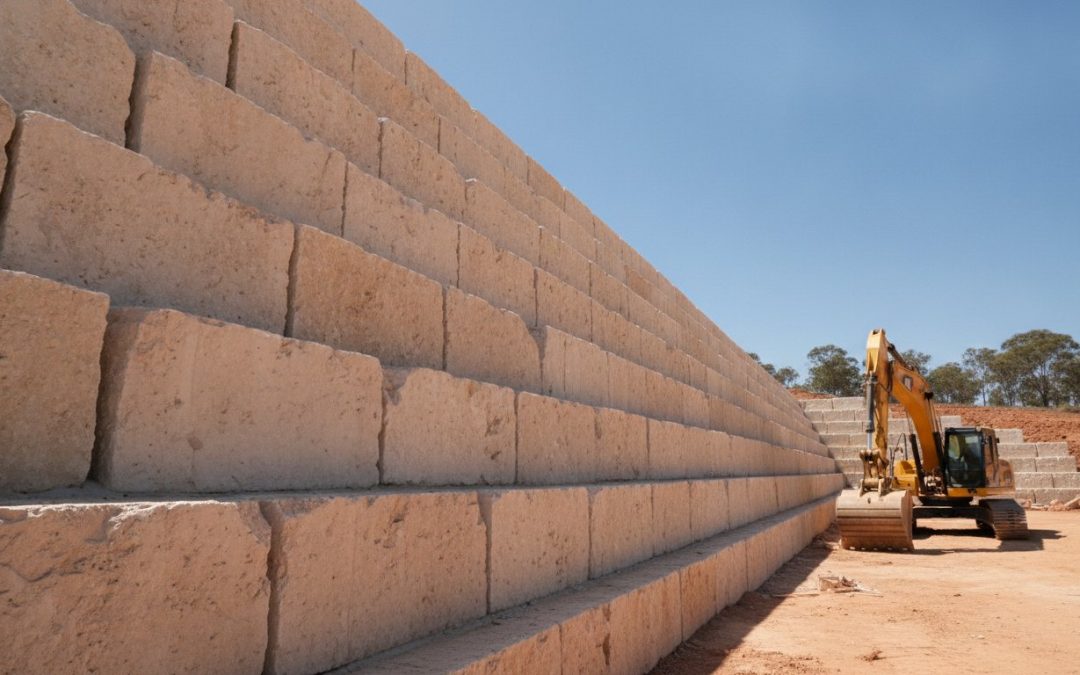
A retaining wall in a large-scale civil project is far more than a simple boundary; it is a critical piece of load-bearing infrastructure that must withstand immense hydrostatic pressure and surcharge loads for decades. For many engineers and project managers across Australia, the primary concern remains the long-term structural integrity of these assets under varying soil profiles. It is understandable that navigating the complexities of AS 4678-2002 while managing site-specific drainage requirements can feel like a balancing act between compliance and practical performance. This reference provides a detailed look at the technical specifications and engineering benefits of limestone retaining walls, specifically tailored for the rigours of Australian infrastructure works.
You’ll gain a clear understanding of how these structures integrate with broader earthworks and the framework required for selecting materials that meet NCC 2025 standards. We will examine the structural standards necessary for high-performance applications, the impact of moisture management on wall stability, and the methodical approach needed to ensure every block delivers on its promise of reliability. By the end of this guide, you’ll have a comprehensive foundation for implementing limestone solutions that are both technically sound and built to last.
Key Takeaways
- Understand the core requirements of AS 4678-2002 to ensure limestone retaining walls maintain structural integrity under high surcharge loads from heavy machinery.
- Distinguish between natural quarried stone and industrial-grade reconstituted blocks to select the most appropriate material for specific civil applications.
- Learn how the unique breathability of limestone assists in managing hydrostatic pressure and preventing salt damp within reactive Australian soil profiles.
- Establish a robust planning framework that prioritises geotechnical and hydrological assessments to mitigate long-term structural risks in infrastructure projects.
- Explore the benefits of an integrated approach that combines earthworks and rock breaking with wall construction for complex mining and rail environments.
What are Limestone Retaining Walls in a Civil Infrastructure Context?
Retaining walls are fundamental components of any civil earthworks project, designed to resist the lateral pressure of soil and manage grade changes across a site. In the context of large-scale infrastructure, limestone retaining walls function primarily as gravity structures, relying on their substantial mass to hold back embankments, or as part of complex cantilevered systems when combined with reinforced concrete footings. These structures are essential for creating level building pads, stabilising steep slopes, and protecting road and rail corridors from erosion or subsidence.
Australia’s unique climate and geology make limestone a logical choice for both regional and urban projects. It is readily available in many parts of the country, which helps in reducing transport costs and logistical delays. The material’s natural thermal mass helps regulate ground temperature, providing a subtle but vital benefit for protecting buried utilities or supporting sensitive vegetation in road embankments. Because it is a local resource, it offers a level of supply chain reliability that is highly valued in the civil sector.
Quarried vs. Reconstituted Limestone: Material Selection
Natural limestone is often selected for its aesthetic appeal and its performance in coastal regions, where its inherent resistance to salt spray and high-alkaline environments is a distinct advantage. However, for industrial civil works, reconstituted limestone blocks are often the preferred specification. These blocks are manufactured by mixing crushed limestone with cement, resulting in a product with uniform density and precise dimensions that simplify the installation of massive wall systems. Civil-grade reconstituted blocks must typically achieve a minimum compressive strength of 20MPa to ensure they can withstand the rigorous demands of infrastructure loading. This manufacturing process ensures consistency across thousands of units, which is critical for maintaining structural standards on large-scale worksites.
Core Applications in Mining, Rail, and Civil Sectors
Limestone solutions are frequently deployed in environments where durability and speed of construction are paramount. Their versatility allows them to be used across a variety of demanding applications:
- Rail Corridors: Providing essential slope stabilisation to prevent track subsidence and managing ballast retention.
- Bridge Abutments: Serving as robust wing walls that guide water flow and support approach embankments.
- Mining Infrastructure: Forming the backbone of mining camp pads and heavy vehicle hardstands where high surcharge loads are expected.
- Site Levelling: Creating large, flat areas for industrial warehouses and logistics hubs on uneven terrain.
These walls integrate seamlessly with broader drainage earthworks, allowing for the effective management of high-volume water runoff. By combining the wall construction with expert rock breaking and site preparation, engineers can ensure the entire earth-retention system operates as a single, cohesive unit. Whether it is supporting a bridge or levelling a site for a new facility, limestone provides a stable, long-term solution that meets the high standards of Australian civil engineering.
Engineering Standards and Structural Integrity (AS 4678)
Designing limestone retaining walls for civil applications requires strict adherence to AS 4678-2002, the Australian Standard for earth-retaining structures. This standard provides a rigorous framework for ensuring that every wall can withstand the unique environmental and mechanical stresses of its location. It’s not just about the blocks themselves; it’s about the entire system, from the footings to the surface drainage. Adhering to Engineering Standards and Structural Integrity (AS 4678) ensures that a project remains compliant and, more importantly, safe for the public and workers alike.
A critical factor in civil design is “Surcharge Loading.” When a wall is positioned adjacent to a haul road or heavy machinery hardstand, the lateral pressure increases significantly. Engineers must calculate these loads to prevent the wall from sliding or overturning under the weight of heavy vehicles or industrial equipment. This is why the foundation is non-negotiable. Every structural wall must be founded on either competent rock or a carefully prepared bed of engineered fill. Without a solid base, even the highest quality limestone will fail as the ground beneath it shifts.
Calculating Load and Pressure Factors
Understanding active earth pressure is the first step in resisting overturning. Limestone gravity walls use their own mass to counter the force of the soil behind them. However, hydrostatic pressure remains the leading cause of structural failure in Australia. If water can’t escape from behind the wall, the pressure builds until it exceeds the wall’s capacity. For any wall exceeding 1.5 metres in height, professional engineering certification is mandatory to ensure these variables are properly managed. Our team at McMahons Civil integrates these calculations into every project to ensure long-term stability.
Compaction and Backfill Specifications
The space behind the limestone face must be filled with granular, free-draining material. This backfill acts as a primary filter, allowing water to reach the drainage pipe at the base while preventing fine soil particles from clogging the system. Geofabric is used to separate the backfill from the natural soil, maintaining the integrity of the drainage layer. Compaction must meet AS 1289 standards to prevent the ground from settling over time. If the soil isn’t compacted in layers, or “lifts,” the surface above the wall will eventually sink, leading to pavement cracks or structural misalignment at the interface.
Performance in Australian Soils and Climates
Australian soil profiles vary immensely, ranging from the shifting sands of the coastline to the heavy, reactive clays found in many inland infrastructure corridors. Limestone retaining walls are uniquely suited to these diverse conditions because of their substantial mass and inherent material properties. In non-reactive sandy profiles, the weight of the blocks provides immediate, reliable stability against lateral earth pressure. When working with reactive clay, which expands and contracts with moisture changes, the wall relies on the engineered foundation and granular backfill to accommodate these movements without compromising the structure.
A significant technical advantage of limestone is its natural porosity. This “breathability” allows for the controlled migration of moisture through the stone, which helps prevent the buildup of salt damp and efflorescence that often plagues solid concrete structures in civil environments. By allowing the structure to “breathe,” engineers can reduce the risk of internal pressure points that lead to surface spalling or structural degradation over time. This makes it an ideal material for long-term assets that must maintain both their strength and appearance in harsh environments.
Thermal stability is another factor where limestone excels. In regions where summer temperatures frequently exceed 40 degrees Celsius, limestone remains remarkably stable. Its low coefficient of thermal expansion means it doesn’t undergo the significant volume changes that can cause cracking in rigid, cast-in-situ concrete. This stability, combined with the fact that limestone does not rust or rot, ensures it remains a viable infrastructure asset for 50 years or more with minimal maintenance.
Effective Drainage Systems for Civil Walls
Managing water is the most critical aspect of wall longevity. Civil-grade drainage typically involves the installation of heavy-duty agricultural (agg) pipes at the heel of the wall, coupled with strategically placed weep holes through the face. For projects in high-rainfall areas or near watercourses, we often integrate limestone walls with Reno mattresses and gabion baskets to provide superior energy dissipation and erosion control at the toe of the structure. Geofabric serves as a vital filtration layer that prevents fine soil particles from migrating into and clogging the drainage aggregate behind the wall. This ensures the hydrological path remains clear, preventing the hydrostatic pressure buildup that is the primary cause of wall failure.
Erosion Control and Slope Stabilisation
Limestone walls serve as a primary defence against soil erosion on steep embankments and road cuttings. Their ability to be tiered allows for the creation of stable, manageable slopes that protect the surrounding infrastructure. In many civil projects, we combine limestone walls with rock pitching to provide comprehensive site protection, especially in areas prone to high-velocity surface runoff. This combination is particularly effective in coastal infrastructure. Limestone is naturally resistant to salt-air corrosion, making it a more durable choice than steel-reinforced systems that may be susceptible to chloride-induced degradation in maritime environments.
A Framework for Planning Large-Scale Retaining Projects
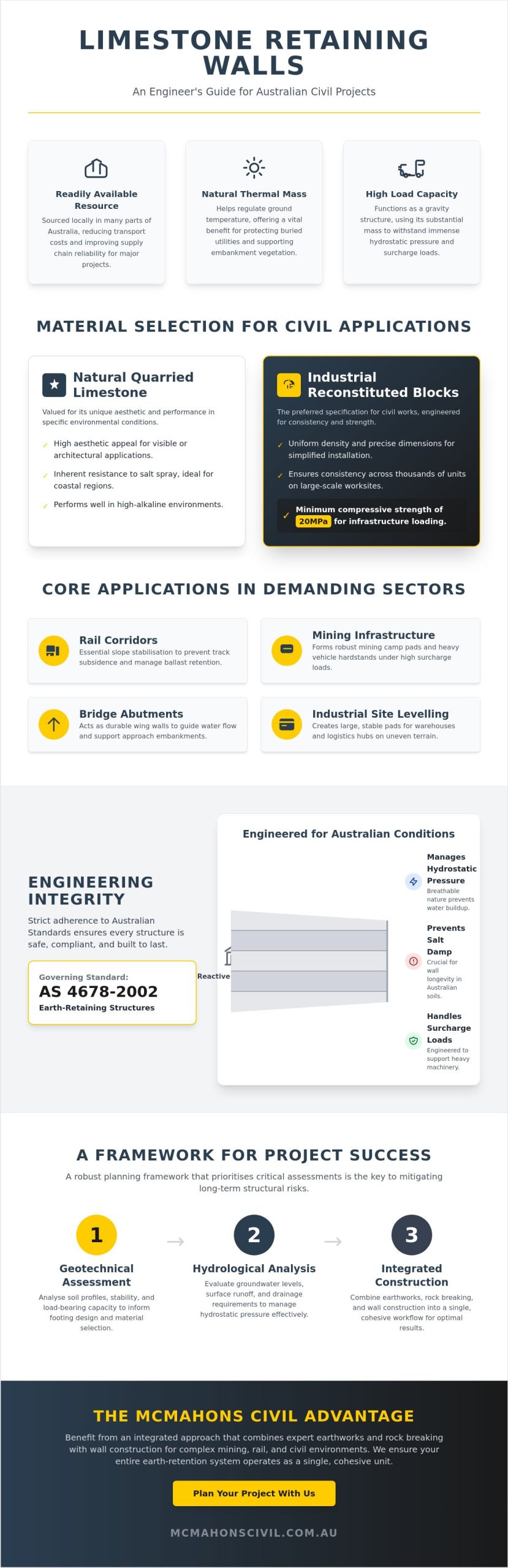
Successful civil projects begin long before the first block arrives on site. For large-scale infrastructure, a methodical planning framework is essential to ensure that limestone retaining walls perform as intended over their entire design life. This process starts with a comprehensive site survey and a geotechnical investigation to identify the soil bearing capacity. Understanding whether the ground can support the combined weight of the structure and the anticipated surcharge loads is the first step in preventing future settlement or lateral displacement. A hydrological assessment must follow, mapping out surface water flow and sub-surface drainage to ensure the wall doesn’t inadvertently become a dam during high-rainfall events.
Material procurement is another critical phase where precision is required. Sourcing civil-grade blocks that meet the 20MPa compressive strength requirement ensures the wall can handle the rigours of industrial use. This stage must be tightly coordinated with other civil works, such as earthworks and rock breaking. If a site contains existing rock formations that require removal, these activities must be integrated into the construction programme to avoid costly delays. Finally, once construction is complete, providing a compliance report and final certification is a standard requirement for government and industrial clients to verify that the structure meets all safety and regulatory benchmarks.
The Civil Contractor Selection Checklist
Selecting a partner for industrial-scale works requires a focus on technical capability and safety. A reliable contractor should be able to demonstrate:
- Extensive experience with AS 4678 and the management of heavy industrial load requirements.
- Integrated service capabilities, allowing them to handle the earthworks and rock breaking alongside the wall construction.
- Strict adherence to Tier 1 safety standards, which is a non-negotiable requirement in mining and rail sectors.
- A transparent approach to documentation, ensuring all compliance and engineering certifications are provided promptly.
If you’re currently planning a major site development, our team at McMahons Civil can provide the integrated earthworks and retaining solutions needed to secure your project’s foundation.
Maintenance and Asset Management
While limestone is known for its durability, large-scale assets still require routine inspection protocols to ensure they reach their 50-year life expectancy. Asset managers should be trained to identify early signs of distress, such as leaning, significant structural cracking, or evidence of drainage blockage, such as water pooling at the base of the wall. Catching these issues early often allows for professional repair or targeted maintenance, such as flushing out drainage lines, rather than a total replacement. When a wall shows signs of movement, it’s vital to seek civil engineering advice immediately to assess the cause and protect the surrounding infrastructure.
The McMahons Civil Advantage: Integrated Retaining Solutions
A project’s success often hinges on the seamless coordination between various civil disciplines. At McMahons Civil, we provide a unified service model that integrates the construction of limestone retaining walls with expert earthworks and rock breaking. This approach eliminates the friction often found between separate contractors, ensuring that site preparation and structural installation are perfectly aligned. Our methodical approach to structural integrity is particularly vital in the mining and rail sectors, where the margin for error is non-existent and environmental conditions are often unforgiving.
Our capability extends to remote and complex geological locations across Australia. We possess the logistical expertise and specialised equipment needed to deliver high-standard infrastructure in areas where access is difficult and ground conditions are unpredictable. This reliability is built on a foundation of quiet confidence and a serious commitment to delivering exactly what we promise, regardless of the project’s scale or location. We understand that in civil works, consistency is the key to long-term asset performance.
Beyond the Wall: Comprehensive Site Earthworks
Integrating limestone structures with bulk earthworks allows for a more efficient site preparation phase. We don’t just place blocks; we manage the entire grade change process, from the initial excavation to the final compaction. Where a project requires additional structural support, we utilise specialised concrete works to reinforce the limestone system, ensuring it meets specific industrial load requirements. Our expertise in rock pitching and the installation of gabion baskets further complements our limestone work, providing a holistic solution for erosion control and site stabilisation that addresses every facet of the landscape.
Partnering for Success in Civil Infrastructure
We view every project as a partnership. Our focus is on maintaining professional standards that reassure project stakeholders and government bodies alike. By being transparent about the “how” and the “why” of our construction methodology, we foster an environment of trust and open communication. We take pride in our workmanship and our ability to solve complex engineering challenges with a hands-on, responsible approach. This dedication to excellence ensures that every asset we build remains a stable and functional part of Australia’s infrastructure for decades to come.
Contact McMahons Civil for a professional consultation on your next infrastructure project.
Securing Your Infrastructure with Engineered Retaining Solutions
Implementing high-performance limestone retaining walls requires a balance of material knowledge and strict adherence to AS 4678-2002 standards. We’ve examined how precise surcharge loading calculations and integrated drainage systems are essential for maintaining structural integrity under the rigours of industrial use. By choosing a framework that prioritises geotechnical investigations and high-grade reconstituted blocks, you ensure your project remains a durable asset for decades. It’s about more than just the blocks; it’s about the entire engineered system working in harmony with the site’s unique soil profile.
With over 18 years of civil and mining experience, McMahons Civil provides the specialised expertise needed for compliant earth-retention and comprehensive site preparation. Our team combines rock pitching, earthworks, and wall construction into a single, reliable service model that simplifies complex logistics. Discuss your structural retaining wall requirements with the experts at McMahons Civil to see how our methodical approach can benefit your next infrastructure project. We look forward to partnering with you to deliver a result that reflects our shared commitment to high standards and professional excellence.
Frequently Asked Questions
Do limestone retaining walls require a building permit in Australia?
Yes, most Australian local councils require a building permit for limestone retaining walls over one metre in height or those located near a boundary or easement. Even for smaller walls, a permit is often necessary if the structure supports a surcharge load, such as a driveway or a neighbouring building. It’s essential to consult with a registered building surveyor or your local council before commencing works to ensure full compliance with regional planning regulations.
What is the maximum height for a limestone retaining wall before it needs engineering certification?
Engineering certification is typically required for any wall exceeding one metre in height or for walls of any height that support a surcharge load. AS 4678-2002 dictates that these structures must be designed to withstand specific lateral pressures. For civil infrastructure, most project specifications will mandate engineering oversight regardless of height to ensure the long-term stability and safety of the asset within the broader site earthworks and drainage systems.
How does reconstituted limestone compare to concrete sleeper walls for industrial use?
Reconstituted limestone blocks provide significantly more mass than concrete sleepers, making them superior for gravity-based earth retention in large-scale works. While concrete sleepers rely on cantilevered steel posts, limestone retaining walls use their own weight to resist overturning forces. Additionally, limestone offers better thermal stability and a more natural aesthetic that integrates well with regional Australian landscapes, often making it the preferred choice for permanent infrastructure and road embankments.
What type of footing is required for a large-scale limestone wall?
Large-scale walls require a footing founded on either competent rock or a heavily compacted bed of engineered granular material. For walls under 1.5 metres, a well-compacted road base footing is often sufficient, but taller or more heavily loaded structures usually require a reinforced concrete strip footing. The specific dimensions and depth of the footing are determined by a geotechnical investigation into the site’s soil bearing capacity and the anticipated load.
Can limestone walls be used in high-traffic areas with heavy vehicle surcharge?
Yes, limestone walls are frequently used in high-traffic environments, provided the design accounts for the specific surcharge loads of heavy vehicles. In these scenarios, the engineering must consider the dynamic pressure exerted by trucks or machinery operating near the wall’s crest. This often involves increasing the wall’s thickness or using larger, more dense reconstituted blocks to ensure the structure remains stable under constant mechanical stress and high-volume traffic.
What is the expected lifespan of a civil-grade limestone retaining wall?
A professionally installed, civil-grade limestone wall has an expected lifespan of 50 years or more. Because limestone is a natural stone product, it doesn’t suffer from the internal corrosion that can affect steel-reinforced concrete systems. Its longevity is primarily dependent on the quality of the initial installation, specifically the effectiveness of the sub-surface drainage system in preventing hydrostatic pressure buildup and the saturation of the backfill material behind the wall.
How do you prevent limestone walls from discolouring or eroding over time?
Preventing discolouration and erosion is achieved by using high-quality reconstituted blocks and maintaining a clear path for water runoff. Efflorescence, or the white powdery staining often seen on stone, is prevented by ensuring the geofabric and backfill layers are correctly installed to stop minerals from leaching through the face. Regular inspections of the drainage pipes and weep holes will also ensure the wall remains dry, clean, and structurally sound over time.
Is limestone suitable for retaining walls in mining and rail corridors?
Limestone is highly suitable for mining and rail corridors due to its durability and the speed at which large gravity blocks can be installed. It’s an industry-standard material for stabilising steep rail embankments and creating level pads for mining camp infrastructure. Its resistance to the harsh, often corrosive environments found on remote sites makes it a reliable choice for long-term earth retention in regional Australia where maintenance access is limited.