
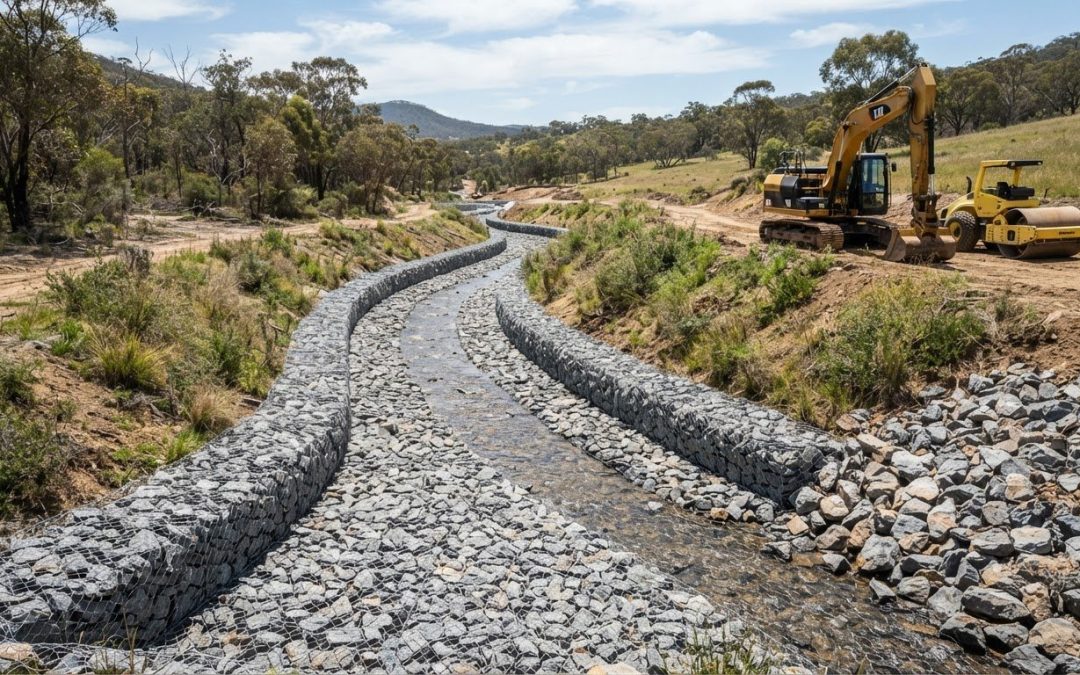
A channel that needs erosion protection doesn’t automatically need a thicker, heavier structure. The right treatment depends on how water moves through the channel, where scour may occur, and the shape and stability of the ground. Reno mattress applications in channel lining are best assessed against these site conditions, rather than treated as a one-size-fits-all product choice.
If you’re comparing mattresses with gabions or other forms of channel protection, their different profiles and roles matter. Reno mattresses are thinner and more flexible, so they may suit channel beds and banks where the ground profile and hydraulic conditions support their use. This article explains what to assess, how bed and bank protection relate, and what to consider where flow, scour or channel geometry creates challenges. It also covers how lining fits into broader civil works, from preparing the surface and selecting materials to installation and connections with adjacent works. McMahons Civil and Contracting delivers reno mattress and gabion work as part of civil, mining and rail projects across Australia.
Key Takeaways
- Reno mattresses provide a flexible protective surface for channel beds and banks, while gabions serve different structural roles.
- Assess flow, scour risk, channel shape and foundation stability to understand whether reno mattress applications in channel lining suit the site.
- Bed and bank protection cover different exposed areas, so their design needs to work together across the channel.
- Plan around the channel’s function, site conditions, design requirements, access and inspection needs.
- McMahons Civil and Contracting delivers reno mattress work as part of civil, mining and rail projects, with attention to workmanship and structural integrity.
What Are Reno Mattress Applications in Channel Lining?
A reno mattress is a shallow, rock-filled wire unit used to protect exposed channel beds and banks from erosion. Channel lining is the protective surface placed where water meets the channel, helping limit the movement of underlying soil or fill. Reno mattress applications in channel lining can include protecting a channel bed, a bank or connected areas where erosion needs to be managed.
The mattress contains rock within a flexible mesh structure and sits close to the channel surface. Its low profile may suit surface protection where the channel geometry allows, while deeper gabion baskets are generally considered where a more substantial structure is required. Neither option is automatically preferable. The channel’s purpose, ground conditions, water behaviour and project design requirements determine which treatment is appropriate.
How does a reno mattress differ from a gabion basket?
The main difference is profile and intended application. A reno mattress is comparatively shallow and is commonly considered for lining or erosion protection. A gabion basket is deeper and may be used for structural applications, including retaining. Both use mesh to contain rock, but their roles are not interchangeable in every project. For a broader overview of gabion baskets, see our related guide. The encyclopaedic overview of Reno mattresses also describes their place within the wider gabion category.
A lower-profile unit may follow the channel surface without taking up the same depth as a basket. That can be relevant where channel shape or available space constrains the treatment, but it does not make a mattress suitable by default. The underlying ground, expected water action and design requirements still need to guide the choice.
What does channel lining protect against?
Water moving through a channel can dislodge soil or fill from the bed and banks. Over time, erosion may change the channel profile or expose nearby ground. Flow can also cause local scour, where water removes material from a concentrated area. The location and severity of erosion depend on site conditions, so they need to be assessed for the specific project.
Reno mattress channel lining is a rock-filled mesh surface used to help manage erosion along a channel bed or bank. This describes its protective role, not a guaranteed outcome. Suitability depends on channel geometry, foundation conditions and engineering requirements. The product name alone cannot establish whether it is the right solution.
How Reno Mattresses Work Along a Channel Bed and Banks
A mattress lining forms a contained layer over the channel surface. The rock fill provides the protective covering, while the mesh holds the fill in place as part of the assembled unit. Internal compartments, where included in the selected configuration, help keep the rock arranged within sections of the mattress. Materials and arrangement should follow the project documentation, as specifications are not universal.
The relationship between containment, fill and ground matters because the lining needs to suit the surface beneath it. A prepared bed and a sloping bank present different conditions, so protecting one does not automatically protect the other. A project may require treatment across both, with the connection between them considered in the overall layout. The design should account for how the lined surfaces meet and how water interacts with those transitions.
How do rock fill and wire containment contribute to lining?
Placed over a prepared surface, contained rock forms a layer between the channel and flowing water. The mesh confines the fill, and the unit’s configuration helps maintain that containment across the treated area. These components work together, but their suitability depends on the site and the project’s design requirements. Claims about hydraulic capacity, durability or performance need technical verification for the materials and application being proposed.
Why do flow and scour conditions matter?
Water does not act evenly across a channel. Flow velocity, turbulence and sediment movement can vary by location, affecting where erosion is concentrated. Scour may develop where flow locally removes bed or bank material. Bends, transitions and outlets warrant particular assessment because changes in direction or geometry can alter water movement. Exposure varies by site, so a general product description cannot establish design suitability.
Channel flow conditions inform reno mattress selection and detailing. Understanding those conditions helps define requirements for the bed, banks and connecting areas. Reno mattress applications in channel lining should be considered alongside channel geometry, the condition of the underlying surface, and expected water and sediment movement, rather than judged by the product name alone.
McMahons Civil and Contracting delivers reno mattress work as part of civil, mining and rail infrastructure projects across Australia. For an overview of McMahons’ civil project experience, explore its broader contracting capability.
When Are Reno Mattresses Suitable for Channel Lining?
Exposed channel beds or banks may be candidates for reno mattress lining, but the presence of erosion alone does not determine the right treatment. Suitability depends on the channel’s purpose, how water and sediment move through it, the condition of the ground and the project’s design requirements. Use the table below as a starting point for assessment, not as a substitute for project-specific design.
| Channel location | Erosion concern | Site constraints | Assessment needed |
|---|---|---|---|
| Exposed channel bed | Soil or fill being displaced by flowing water, or local scour | Bed profile, substrate condition and access to the channel | Confirm the channel’s function, expected flows and foundation conditions |
| Exposed channel bank | Bank material eroding or becoming exposed | Bank shape, connection to the bed and nearby drainage outlets | Assess geometry, flow interaction and how the bank treatment will meet adjacent surfaces |
| Bends, transitions or outlets | Potentially changing flow patterns and concentrated erosion | Irregular geometry, existing structures and construction access | Investigate local flow and scour conditions rather than assuming they match the channel reach |
Which channel conditions should the project team assess?
Begin with observable information: channel shape, visible erosion, exposed or unstable material, drainage connections and access constraints. Then identify questions that need further investigation or design input, such as how flows vary, how the substrate may behave or whether sediment movement could affect the proposed treatment.
Separating observations from assumptions helps keep unverified details out of the design. Geometry, ground conditions, expected flows and construction access all contribute to the assessment. A project designer should select reno mattress applications in channel lining using verified site and hydraulic information, and plan the treatment for the channel’s actual function and conditions.
How does mattress lining compare with other protection?
Reno mattresses are low-profile, rock-filled units considered for surface lining. Gabion baskets have a deeper form and can suit different structural roles. Rock pitching places rock directly as a protective surface, with its suitability shaped by the project design and site requirements. These approaches are not interchangeable, and none is a universal solution.
Compare them against the channel shape, erosion concern, project function and design requirements. The assessment should also consider how protected areas connect to one another. For further background, see McMahons Civil and Contracting’s information on professional rock pitching services.
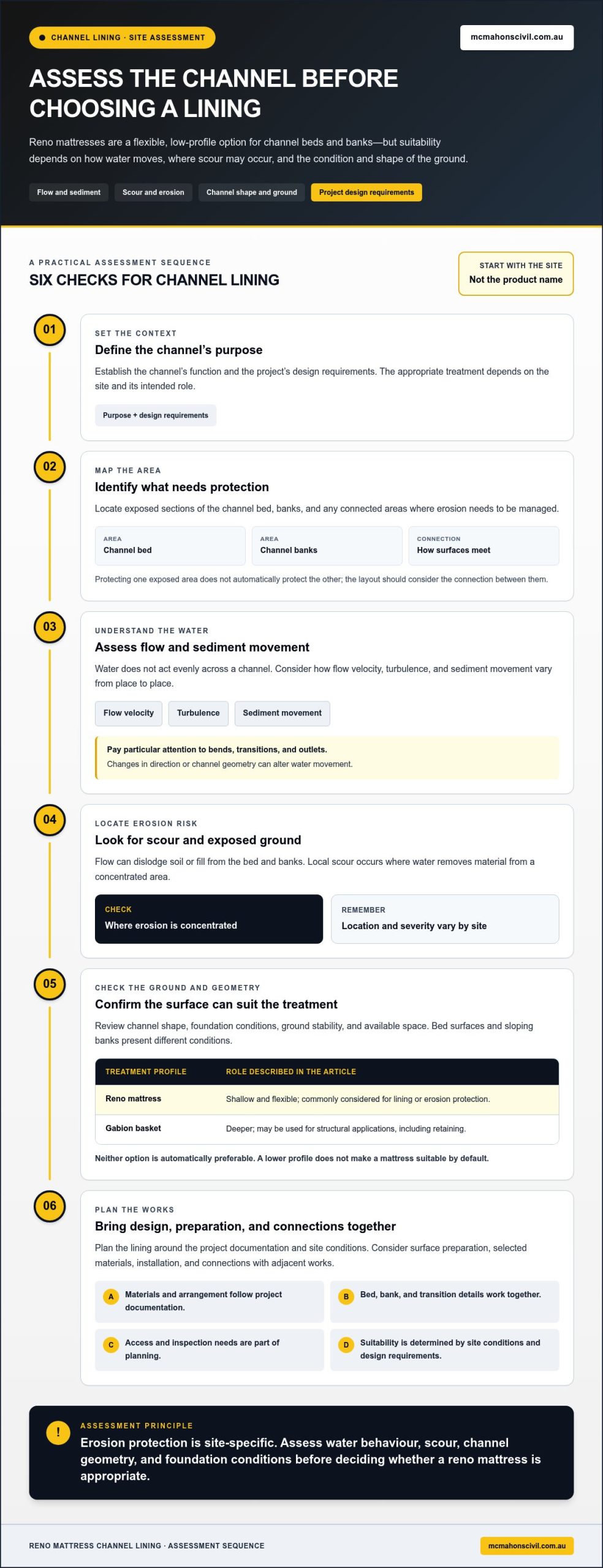
What Project Factors Shape Reno Mattress Channel Lining?
A suitable channel lining starts with a clear understanding of the channel’s function and the conditions that shape the work. Reno mattress applications in channel lining are project-specific, so planning should connect design intent with site access, water conditions and adjacent civil works. A practical sequence keeps the key considerations in view:
- Understand the channel function: establish what the waterway serves and which areas need erosion protection.
- Assess site conditions: review channel geometry, substrate, existing erosion, access, services and water behaviour.
- Establish design requirements: use the relevant project documentation to define materials, interfaces and technical acceptance criteria.
- Plan delivery: coordinate access, water management, work sequencing and adjoining activities.
- Inspect the completed work: assess it against the applicable project requirements and documentation.
What should be established before works begin?
Before work is planned, clarify the channel’s function, the treatment limits and the design documentation that governs the project. Site access and existing services can influence sequencing, while water conditions may affect when and how the work area can be managed. Consider these constraints together, rather than as separate details.
Inspection and acceptance should follow the applicable project requirements. Avoid relying on generic dimensions or assumptions about performance. Technical criteria belong in the project documentation and should reflect the specific design.
How should adjoining channel features be considered?
A lined channel reach connects to other features, and those junctions matter. Transitions, outlets, culverts and bank interfaces need coordinated treatment so the proposed lining fits the channel layout. Adjacent earthworks or erosion controls can also affect surface preparation and the way different treatments meet.
Planning these interfaces early helps align channel lining with the wider civil scope. McMahons Civil and Contracting delivers reno mattress and gabion work as part of civil, mining and rail infrastructure projects across Australia. Read about structural earthworks and site preparation to see how related works can form part of the project context.
McMahons Civil and Contracting delivers civil projects that include reno mattress work. Explore McMahons’ civil contracting capability.
Delivering Reno Mattress Channel Lining with McMahons Civil
Channel lining is often one part of a broader civil scope. Its connections with earthworks, drainage features and other protective structures need to be considered alongside the channel itself. McMahons Civil and Contracting delivers reno mattress and gabion basket work within civil, mining and rail infrastructure projects across Australia, bringing the work into the wider project context.
How does channel lining fit into wider civil works?
Reno mattress applications in channel lining may sit alongside bank preparation, earthworks or other erosion-control elements. These components need to connect appropriately with adjoining surfaces and project features, rather than being treated as isolated products. Where gabion structures form part of the same scope, their role and interfaces can be coordinated with the channel treatment in line with project requirements.
Planning channel lining as part of the broader civil package helps align the work with adjacent activities and site constraints. Each project has its own design and delivery requirements, so the scope should reflect the specified work and conditions on site.
What can project teams expect from McMahons Civil?
McMahons Civil and Contracting is an Australian civil and infrastructure contractor that delivers reno mattress and gabion work. The company works across civil, mining and rail projects, with attention to workmanship and structural integrity.
For project teams, the practical value is in connecting the channel-lining scope with the wider civil works and relevant project requirements. This article has outlined where reno mattresses may be considered, how channel conditions shape suitability and which planning factors influence delivery. Final decisions remain specific to the design, site information and scope of each project.
Planning channel protection as part of a larger civil package? Discuss a civil project with McMahons Civil.
Plan Channel Protection Around the Conditions
Choosing reno mattress applications in channel lining starts with the site, not the product name. Channel geometry, ground conditions, expected flows and erosion risks all inform whether mattress lining fits the project. Bed and bank treatments may also need to work together, with transitions and adjoining civil works considered as part of the wider design.
Reno mattresses, gabion baskets and other erosion-control approaches have different forms and roles. Project-specific requirements should guide selection, planning and inspection. McMahons Civil and Contracting delivers reno mattress and gabion basket work as part of civil and infrastructure projects across Australia.
If your team is planning channel protection as part of a civil project, discuss your civil project with McMahons Civil.
Frequently Asked Questions
What is a reno mattress used for in channel lining?
A reno mattress is a low-profile, rock-filled mesh unit used in some channel protection applications. It can line an exposed bed, bank or both when the project design calls for a contained protective layer. Its purpose is to help manage erosion at the channel surface, not to guarantee a particular outcome. Suitability depends on channel geometry, ground conditions, expected water behaviour, selected materials and project detailing.
Where are reno mattresses used in channels?
Reno mattresses may be considered for channel beds, banks, drainage channels and selected transitions where erosion protection is required. Their use depends on the channel’s shape, underlying ground and expected flow conditions. Bends, outlets and changes in channel profile deserve particular attention because water movement and scour exposure can vary at these locations. A site-specific assessment helps establish whether mattress lining fits the project requirements.
How do reno mattresses help control channel erosion?
Reno mattresses form a contained rock layer over a prepared channel surface, helping shield the underlying material from erosive forces. Their performance depends on the design, site conditions and connections with adjoining works. Flow, substrate and channel geometry all matter. A product description alone cannot establish suitability or performance, so the project requirements and technical design should guide material selection and detailing.
Are reno mattresses and gabion baskets the same?
Both use mesh containment and rock, but they generally have different profiles and applications. Reno mattresses are lower-profile units commonly considered for surface lining, while deeper gabion baskets may be used for structural work, including retaining applications. They are not interchangeable by default. The channel’s function, geometry, ground conditions and project design determine which form, or combination of forms, is appropriate.
Can reno mattresses be used on both channel beds and banks?
Yes, reno mattresses may be used on channel beds, banks or both where the project design and site conditions support the application. Beds and banks can face different flow, stability and interface considerations. A coordinated design should account for how the treatments meet, as well as transitions to adjoining ground or structures. The required protection depends on the channel and its expected water behaviour.
What determines whether a reno mattress is suitable for a channel?
Suitability depends on channel geometry, expected flows, substrate, erosion exposure, construction access and the project’s required outcome. Existing scour, bends, outlets and nearby structures can also affect the assessment. Reno mattress applications in channel lining should be based on verified site and hydraulic information, not the product name alone. Project documentation should establish the materials, dimensions, detailing and construction requirements.
Do reno mattresses need engineering design for channel lining?
Channel lining requirements should be established through project-specific design and documentation. Flow conditions, ground characteristics, channel geometry and adjoining infrastructure can all influence the proposed solution. Rather than relying on generic dimensions or performance claims, the project should set out the technical criteria and relevant specifications for the site. Check any applicable standards against the project documentation before relying on them.