
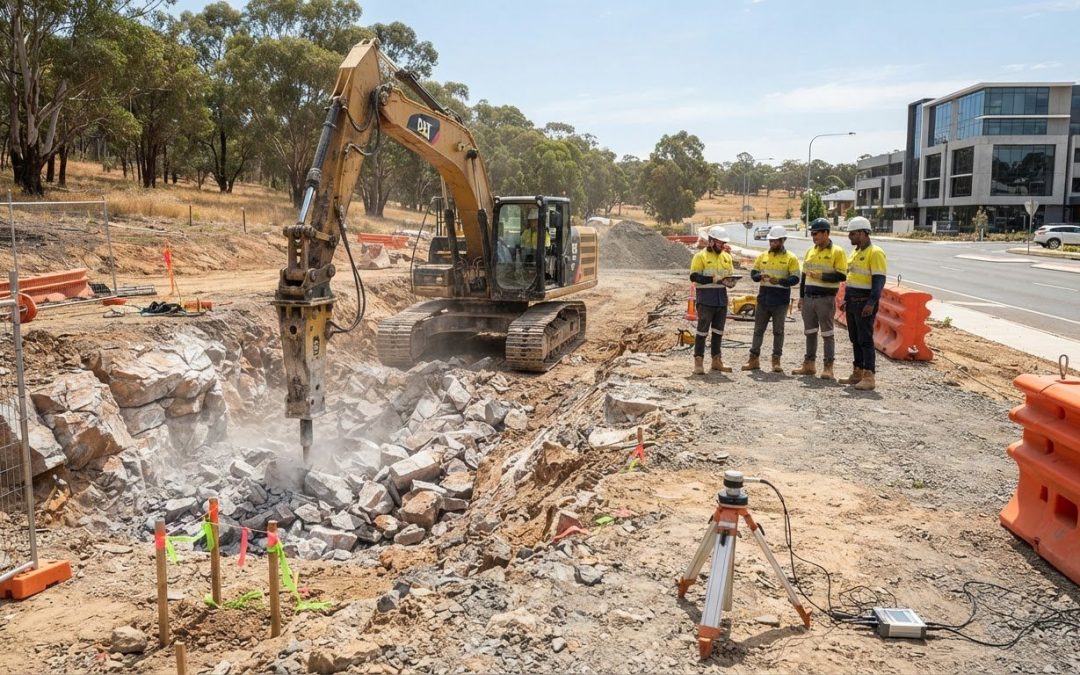
How do you break rock while managing vibration impacts on nearby buildings, people and buried assets? It depends on more than the breaking method. Minimizing vibration from rock breaking starts with understanding the geology, equipment, distance to sensitive structures and how the work will be carried out. No single method or control suits every site.
A practical approach is to select controls for the project, measure against its requirements and adjust as work progresses, rather than assume vibration can be eliminated. This guide explains how ground vibration is described, compares rock-breaking methods and sets out a workflow for planning and reviewing controls while keeping approvals and asset-owner conditions in view.
McMahons Civil and Contracting provides rock breaking for civil and mining projects. The sections ahead offer a framework for planning the work, responding to monitoring results and coordinating rock breaking with the wider project scope.
Key Takeaways
- Distinguish occupant annoyance from concerns about sensitive assets or possible structural effects. Each needs to be considered in its own context.
- Interpret peak particle velocity readings alongside frequency, sensor placement and the activity being measured, not as a number in isolation.
- Compare mechanical breaking, controlled blasting and expansive demolition agents against the geology, access and project constraints. No method is right for every site.
- Plan minimizing vibration from rock breaking as a cycle: identify nearby receptors, set project criteria, choose controls, then review results and adjust the approach.
- McMahons Civil and Contracting’s rock-breaking work can form part of coordinated civil and mining project delivery, with the scope planned around site conditions.
Why minimising vibration from rock breaking matters on constrained sites
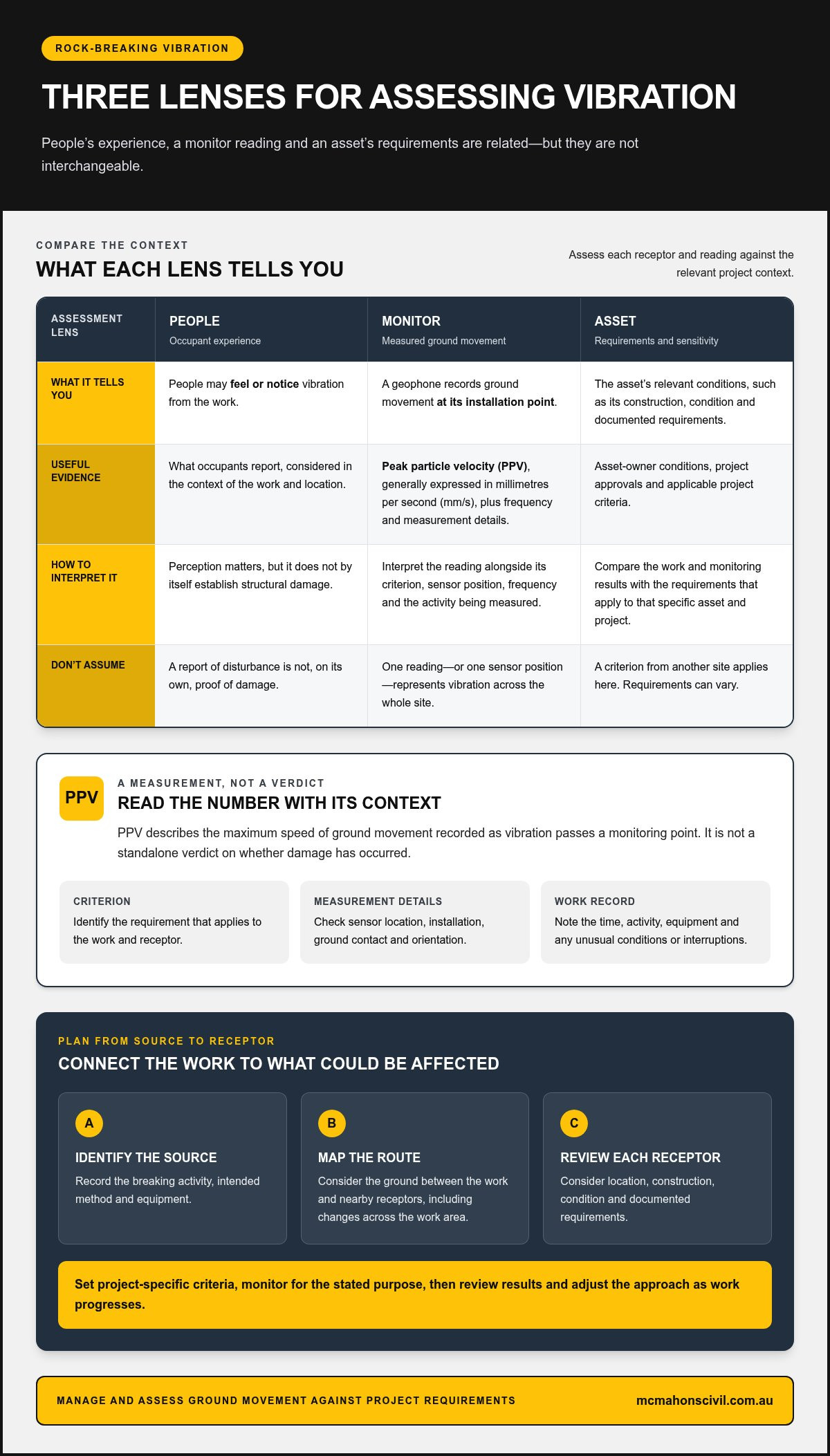
On a constrained site, rock breaking may take place close to occupied buildings, buried services, transport infrastructure or structures with specific sensitivity requirements. Ground vibration is the movement of particles through rock and surrounding ground as energy from the breaking activity travels away from its source. People may feel this movement, it may raise concerns about a sensitive asset, or, depending on the conditions, it may contribute to structural effects. These considerations are related but not interchangeable: perception alone does not establish damage, and a reading must be interpreted against the relevant asset and project criteria.
Vibration control means managing and assessing ground movement against project-specific requirements, not promising that breaking will produce zero vibration. A sound plan identifies what could be affected, considers how the work transfers energy into the ground and explains how the method and controls will respond to site conditions.
What makes rock breaking generate ground vibration?
Mechanical breakers deliver repeated impacts to the rock. Each impact transfers energy into the material. Some energy fractures or dislodges the rock, while some travels through the surrounding ground. Other approaches release energy differently. For example, drilling and blasting, a common rock breaking technique, uses controlled explosive energy to fragment rock. Neither approach guarantees a particular vibration outcome.
Ground conditions affect how energy travels. Rock type, fractures, layering, moisture and confinement can alter vibration across a work area. Equipment, operating approach and the distance between the work and a receptor also matter. A reading at one position may not represent conditions elsewhere on the site.
Which receptors and assets need consideration?
Map occupied buildings, sensitive structures and infrastructure near the work, including buried services and overhead assets where relevant. Consider their construction and condition, distance from the breaking activity, and any asset-owner conditions. Project approvals and applicable guidance may also set criteria for the specific work.
People may notice vibration even when it does not indicate structural damage. An asset may also have requirements that need attention whether or not occupants report disturbance. Keep these questions distinct: what people may experience, what instruments measure at a particular location, and what the asset owner or project criteria require.
Start with a source-to-receptor view: identify the breaking activity, consider the ground between it and nearby receptors, then review each receptor’s characteristics and documented requirements. This helps connect method selection with site planning and prevents a single distance, complaint or measurement from being treated as a complete assessment.
Conditions and receptor types can vary across the work area, so the same controls may not suit every stage. Record the assumptions behind the plan, including the intended method, nearby asset locations and applicable criteria. The team can then review conditions and refine its approach as work progresses, without expecting vibration to disappear entirely.
How rock-breaking vibration is measured and interpreted
A vibration reading is useful only when the team knows what was measured, where it was measured and what was happening at the time. One commonly used measure is peak particle velocity (PPV), which describes the maximum speed of ground movement recorded as vibration passes a monitoring point. It is generally expressed in millimetres per second (mm/s). PPV is a measurement, not a standalone verdict on whether damage has occurred.
Interpret each vibration reading against the project-specific criteria, measurement location and recorded work activity. The relevant approval, asset-owner condition or project requirement provides the comparison point. Requirements can vary, so a figure should not be treated as a universal limit.
What a vibration monitor records
A geophone detects ground movement at its installation point and passes the signal to a recording instrument. Depending on the equipment and monitoring plan, the record can show PPV and other information, including vibration frequency. Position and installation matter: a sensor beside a structure may record a different response from one nearer the breaking activity. Set up and report monitoring to suit its stated purpose.
Frequency adds context because two readings with the same PPV may have different characteristics. Sensor location, ground contact and orientation also affect how useful a record is. Review a result alongside its measurement details rather than copying a figure from a report without explanation.
How to interpret readings responsibly
First, identify the criterion that applies to the work and receptor. It may be set out in an approval, an asset-owner condition or another project document. Compare readings with that criterion rather than importing a figure from another site or assuming a published value applies. Resolve any uncertainty about requirements through the project’s established technical and approval processes.
Keep a clear record with each relevant reading. Include the time, sensor location, breaking activity and equipment in use, along with unusual site conditions or interruptions. This helps the team distinguish a change associated with the work from background vibration or an unrelated event.
- Baseline: Where the project plan calls for it, record existing vibration before breaking begins to describe background conditions.
- During the work: Monitoring may be continuous or carried out at planned stages, according to project criteria and risk.
- After an event or work stage: Review records against the activity log, document relevant findings and decide whether the planned approach needs adjustment.
Monitoring arrangements should reflect nearby receptors, documented requirements and the decisions the team needs to make. This gives measurements a practical role in minimizing vibration from rock breaking, without implying that a monitor prevents impacts or confirms every asset is unaffected.
For rock-breaking work within a wider civil or mining scope, McMahons Civil and Contracting can discuss the work scope and site constraints as part of planning coordinated delivery.
Comparing rock-breaking methods for vibration control
Method selection is a project decision, not a simple ranking from “most” to “least” vibration. Geology, access, the production sequence and nearby receptors all affect what is practical. A method that suits an open work area may not fit a confined excavation beside buried services. A slower approach may not suit the required programme. Compare options against the actual work and its documented criteria.
A method intended to reduce vibration does not make work vibration-free. Ground response can still vary with rock conditions, equipment setup and how the task is carried out. Choose and manage a method that fits the site, then review its performance against project requirements.
Mechanical breaking and controlled blasting
Mechanical breakers use repeated impacts to fracture rock. Their effects depend on the equipment and setup, the material being broken and the surrounding ground. They can suit staged work where machinery can access the face, but plant movement, working room and the required sequence need consideration.
Controlled blasting uses a designed release of explosive energy and requires project-specific planning and management. Its suitability depends on the rock, work area, production needs and receptors, as well as applicable approvals and conditions. Neither method has a fixed vibration outcome that can be assumed across sites.
Expansive demolition agents and other alternatives
Expansive agents are placed in drilled holes and cause the surrounding rock to crack as they react. The pace and result depend on hole layout, rock characteristics, sequencing and the time allowed for the reaction. This can make the method useful for selected tasks, but it may not suit every production programme or site layout. Assess other approaches against the same project-specific requirements.
For minimizing vibration from rock breaking, compare the work face, access route, required output and nearby receptors, then consider how each option fits the project criteria. McMahons Civil and Contracting can discuss how rock-breaking work fits your civil or mining scope and site constraints.
A practical workflow for minimising vibration during rock breaking
A reliable plan connects the work method to the ground, nearby receptors and documented project criteria. It also sets out how the team will respond if conditions change. This makes minimizing vibration from rock breaking a cycle of planning, observation and adjustment, rather than a one-off choice made before work starts.
Plan the work around the site
Before breaking begins, bring the site information together. Map occupied buildings, sensitive structures, buried services and other relevant assets. Review available ground information, identify uncertainties that could affect method selection, and note access, sequencing and production constraints. Record applicable approvals, asset-owner conditions and project criteria. Agree who is responsible for communicating, documenting and acting on relevant information.
- Identify receptors and assets. Record their locations in relation to the work area and note conditions that affect how the work must be planned.
- Review ground and scope. Confirm the rock to be removed, the extent and sequence of the work, available access and what is known about local geology. Flag uncertainties for review before they affect the work plan.
- Set project criteria and responsibilities. Bring relevant approvals and asset-owner requirements into the project plan. Define who reviews records, receives reports of concern and can escalate an issue.
- Choose the method and sequence. Match the proposed approach to ground conditions, receptor locations, access and production needs. Plan stages that allow the team to review conditions as work progresses.
- Set out measurement arrangements where required. Follow the project monitoring plan for measurement locations, installation and reporting. Ensure readings can be linked to the correct activity and timing.
- Review and adjust. Compare results and observations with agreed criteria at planned review points. If a criterion is reached or an unexpected result arises, pause or modify the activity as project controls require. Investigate the cause and document the decision before proceeding.
Monitor, review and adjust the approach
Measurement is useful when it informs a decision. Review readings alongside the work record, equipment and location details, site observations and any reported concerns. A change in ground conditions or a different excavation stage may call for a reassessment of the sequence or controls. Record the reasoning so the team can see what changed and why.
Set escalation steps in advance. If results are unexpected or a concern is reported, follow the project’s review process and applicable criteria rather than relying on an improvised numerical threshold. Where controls require work to stop, hold the activity while the issue is assessed. Document the agreed response and any revised instructions.
For rock breaking within a civil or mining project, discuss your project scope and site constraints with McMahons Civil and Contracting as part of planning coordinated delivery.
Planning rock-breaking work with McMahons Civil and Contracting
Rock breaking is most effective as part of a coordinated project plan, not as an isolated task. Scope, ground conditions, access and nearby assets all influence how work can be sequenced and delivered. For civil and mining projects, bringing these details together early helps align breaking with surrounding earthworks, construction stages and site constraints.
Planning for minimizing vibration from rock breaking also means setting realistic expectations. The method and controls should respond to the site and its documented requirements, not rely on a promise of zero vibration. Clear project information gives the team a basis for discussing the work and coordinating it with the broader programme.
What project information helps shape the scope?
A useful planning discussion starts with the work area and the rock to be removed. Describe the extent of the breaking, the intended sequence and how the work connects with other activities. Note access restrictions, available working space and practical constraints that could affect equipment movement or the order of operations.
Share what is known about local ground conditions, including available site information and areas of uncertainty. Identify nearby buildings, structures, buried services and other infrastructure, along with relevant asset-owner conditions, approvals or project criteria. These details help frame the scope and identify interfaces that need coordination. They do not replace project-specific technical assessments or approvals, but they make work requirements clearer from the outset.
- Work scope: The location, extent and sequence of rock breaking, plus its relationship to adjoining earthworks or construction.
- Site conditions: Available information about the ground, access routes, working space and known constraints.
- Nearby assets: The location of relevant structures and infrastructure, and any documented conditions that apply to the work.
- Project interfaces: The activities, access arrangements and timing that need to align with the breaking work.
With this information, the project team can have a focused discussion about scope, site constraints and how rock breaking fits into the delivery plan. Gaps in available information can be identified and addressed through the project’s established processes.
Discuss a rock-breaking project with McMahons
McMahons Civil and Contracting provides rock breaking for civil and mining projects, alongside broader civil contracting and earthworks capabilities. The company has been operating for over 18 years. Discussing the work in its wider project context helps bring the ground, access, nearby assets and required sequence into view.
Share your project requirements and site constraints with McMahons to discuss the rock-breaking scope and how it fits your civil or mining work.
Discuss your rock-breaking project with McMahons.
Put your project requirements into action
Turn site knowledge into a clear working scope. Bring together the areas to be broken, known ground conditions, access constraints, nearby assets and project-specific requirements. This gives the planning conversation a practical starting point and connects rock breaking with the wider sequence of civil or mining work.
Minimizing vibration from rock breaking is not about relying on a single method or expecting vibration to disappear. It means making informed decisions for the site and keeping project requirements in view as work progresses. Clear communication between the project team and contractor helps align scope, interfaces and responsibilities.
McMahons Civil and Contracting brings rock-breaking capability to civil and mining projects, supported by over 18 years of operation. If you are preparing a project or refining its scope, share the requirements and site constraints with the team. Discuss your rock-breaking project with McMahons.
A considered plan and a clear understanding of site conditions help your team move forward with confidence.
Frequently Asked Questions
Can rock breaking be carried out without vibration?
No. Breaking rock releases energy, and some of it can travel through the ground as vibration, even when the selected method is intended to limit impacts. The practical objective is to manage vibration in line with site conditions and project criteria, not to promise its complete absence. For example, changing the work sequence may help address a sensitive area, but the effect still needs to be considered against project requirements.
How is vibration from rock breaking measured?
Ground vibration is commonly measured using a geophone connected to a recording instrument. One reported measure is peak particle velocity (PPV), usually expressed in millimetres per second. Consider a reading alongside its frequency, sensor position and the work happening at the time. A result recorded near one building, for example, cannot automatically represent vibration at a buried service elsewhere on site.
Does a vibration monitor prevent damage to nearby structures?
No. A monitor records ground movement at its installation point; it does not reduce vibration or protect a structure by itself. Its value depends on the project team acting on the information in line with agreed criteria and response procedures. If monitoring is part of the plan, establish who reviews results and what happens if a reading or site observation needs attention. Monitoring supports decisions, but it does not replace suitable planning and controls.
What causes vibration during rock breaking?
Vibration is caused by energy from the breaking activity travelling through rock and surrounding ground. A mechanical breaker transfers energy through repeated impacts, while other methods release energy differently. The response can vary with the rock’s characteristics, fractures, confinement, equipment setup and activity location. Two work areas on the same project can therefore behave differently, even when the equipment and general method are unchanged.
How can a project reduce vibration from rock breaking?
Start by identifying sensitive receptors and project-specific conditions, then match the breaking method and work sequence to the site. Consider whether staged work or changes to the planned activity are appropriate for the area. Where project requirements call for monitoring, review results alongside work records and site observations. Minimizing vibration from rock breaking is an ongoing planning task, so reassess the approach if conditions or results differ from expectations.
Is expansive demolition agent always the best low-vibration option?
No. Expansive agents can suit tasks where drilled holes and the time needed for the reaction fit, but they are not right for every rock type, access arrangement or production sequence. Drilling layout and ground conditions affect how practical the method is. It does not mean vibration-free work. Compare it with mechanical breaking or other suitable approaches against site constraints and documented criteria.
What should happen if vibration readings exceed project criteria?
Follow the project’s agreed response process rather than applying an improvised threshold. If the criteria require the activity to pause, hold work as specified while the result is reviewed. Check the record against sensor location, equipment, timing and activity, then escalate it to the people responsible for project controls. Document the assessment and any revised instructions before work resumes in accordance with applicable project requirements.