
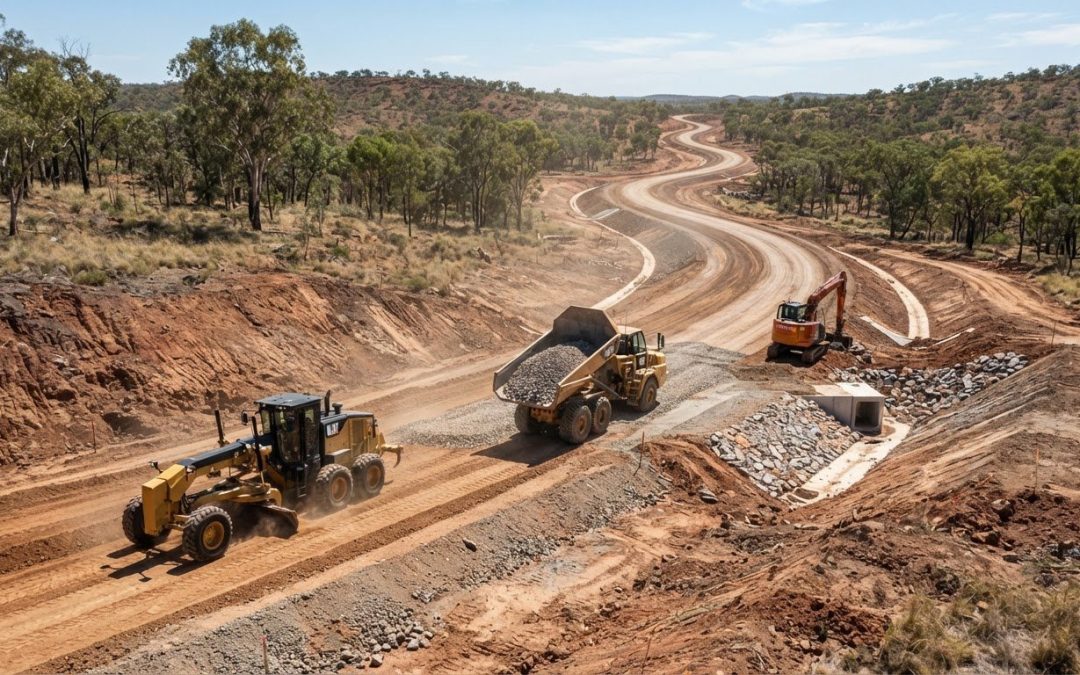
What if the weak point in a remote access road is decided before the first machine arrives? A suitable route is only the starting point. Ground conditions, drainage, material selection and expected heavy vehicle movements all influence how well the road performs. Earthworks for remote site access roads need to bring these decisions together, especially when distance and weather make repairs difficult to coordinate.
To understand what work is needed, assess the site and the road’s intended use first. Then plan earthworks around the terrain, water movement, construction logistics and ongoing maintenance needs. This creates a practical basis for deciding where to excavate, what material may be suitable and how drainage relates to the road formation.
This guide covers the key stages, from route planning and ground preparation to drainage, materials and construction logistics. It also explains how traffic demands and site conditions shape road formation, and how related civil works can be coordinated. McMahons Civil and Contracting delivers earthworks for civil and mining projects, with scope tailored to project requirements.
Key Takeaways
- Define whether the road will serve construction, ongoing operations or site servicing, then plan its formation around that purpose and expected traffic.
- Assess route options and ground conditions in sequence so terrain, drainage paths and sensitive areas inform the earthworks scope.
- Match the response to soil, vehicle loads and water exposure. Use site investigation to guide cut-and-fill and decisions about suitable materials.
- Plan mobilisation, plant, material supply and work sequencing together, then include construction checks and maintenance in the delivery framework.
- Effective earthworks for remote site access roads bring route, ground, traffic and drainage decisions into one project-tailored civil approach.
Earthworks for remote site access roads: what the work needs to achieve
Access-road earthworks prepare and shape the ground so a route can serve its intended purpose. Work may include clearing and stripping, cut and fill, forming the road alignment and preparing the surface. The right scope depends on the route and its use, not on a standard template. In civil engineering, Earthworks in civil engineering covers ground shaping used in works such as road construction and embankments.
A formed access road is more than a cleared or periodically graded track. It has a planned formation suited to expected vehicles and site conditions, with attention to ground support and water movement. Grading alone may not address weak ground, erosion or repeated heavy loading, so assess the road’s condition and intended use before deciding what work is required.
Road function can also change over a project’s life. Construction access may need to accommodate moving plant and materials; operational access may carry regular traffic; and site servicing may involve less frequent but still essential vehicle movements. Earthworks for remote site access roads must reflect the intended role, terrain, vehicle movements, site risks and project specifications.
What makes a remote site access road different?
Distance from support services can affect how equipment, materials and people reach the work site. Delivery sequencing matters: materials or plant needed early may have to arrive before later construction stages can proceed. Planning these movements alongside the earthworks helps identify dependencies and reduce avoidable disruption.
Australian conditions vary considerably. Seasonal rain can soften ground, affect access and increase runoff, while dry periods may bring challenges such as dust or changes in surface condition. The relevant risks depend on the site’s climate, terrain and drainage, so remoteness alone does not define the solution. Assess each route against its own conditions and intended use.
Which vehicles and activities must the road support?
List the vehicles and activities the road is expected to serve rather than treating all traffic as equivalent. Construction plant, service vehicles and operational traffic can place different demands on the formation. Vehicle size, loading and frequency help define the road’s intended function and inform the earthworks scope.
Identify exceptional access needs early, including emergency vehicles, oversize movements or high-frequency traffic. These requirements may influence route suitability, formation planning and construction sequencing. Clear inputs at the outset help align the road with the work it must support.
How route assessment and ground conditions shape remote road earthworks
A reliable scope starts with evidence, not assumptions. For earthworks for remote site access roads, use a clear sequence: define access needs, assess route options, investigate ground conditions, plan the earthworks, then review the proposed approach against project requirements. Each stage informs the next. Findings may lead to changes in alignment, excavation, fill selection or ground treatment before construction begins.
Define the purpose of route and ground investigations before construction, so the information gathered can guide practical earthworks decisions. Set the investigation scope to suit the road’s intended use, design detail and approval requirements. This keeps survey and ground information focused on decisions the project needs to make.
What should route planning examine before earthworks start?
Assess more than the shortest path. Gradients and cross-slope affect how a route can be formed, while constructability, turning areas and connections to existing routes influence how vehicles and plant can move through the site. Map waterways, drainage paths and erosion-prone ground to identify where runoff may affect the alignment or need specific attention.
Environmental and cultural heritage constraints also need assessment as part of route planning. Set survey and investigation work to suit the project design and approval requirements, rather than applying a fixed checklist. A route that looks straightforward on a plan may need adjustment once terrain, access and site constraints are considered together.
How do ground conditions affect formation and material decisions?
Ground conditions can vary along a single alignment. Weak or variable soils may require excavation or treatment before a stable formation can be prepared; rocky ground can change excavation methods and the balance between cut and fill. Geotechnical information helps identify these differences and supports decisions about whether excavated material is suitable for reuse or fill needs to be sourced elsewhere.
Assess fill for its intended role and against project requirements. Compaction requirements and formation details should follow the verified design and project specifications, not assumed layer depths or generic figures. If site investigation identifies a mismatch between design assumptions and actual ground, review the earthworks plan before proceeding. This gives the project team an opportunity to coordinate adjustments with the wider civil scope.
McMahons Civil and Contracting delivers earthworks for civil, mining and rail projects, with scope tailored to project requirements. Explore McMahons civil contracting capabilities as part of planning a coordinated project approach.
Choosing earthworks and drainage approaches for remote access roads
Consider road formation, traffic and water management together. A surface suited to light, occasional use may not suit repeated heavy vehicle movements. Likewise, a formation that performs on stable ground may need a different approach across weak or water-prone areas. Use the comparison below as a planning guide, alongside site investigation and project design.
| Site factor | Planning consideration | Possible response to assess |
|---|---|---|
| Stable ground | Confirm it can support the intended vehicle loads and road formation. | Assess whether suitable on-site material can be used, with formation and compaction to the design requirements. |
| Variable or weak ground | Identify changes in support along the alignment and areas prone to softening. | Consider excavation, material replacement or other engineered treatment, guided by investigation. |
| High traffic demand | Account for vehicle size, loading and frequency, not just occasional access. | Align material selection and formation requirements with the documented design. |
| Water exposure | Consider runoff paths, wet areas and the risk of erosion or interrupted access. | Coordinate crossfall, drainage paths and outlets with the road formation. |
How should road formation respond to different ground conditions?
Stable, variable and weak ground are useful planning categories, but they do not prescribe a construction solution. Ground investigation helps determine whether excavated material is suitable for reuse, whether additional suitable material should be imported, or whether treatment is needed. Cut-and-fill can make use of material already on site where it meets design requirements; importing fill may be appropriate where it does not. Material selection and compaction controls should follow the verified design and project specifications, rather than assumed layer depths or generic figures.
Why do drainage and erosion control affect road reliability?
Water can erode the running surface, affect embankments and batters, and make sections difficult to use. Drainage is therefore part of road formation planning, not a finishing task. Crossfall, drainage paths and outlets need to work with the alignment so water is directed appropriately and does not undermine the road or create new erosion points.
Where the project design identifies erosion-control needs, rock pitching or gabion baskets may be considered alongside earthworks. These related civil works can address specific site conditions when incorporated into the design. McMahons Civil and Contracting delivers earthworks and related civil works tailored to project requirements. For a coordinated project approach, explore remote access road earthworks.

How to plan construction, logistics and maintenance for remote access roads
Remote delivery works best when access, earthworks, drainage and checks are planned as a connected sequence. For earthworks for remote site access roads, mobilisation involves more than moving plant to site. Delivery routes, material supply, workforce access and the order of work all affect how efficiently the formation can be built and maintained.
What does construction sequencing need to account for?
A practical sequence may include:
- Mobilisation and access preparation: organise site entry, plant movements, material staging and workforce access before major works begin.
- Clearing and formation: carry out approved clearing, cut-and-fill, and preparation of the road formation in line with the design.
- Material placement and compaction: coordinate supply and placement so the work follows documented requirements and construction checks.
- Drainage and final checks: complete drainage works alongside formation, then review the finished road against approved drawings, specifications and site requirements.
Supply distances can influence when materials need to be ordered and brought to site. Weather windows may also affect access, ground conditions and the order in which tasks can proceed. Include these factors in the programme without assuming fixed delivery times. Safety measures, environmental controls and applicable approvals belong in the project plan from the outset, not as late additions.
How can maintenance needs be considered before handover?
Build inspection and upkeep into planning before construction is complete. Surface deterioration, blocked drainage and erosion after severe conditions can indicate that attention is needed. Set the inspection approach and maintenance plan to reflect expected traffic, seasonal exposure and project requirements.
Planned drainage and maintenance help protect access-road function over time. Before handover, establish what records are required, who is responsible for inspections and upkeep, and what inspection intervals apply under the project requirements. Clear records of completed works and relevant checks help the receiving team understand the road’s condition and planned care.
McMahons Civil and Contracting coordinates earthworks as part of civil, mining and rail project delivery, with scope tailored to project needs. Plan your access-road earthworks with a methodical approach to construction sequencing, drainage and ongoing maintenance.
Delivering remote site access road earthworks with an integrated civil approach
A clear project scope connects route and ground findings to the road’s intended use, drainage needs and practical delivery constraints. For earthworks for remote site access roads, these inputs help define what needs to be prepared, which related works may be required and how the stages can be coordinated. The scope should reflect the project rather than assume every remote site needs the same solution.
What information helps establish a clear project scope?
Gather available project information before setting out the work. Useful inputs include:
- Route plans, survey information and site investigations.
- Access requirements, vehicle types and traffic assumptions.
- Project specifications and approved design information.
- Known environmental, cultural heritage and water-management constraints.
- Mobilisation, material supply and site access considerations.
These details help clarify where earthworks begin and end, how drainage relates to formation, and which site controls need to be accommodated. They also support coordination between planning, material supply and construction activities. A defined scope provides a sound basis for project discussions without implying a fixed price or programme before requirements are understood.
How does an integrated civil contractor support project delivery?
Earthworks are often one part of a broader civil project. Where site conditions and design requirements call for it, ground preparation can be planned alongside related structural works. For example, rock pitching or gabion baskets may be considered where erosion control or ground support forms part of the project design. Rock breaking may also be relevant where rock affects the required formation. The appropriate scope depends on site investigations and project specifications.
McMahons Civil and Contracting delivers earthworks across civil, mining and rail projects, supported by related civil contracting capabilities. The company takes a project-tailored approach to coordinating ground preparation and associated works. Bringing these considerations together can help establish clear interfaces between the road formation, drainage and any related structures.
Share your route plans, site information and access requirements with McMahons Civil and Contracting to discuss a suitable delivery approach for your project. Discuss your access-road earthworks.
Plan your next access road with confidence
Dependable access starts with a clear understanding of what the road must support. Route suitability, ground conditions, traffic demands and drainage all shape the earthworks scope, while remote logistics and planned maintenance influence how the work is delivered and cared for over time.
Earthworks for remote site access roads are most effective when these decisions are coordinated from the outset. A project-tailored approach can connect ground preparation with drainage and, where required, related works such as rock pitching, rock breaking or gabion baskets.
McMahons Civil and Contracting delivers earthworks across civil and mining projects, with related civil capabilities that can be considered as part of the project scope. Clear communication about route plans, site investigations, access needs and project requirements helps establish a practical delivery approach.
Discuss your remote access road earthworks requirements with McMahons Civil and Contracting to plan a considered delivery approach.
Frequently Asked Questions
What earthworks are needed to build a remote site access road?
Earthworks for remote site access roads typically prepare and shape the ground to suit the route, terrain and intended traffic. Work may include clearing and stripping, excavation, cut-and-fill, formation preparation, placing suitable material and compaction to project requirements. Coordinate drainage with the formation. The exact scope depends on site investigations, vehicle demands and project specifications, so there is no single construction prescription that suits every access road.
How are remote access road routes assessed before construction?
Route assessment considers whether the alignment is practical to build and suitable for the vehicles and activities it must support. The review may examine gradients, cross-slope, turning areas, connections to existing access, waterways, drainage paths and erosion-prone ground. Environmental and cultural heritage constraints also inform route planning. Survey and investigation requirements should match the project design and approval needs, so route decisions and earthworks planning are based on relevant site information.
What ground conditions can affect access road earthworks?
Weak or variable soils, rock, wet areas and changes in terrain can affect excavation, formation preparation and material selection. Geotechnical information helps assess whether excavated material is suitable for reuse, whether material replacement is needed or whether other engineered treatment should be considered. The design should set the required material and compaction controls. Conditions can vary along one route, so base decisions on site investigation rather than assumptions.
How does drainage protect a remote access road?
Drainage directs water away from the road formation and helps limit damage to the running surface, embankments and batters. Crossfall, drainage paths and outlets need to be coordinated with the alignment so runoff is managed without creating new erosion points. Blocked or poorly planned drainage can contribute to deterioration and disrupted access. The appropriate arrangement depends on site conditions and the road design, with inspections helping identify issues such as blockages or erosion.
Can an existing track be upgraded for heavy vehicle access?
Yes, an existing track can be assessed for upgrading, but its current condition does not establish whether it can support heavy vehicles. Review the alignment, ground support, drainage, traffic demands and any erosion or weak sections. Investigation and design can then identify whether earthworks, material replacement, formation changes or drainage improvements are needed. The scope should reflect vehicle size, loading and frequency, as well as project specifications, rather than relying on grading alone.
How are earthworks managed when a project site is remote?
Remote earthworks require delivery planning that connects mobilisation, access preparation, plant movements, material supply and work sequencing. Supply distances can affect when materials need to be brought to site, while weather and ground conditions may influence the order of work. Integrate safety, environmental controls and applicable approvals into project planning. Construction checks against approved drawings, specifications and site requirements help track whether the work aligns with the intended scope.
What information is needed to scope remote access road earthworks?
Useful scoping information includes route plans, survey and ground investigation findings, vehicle and access requirements, traffic assumptions and project specifications. Include known water-management, environmental and cultural heritage constraints, along with mobilisation and material supply considerations. This information helps define the earthworks, drainage and related civil requirements, and supports coordinated planning. McMahons Civil and Contracting delivers earthworks across civil, mining and rail projects, with scope tailored to project requirements.