
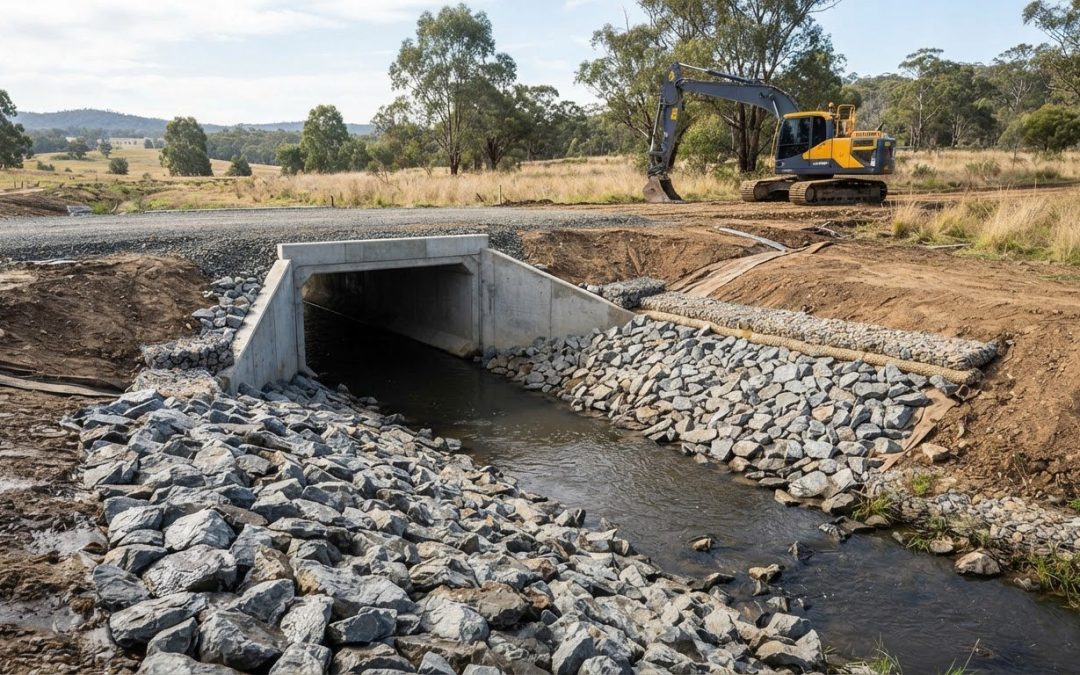
A culvert can look well protected while flowing water gradually removes the soil beneath its rock cover. Culvert rock pitching needs to do more than sit around an inlet or outlet: it must suit the way water moves through the site and the ground supporting it.
The rock itself is only one part of long-term performance. Flow conditions, slope, underlying soil and installation all affect how protection works. This guide explains how pitching helps limit erosion, which site factors shape its effectiveness, and what to look for during inspection and maintenance.
We’ll cover rock protection at culvert inlets and outlets, the hydraulic and ground conditions to consider, and signs that may need closer inspection. You’ll also find a practical framework for scoping work and planning ongoing care. McMahons Civil and Contracting delivers rock pitching alongside earthworks and broader civil infrastructure work, bringing related project requirements together.
Key Takeaways
- Understand how culvert rock pitching helps limit erosion around inlets, outlets and nearby channels.
- Identify how water movement, ground condition, slope and existing scour shape the protection required at a site.
- Compare placed rock, gabion baskets and reno mattresses by their form and typical project role.
- Use visible signs such as displaced rock, exposed ground, new scour and blocked drainage to guide inspection.
- Plan protection as part of the asset’s lifecycle, including drainage interfaces, surrounding earthworks, records and future access.
What Culvert Rock Pitching Does for Long-Term Infrastructure Performance
Water moving through a culvert can disturb soil at the inlet, outlet or along a nearby channel, especially where flow meets exposed or vulnerable ground. Culvert rock pitching is placed rock protection for these areas. It helps resist flow-related erosion and stabilise the ground around drainage infrastructure. Its role is to protect a particular interface, not to control every process affecting the wider asset.
The culvert conveys water beneath or through an obstruction. Its capacity and structural design determine how it performs as a drainage structure; pitching has a separate, supporting role. Covering susceptible ground with rock can reduce its direct exposure to flowing water and help limit soil loss. For a general overview of culvert types and their role, see What is a Culvert?
Culvert rock pitching is placed rock that protects vulnerable ground near a culvert from flow-related erosion, without replacing the culvert’s drainage or structural functions. This distinction keeps the project scope clear. Rock protection cannot compensate for a culvert that does not suit the required flow, and it does not manage water across the entire catchment.
Where culvert rock pitching fits in an asset lifecycle
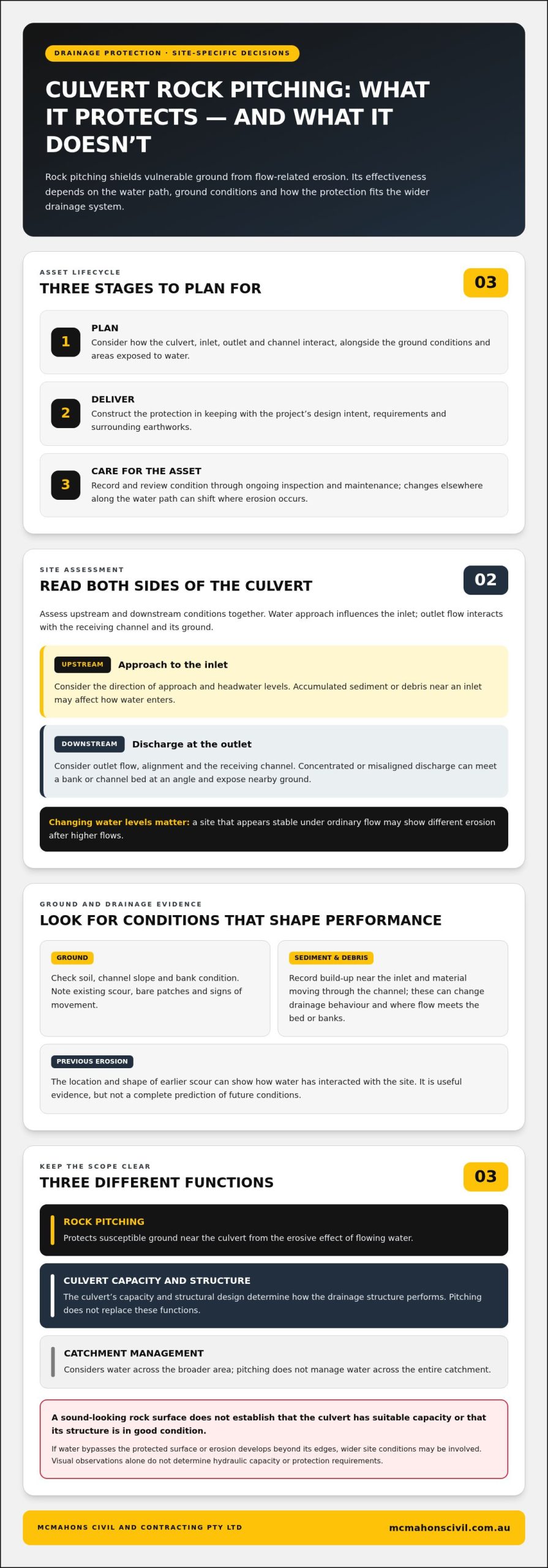
Protection decisions start during planning, when the drainage layout, ground conditions and areas exposed to water are considered together. During delivery, the work needs to follow the project’s design intent and connect appropriately with the culvert and surrounding earthworks. Once the asset is operating, inspection and maintenance help identify changes that could affect the protected area.
- Plan: understand how the culvert, inlet, outlet and channel interact.
- Deliver: construct the protection in keeping with project requirements and surrounding ground.
- Care for the asset: record and review its condition through ongoing inspection and maintenance.
These stages matter because pitching is part of a wider drainage system. Water may approach from the upstream channel, pass through the culvert and meet different ground at the outlet. A change anywhere along that path can shift where erosion occurs. Protection supports asset performance, but it does not remove every erosion risk or replace observation of the surrounding system.
What culvert pitching can and cannot address
Rock pitching shields vulnerable surfaces from the erosive effect of flowing water. Its performance depends on site conditions, design intent and workmanship, so it should be considered alongside ongoing asset care. A rock surface that looks sound does not establish that the culvert has suitable capacity or that its structure is in good condition.
Keep the scope distinction practical: surface protection addresses exposed ground; culvert sizing and structural design address the drainage structure; catchment management considers water across the broader area. If water bypasses the protected surface or erosion develops beyond its edges, the cause may involve wider site conditions rather than the pitching alone. Assessing the drainage interface and surrounding ground together gives project teams a sounder basis for planning and maintenance.
How Site Hydraulics and Ground Conditions Shape Culvert Rock Pitching
Rock protection should respond to conditions at the site, rather than being treated as a standard finish for every culvert. The same outlet treatment may face very different conditions depending on how water leaves the opening, where it meets the channel and how readily the surrounding soil erodes. Durable culvert rock pitching is informed by site-specific evidence of both hydraulic forces and ground behaviour.
Assess the water path on both sides of the structure. Upstream conditions influence how water approaches the inlet and the headwater level. Downstream conditions affect the flow leaving the outlet and its interaction with the receiving channel. Considering these observations together helps identify where erosion may develop and what the protection needs to address.
Hydraulic conditions around a culvert inlet and outlet
Flow can become concentrated as it enters or exits a culvert. At an outlet, a strong or misaligned discharge may meet a bank or channel bed at an angle, creating local turbulence and exposing nearby ground. Changing water levels can also shift the zone of contact, so a site that appears stable under ordinary flow may show different erosion after higher flows.
Consider headwater levels, outlet flow and channel alignment together. Establishing relevant flow conditions and design values requires competent, project-specific evaluation. Visual observations alone do not determine hydraulic capacity or protection requirements.
Ground, sediment and surrounding drainage conditions
Ground condition influences how readily water can remove material beneath or beside a protected area. Inspect the soil, channel slope and bank condition. Note existing scour, bare patches or signs of movement. Previous erosion is useful evidence: its location and shape can show how water has interacted with the site, but it is not a complete prediction of future conditions.
Sediment and debris can change drainage behaviour. Accumulation near an inlet may affect how water enters, while material moving through a channel can change where flow meets the bed or banks. Record these conditions during assessment and compare them with later observations.
A practical site review can capture:
- Flow path: direction of approach, outlet alignment and the channel receiving the discharge.
- Water behaviour: observed turbulence, changing water levels and signs of concentrated flow.
- Ground evidence: soil and bank condition, slope, exposed material and existing scour.
- Drainage changes: sediment or debris that could influence flow or affect inspection.
These observations help define a clearer project scope, but they do not replace hydraulic assessment or design. Road-authority requirements and project specifications can vary, so do not assume one national detail applies to every site. For civil works involving rock pitching and earthworks, McMahons Civil and Contracting delivers project-specific work through its rock pitching work.
Culvert Rock Pitching, Gabions and Reno Mattresses: Choosing a Protection Approach
Rock pitching, gabion baskets and reno mattresses all use rock, but they hold and position it differently. Those differences affect how each approach fits the site, drainage layout and project design. None is automatically right for every culvert. Compare the options by their form and the site requirements, then follow the project-specific design for final selection.
How rock pitching differs from gabion baskets and reno mattresses
Rock pitching is rock placed to protect a surface. The stones are placed individually rather than enclosed in a wire structure. Depending on the site, pitching may be considered around an inlet or outlet, or along a nearby channel where flow exposes the ground.
Gabion baskets contain rock within wire mesh, forming a connected structure. Reno mattresses use a similar rock-filled wire form but have a lower-profile, broader shape. Their form can suit different channel or ground geometries, subject to the project design. These descriptions are not installation specifications: dimensions, materials and construction details need to come from the applicable project requirements.
Compare the options by how they are formed and where they need to fit, rather than assuming one is inherently more durable. A design may also use different protection forms in separate parts of a drainage system, where conditions and interfaces differ.
What project conditions should guide the comparison
Start with the design intent and site geometry. Consider how flow approaches and leaves the culvert, what ground needs protection, and whether the footprint and slope suit the proposed form. The foundation condition and the way protection connects with the culvert, channel and surrounding earthworks also matter. A change in surface level or an awkward transition can affect construction and later inspection, so plan these interfaces from the outset.
Access and construction sequencing shape what can be delivered safely and practically. For example, a confined work area may affect how materials are brought to the site and placed. Factor this into planning rather than treating access as a final logistical detail. Future inspection matters too: the selected arrangement needs to allow the relevant parts of the drainage asset to be observed and maintained.
- Flow and site form: consider flow behaviour, channel alignment, footprint and slope.
- Ground and interfaces: account for foundation condition and connections to the culvert and earthworks.
- Delivery: plan around access, construction sequence and project requirements.
- Asset care: consider how the protection will be inspected over time.
McMahons Civil and Contracting delivers rock pitching alongside gabion baskets, reno mattresses and earthworks, supporting coordinated civil project delivery. The approach is tailored to the project’s design and site context. Readers considering gabion baskets for civil infrastructure should assess their role as one option within the broader protection scope, rather than treating them as a default replacement for placed rock.
Inspecting Culvert Rock Pitching and Planning Practical Maintenance
Inspection is most useful when it is repeatable. A consistent process helps asset teams distinguish ordinary changes from signs that culvert rock pitching or the surrounding drainage system may need attention. Set inspection timing according to the asset’s requirements, risk, project specifications and observed condition, rather than applying one interval to every site.
Include the inlet, outlet, pitching and adjacent channel in each review. Rock can appear undisturbed while erosion develops at its edge, or debris can change the flow path and expose nearby ground. Reviewing the whole site gives individual observations useful context.
A practical sequence for checking culvert rock pitching
Plan safe access and begin with a visual review from suitable vantage points. Follow the asset’s access and inspection procedures. Do not enter a culvert or approach unsafe conditions as part of a routine visual check. Compare the inlet and outlet with the surrounding channel, and note any change in how water appears to enter or leave the structure.
Record the condition in a consistent order. Look for displaced or missing rock, gaps in the surface, exposed underlying material, fresh scour, sediment build-up, debris and altered flow paths. Note whether the banks or channel edges show visible change. Photographs taken from repeatable positions help show whether a feature is stable, new or progressing.
- Locate: record which part of the inlet, outlet or channel is affected.
- Describe: note the visible condition, including the extent and direction of any change.
- Compare: review earlier photographs and notes, then check findings against the asset’s inspection requirements.
- Record action: document routine maintenance completed or any item referred for further review.
When inspection findings may require further assessment
Some observations may be addressed through routine maintenance, while others can indicate a developing defect. Clearing debris from an accessible area may restore an obstructed flow path where that work is permitted under the asset’s procedures. It will not resolve recurring scour, progressive rock displacement, newly exposed ground or changes to the culvert surroundings. Those findings may need maintenance or engineering review through the relevant asset-management process.
Keep records clear enough for another person to understand what was observed and where. Use consistent location references, dated photographs and concise condition notes. Describe the evidence rather than guessing at its cause. For example, record that rock has shifted and soil is exposed at the outlet edge, then escalate the finding in line with project and asset requirements.
Review the inspection plan after notable changes in condition or when repeated observations suggest the site is evolving. This does not mean every change requires immediate reconstruction. It means decisions are based on recorded evidence and the asset’s requirements. McMahons Civil and Contracting delivers project-specific rock pitching and civil works.
Managing Culvert Rock Pitching as Part of a Long-Term Infrastructure Asset
Long-term performance depends on more than the choice of surface protection. A practical asset framework connects information about the culvert and its surroundings with project design, construction records and future monitoring. This helps teams make decisions based on site evidence, keep responsibilities clear and recognise when conditions change.
For culvert rock pitching, use a clear sequence: understand the asset, assess site evidence, select protection in line with the design, document what was delivered, then monitor its condition. Each step informs the next. If records show recurring scour, for example, the issue may need a wider review of drainage behaviour and site conditions, not simply another layer of surface treatment.
Information that helps define project scope
Bring together information about the culvert, the area to be protected and how these elements connect. A clear scope gives the delivery team and asset owner a shared basis for planning the work and evaluating it later.
- Asset details: identify the culvert’s location, geometry and relevant drainage information.
- Site evidence: record observed erosion, ground condition, channel form and changes noted during inspections.
- Work interfaces: identify where the protection connects with earthworks, channel works, gabions or other specified civil components.
- Project controls: refer to applicable design documentation and road-authority requirements for the project’s jurisdiction.
These details clarify where one work package ends and another begins. They also bring practical matters, such as construction access and future inspection, into scope before work starts. Requirements are project-specific, so use the relevant documents and authority requirements rather than assumptions based on another site.
How a civil delivery partner supports asset-focused work
Related activities around a culvert may include rock pitching, earthworks and gabion works. Coordinating these within the broader project scope helps manage interfaces between the protection, surrounding ground and drainage works. The sequence and responsibilities should remain aligned with project documentation and site conditions.
McMahons Civil and Contracting provides rock pitching and civil infrastructure services, alongside earthworks, gabion baskets and reno mattresses. These capabilities support coordinated civil delivery where a project needs related work managed within its scope. They do not replace project-specific design decisions; they support delivery of the specified work.
A durable asset plan keeps decisions traceable: understand the culvert, assess the evidence, define the work, document the completed scope and monitor condition over time. If you’re planning a project involving rock pitching or related civil works, McMahons Civil and Contracting can deliver the work as part of your project scope.
Turn site knowledge into a practical next step
Bring site evidence together before defining the work. Gather available culvert and drainage information, inspection records, photographs and notes about access or surrounding earthworks. This gives the project team a clearer starting point for setting priorities, identifying interfaces and aligning the scope with the asset’s requirements. If information is incomplete, make that visible in the planning process rather than relying on assumptions.
With a clear scope, culvert rock pitching can be considered as part of a wider civil delivery plan, with related works and future asset access kept in view. The aim is a considered approach that responds to the site and supports ongoing care, not a one-off decision disconnected from the drainage asset.
McMahons Civil and Contracting brings rock pitching and civil infrastructure capabilities to project-specific work. Plan your civil infrastructure project with McMahons and take the next step towards well-coordinated delivery.
Frequently Asked Questions
Does culvert rock pitching increase the capacity of a culvert?
No. Rock pitching protects selected ground around a culvert, but it does not enlarge the culvert opening or change its designed flow capacity. Capacity depends on the structure and relevant drainage conditions. For example, debris partly blocking an inlet can affect flow even if the surrounding rock remains in place. If water overtops the approach or drainage performance changes, record the conditions and have the issue assessed through the asset’s management process.
Can culvert rock pitching prevent every type of erosion?
No. It can protect the surfaces it covers, but erosion may still develop beyond its edges, beneath the protection or elsewhere along the drainage path. Flow may also change after a flood or following alterations to surrounding ground. For instance, a newly eroded channel beside an intact rock surface suggests the affected area needs assessment, rather than an assumption that the pitching has failed everywhere. Monitoring should consider the wider site.
Can vegetation grow through culvert rock pitching?
Yes, vegetation may establish between rocks if soil, seeds and suitable moisture collect there. Whether that growth is acceptable depends on the project requirements and the role of the protected area. Plants can make the rock surface harder to inspect or conceal gaps and movement. Do not assume vegetation improves erosion protection or remove it without considering the asset’s maintenance requirements, particularly where disturbance could affect the surface or surrounding ground.
What should be recorded during a culvert pitching inspection?
Record the inspection date, location and condition observed, using consistent reference points so later inspections can compare like with like. Note displaced or missing rocks, gaps, exposed ground, signs of scour, sediment or debris, and any visible change to the flow path. Photographs from repeatable viewpoints provide useful context. Also document maintenance completed and any observations referred for further assessment, rather than recording only that the site was checked.
Does existing scour mean a culvert needs to be replaced?
No. Scour alone does not establish that replacement is necessary. Its location and extent, whether it appears to be progressing, the condition of the culvert and any evidence of undermining all inform the next step. For example, erosion near a culvert may warrant a closer structural and ground assessment before anyone decides on repairs or replacement. Document the signs and escalate them through the asset-management process for an appropriate review.
Can culvert rock pitching be considered for both inlets and outlets?
Yes. Culvert rock pitching may be considered at either end, but the protection needs to suit the conditions at that location. Water approaching an inlet and water discharging from an outlet can interact with the ground differently. Assess each end separately, including the adjacent channel and any existing erosion. Whether protection is appropriate, and how it connects with other works, depends on project design and site evidence.
How can sediment build-up affect culvert rock pitching?
Sediment can collect near an inlet, outlet or along the channel, changing where water flows and potentially obscuring the edge of the rock protection. If material restricts an opening, it may also affect drainage behaviour. During an inspection, note where sediment has accumulated, whether it appears to be changing, and whether rock or ground is concealed. This record helps distinguish routine clearing from a change that may need further assessment.