
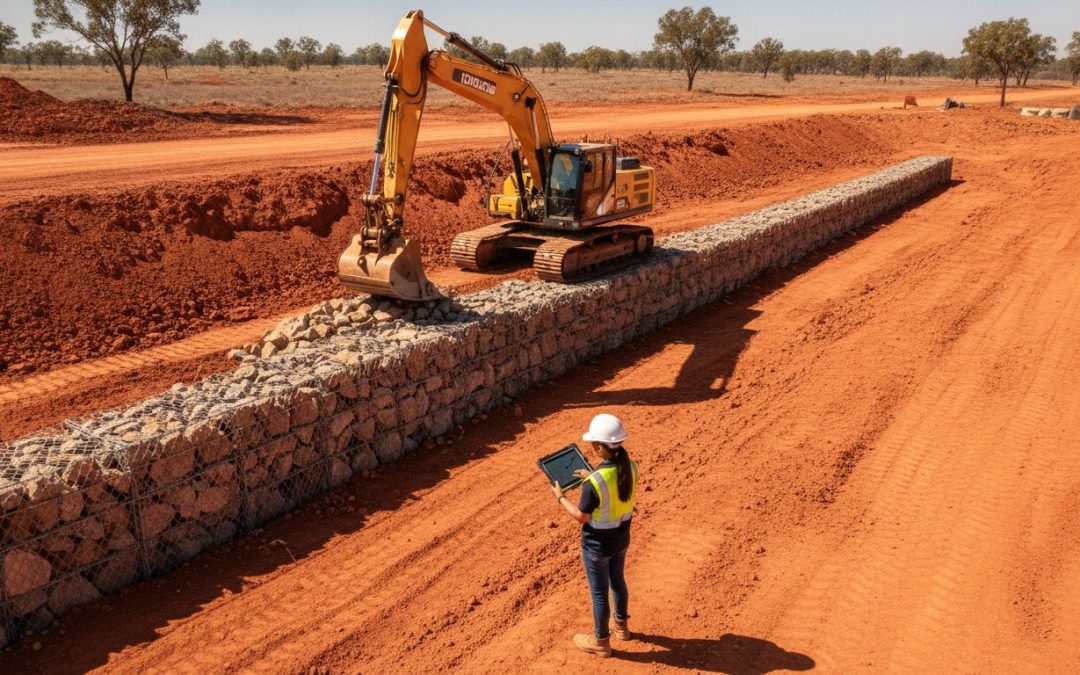
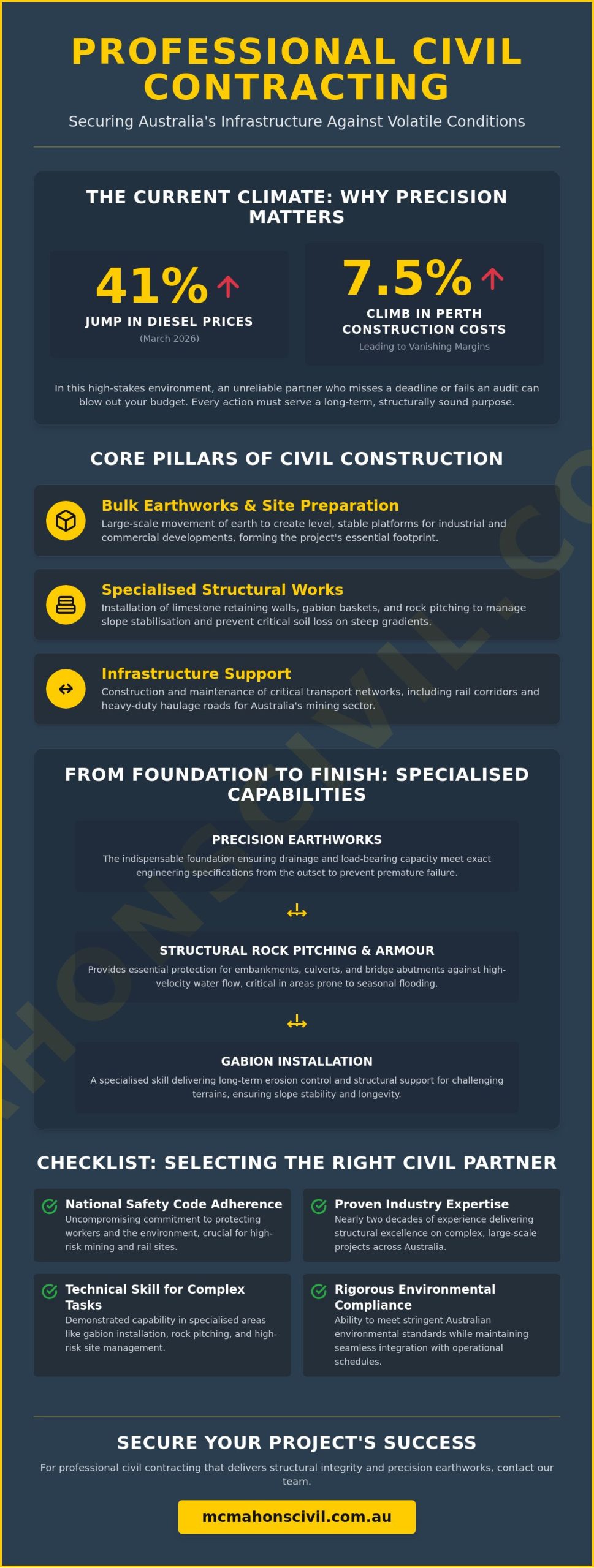
With diesel prices jumping 41% in March 2026 and construction costs in Perth climbing by 7.5%, the margin for error in large-scale infrastructure projects has effectively vanished. You’re likely feeling the pressure of these rising overheads, and the last thing your site needs is an unreliable partner who misses a deadline or fails a safety audit. It’s frustrating when a lack of specialised skill in areas like rock pitching or gabion installation leads to rework that blows out your budget even further. We understand that in the current climate, every centimetre of earth moved must serve a long-term purpose.
This article explores how professional civil contracting provides the structural integrity and precision earthworks required to secure your investment against these volatile market conditions. You’ll discover the technical transition from bulk earthworks to high-precision structural solutions and see how strict adherence to Australian safety standards ensures your project integrates seamlessly with rigorous rail and mining schedules. We will look at how methodical planning and a commitment to workmanship can protect your project from delays while meeting the highest environmental expectations across the country.
Key Takeaways
- Understand how professional civil contracting serves as the essential backbone for Australia’s mining and transport networks by ensuring strict adherence to national safety codes.
- Learn why precision earthworks and rock pitching are critical for managing drainage and providing long-term structural stabilisation for large-scale embankments.
- Discover the specialised requirements for mining and rail infrastructure, from managing haul road durability through rock breaking to maintaining precise track geometry.
- Access a practical checklist for selecting a partner who possesses the technical skill for complex tasks like gabion installation and high-risk site management.
- Explore how nearly two decades of industry expertise helps projects meet rigorous Australian environmental standards while maintaining seamless integration with operational schedules.
What is Civil Contracting in the Australian Infrastructure Landscape?
Civil contracting is the professional management and execution of physical infrastructure projects, encompassing everything from initial earthworks and drainage to complex structural stabilisation. It isn’t merely about operating heavy machinery; it’s a disciplined approach to building the foundations of a functioning society. Fundamentally, civil contracting represents the vital nexus between engineering design and physical site realisation. Within Australia, this sector operates as the backbone of our mining, rail, and transport networks, providing the essential services that allow these industries to thrive. Given the scale and complexity of these projects, the industry requires strict adherence to national safety codes to protect both workers and the surrounding environment.
The scope of modern work extends significantly beyond simple excavation or digging holes. It includes sophisticated erosion control, specialised structural masonry, and the installation of long-term stabilisation solutions like rock pitching. These elements ensure that infrastructure can withstand the harsh Australian climate and the heavy loads of industrial use. Professional contractors must understand the principles of Civil engineering to ensure that every cubic metre of soil moved contributes to the overall integrity of the final structure.
The Core Pillars of Civil Construction
Reliable civil infrastructure rests on several key disciplines that must work in harmony. These pillars include:
- Bulk earthworks and site preparation: This involves the large-scale movement of earth to create level, stable platforms for industrial and commercial developments.
- Specialised structural works: Projects often require limestone retaining walls or gabion baskets to manage slope stabilisation and prevent soil loss on steep gradients.
- Infrastructure support: This focus area includes the construction and maintenance of transport networks, specifically rail corridors and heavy-duty haulage roads for the mining sector.
The Role of a Head Civil Contractor
A head contractor acts as the guiding hand on a project site, ensuring that various moving parts align perfectly. They manage complex sub-contractor chains while maintaining absolute safety compliance across the entire site. This role involves constant liaison with engineers to translate detailed geotech reports into stable, physical structures that meet design specifications. In high-pressure environments like active mining leases or rail shutdowns, the contractor’s ability to maintain strict project timelines is critical. With diesel prices reaching 256 cents per litre in March 2026, any delay on a machine-intensive site can lead to significant financial strain. The head contractor ensures that every task, from rock breaking to final paving, is performed with precision, protecting the client’s investment and the safety of all personnel.
Specialised Civil Capabilities: Beyond Bulk Earthworks
While bulk earthworks provide the broad strokes of a project, the true longevity of an asset is determined by high-precision structural solutions. Precision earthworks form the indispensable foundation of any civil project, ensuring that both drainage and load-bearing capacity meet engineering specifications from the outset. Without this accuracy, even the most ambitious Australian infrastructure investment risks premature failure due to soil instability or water ingress. Professional civil contracting moves beyond simple excavation to address the complex relationship between soil mechanics and structural requirements.
Structural Rock Pitching and Armour
Rock pitching provides essential protection for embankments, culverts, and bridge abutments against high-velocity water flow. In the Australian context, where seasonal flooding can be severe, selecting between hand-placed and machine-placed rock pitching is a technical decision based on slope gradient and accessibility. Hand-placing offers a tighter, more aesthetic finish for culvert entries, while machine-placement is highly efficient for large-scale shoreline protection. Ensuring the longevity of this armour requires a high-quality geotextile underlay and careful stone selection to prevent the rock from sinking into the subgrade over time. For projects requiring this level of technical precision, engaging a specialist in rock pitching ensures the work meets rigorous structural standards and provides a durable barrier against erosion.
Gabion and Reno Mattress Engineering
In areas prone to ground movement or high-velocity scour, rigid concrete structures often fail. Gabion baskets offer a superior, flexible alternative, allowing for slight shifts in the earth without compromising structural integrity. These permeable solutions are particularly effective for soil retention, as they allow water to pass through the structure, which significantly reduces hydrostatic pressure on the wall. Reno mattresses, a thinner variation of the gabion, are frequently utilised in channel linings to prevent scour and facilitate natural drainage. Given the harsh Australian climate, we prioritise specific wire coating standards, such as Galfan or PVC coating, to ensure long-term corrosion resistance in both saline and acidic soil environments.
Beyond the earth and stone, specialised paving solutions are required for high-traffic industrial zones. Products like Geolink and heavy-duty industrial brick paving provide the durability needed for heavy machinery and constant haulage. These aren’t standard residential installs; they require a deep understanding of sub-base preparation and load distribution to prevent cracking or rutting under pressure. By integrating these specialised capabilities, a contractor ensures that every element of the site, from the drainage channels to the final hardstand, is built to last.
Civil Contracting for Mining and Rail Infrastructure
Specialised civil contracting in the mining and rail sectors requires a shift from standard construction to high-precision, high-durability execution. In these environments, the cost of failure is measured in significant operational downtime and environmental penalties. Mining operations rely on a robust civil foundation to support processing plants and heavy-duty haul roads that must withstand constant traffic from ultra-class haulers. These roads are not just tracks; they are engineered structures requiring precise bulk earthworks and rock breaking to ensure stability in complex geological conditions. Every centimetre of the sub-grade must be compacted to specification to prevent the rutting and failure that halts production.
Erosion control remains a primary concern in remote mining areas. Preventing site runoff is essential for maintaining environmental compliance and protecting local ecosystems. By utilising a combination of gabion technology and limestone retaining walls, contractors can create durable barriers that manage water flow and soil retention. Limestone is particularly favoured in industrial settings for its natural durability and significant structural mass, making it ideal for heavy-load environments where longevity is a priority.
Mining Sector Civil Support
Establishing foundations for heavy machinery involves more than just pouring concrete. It requires meticulous site preparation and often, extensive rock breaking to reach competent ground. We use gabion technology to construct tailings dams and water management structures that remain flexible under load while providing superior drainage. This approach aligns with the high standards advocated by the Civil Contractors Federation, ensuring that every industrial structure meets national safety and environmental benchmarks. These structures are designed to be permeable, reducing the hydrostatic pressure that often leads to the failure of rigid walls in mining applications.
Rail Infrastructure Civil Works
Rail projects demand an even higher level of precision than most civil works. The long-term stability of the ballast and the maintenance of track geometry depend entirely on the quality of the underlying precision earthworks. We employ rock pitching to protect rail corridors from the scouring effects of floodwaters, specifically around culverts and bridge abutments. During rail shutdowns, the pressure to perform is immense. Managing civil works within these tight windows requires a contractor who can integrate seamlessly with rail schedules to complete concrete works for signal bases and drainage systems without causing service disruptions. This level of coordination ensures that the rail network remains operational and safe under the heavy load of freight and passenger services.
How to Select the Right Civil Partner: A Selection Checklist
Selecting the right partner for civil contracting is a decision that impacts the structural longevity and financial feasibility of your entire project. It’s easy to find a contractor who can move dirt, but the complexities of modern infrastructure require a team that understands the nuances of structural stabilisation and specialised earthworks. You need to look beyond the surface and assess a potential partner’s ability to execute technical tasks like rock pitching and gabion installation while adhering to the strict schedules of the mining and rail sectors. A partner who can manage the transition from bulk excavation to high-precision structural masonry will save you from the costly rework associated with less experienced operators.
Safety and Compliance Standards
Evaluating a contractor’s OHS management systems is non-negotiable, particularly when working on active mining leases or rail corridors where a single incident can stop production entirely. You should review their safety incident history and verify that they have robust environmental management plans in place for projects on sensitive or protected land. Adhering to ‘Tier 1’ safety standards is a baseline requirement in national civil contracting, as it denotes a rigorous commitment to risk mitigation and regulatory compliance in high-stakes environments. This level of oversight ensures that every worker returns home safely and every project meets its legal obligations without delay.
Technical Proficiency and Plant Capacity
A contractor who owns and maintains their own fleet of specialised earthmoving equipment offers a level of reliability that those relying on hire fleets simply cannot match. This ownership ensures that machinery is available when needed and maintained to the highest standards, reducing the risk of mechanical failure on-site. When reviewing past project case studies, pay close attention to both the structural integrity and the aesthetic finish of their rock work. A multi-disciplinary team capable of handling everything from bulk earthworks to final landscaping provides a seamless transition between project phases, reducing the number of interfaces you need to manage. This holistic approach ensures that the structural foundations and the final surface finishes are perfectly aligned.
Choosing a partner with a comprehensive suite of services, from concrete works to Geolink paving, ensures that all elements of your site are integrated correctly. If you’re looking for a partner with a proven track record in high-risk environments and a commitment to precision, consult with our expert civil contracting team to ensure your next project is built on a foundation of reliability and skill.
The McMahons Advantage: Delivering Structural Excellence Nationally
McMahons Civil and Contracting PTY LTD stands as a pillar of reliability in the Australian construction sector, bringing over 18 years of specialised experience to national infrastructure projects. Our approach to civil contracting is defined by a methodical focus on structural integrity and a commitment to delivering exactly what we promise. We don’t just complete tasks; we deliver engineered solutions that meet the rigorous demands of the mining and rail environments. Whether it’s the placement of limestone retaining walls or complex rock breaking in remote regions, our team prioritises safety and precision above all else. This grounded, serious approach reflects our value for high standards and consistent results on every site we manage.
Our expertise isn’t limited to simple excavation. We’ve built a reputation on high-standard workmanship across a diverse range of disciplines. In an industry where diesel costs rose 41% in March 2026 and labour shortages continue to drive up overheads, having a partner who values clear communication and methodical planning is essential. We understand that our clients need more than just a contractor. They need a dedicated partner who possesses deep-seated knowledge of soil mechanics, erosion control, and high-precision structural masonry. Our history is built on this foundation of professional reliability and quiet confidence.
Why McMahons is the Trusted Partner for Civil and Mining
We operate with a sense of established stability, knowing that our professional reliability provides peace of mind for our clients. Our national delivery capability means we can mobilise to support large-scale projects regardless of their location, maintaining the same high standard of workmanship from start to finish. We offer a comprehensive service suite that simplifies project management, including:
- Precision rock pitching and gabion installation for long-term erosion control.
- Bulk earthworks and rock breaking tailored to the unique geology of mining leases.
- Specialised concrete and paving solutions, such as Geolink and industrial brick paving, for high-traffic zones.
- Limestone retaining walls that provide both structural mass and natural durability.
Contact Us for Your Next Civil Project
Every project has its own unique set of challenges, especially in the high-pressure environments of rail shutdowns or active mine sites. We’re here to discuss your specific requirements for rock pitching, earthworks, or structural stabilisation. Our specialised civil solutions are designed to support your broader goals, ensuring that your infrastructure remains resilient and compliant with Australian standards for decades. We take a hands-on, responsible approach to every contract, ensuring that the “how” and the “why” of our process are as transparent as the quality of the final build. Partner with McMahons Civil and Contracting for your next project to ensure your infrastructure is built on a foundation of skill, safety, and reliability.
Building Resilient Foundations for Australia’s Future
The success of your next project depends on a disciplined approach to civil contracting that prioritises long-term structural integrity over short-term shortcuts. We’ve explored how specialised earthworks, from precision rock pitching to gabion engineering, provide the essential stabilisation required to protect multi-million dollar assets against the harsh Australian climate. It’s clear that in high-stakes sectors like mining and rail, selecting a partner who understands the necessity of ‘Tier 1’ safety standards and seamless schedule integration is the most effective way to mitigate risk. With over 18 years of industry experience, McMahons Civil and Contracting PTY LTD remains dedicated to delivering the professional reliability your site deserves.
Our specialists in rock pitching and gabion engineering have a proven track record in the mining and rail sectors, ensuring every project meets the highest national standards. We’re ready to bring that same methodical care and deep-seated technical knowledge to your next development. Secure your civil infrastructure with McMahons Civil and Contracting and ensure your project is built to last. We look forward to helping you achieve a result that reflects the quality and precision your infrastructure demands.
Frequently Asked Questions
What is the difference between general excavation and civil contracting?
Civil contracting involves the comprehensive management and execution of infrastructure projects, whereas general excavation is primarily limited to the physical act of earthmoving. While a general excavator might focus solely on digging or trenching, our services encompass engineering liaison, structural stabilisation, and strict adherence to national safety codes. It’s the difference between simply moving soil and building a durable foundation that supports long-term industrial use for rail and mining networks.
Why is rock pitching important for civil infrastructure?
Rock pitching is essential for protecting embankments, culverts, and bridge abutments from the scouring effects of high-velocity water flow. In the Australian environment, where seasonal flooding can be severe, this specialised structural work prevents soil loss and maintains the integrity of the surrounding infrastructure. By using hand-placed or machine-placed stones, we create a durable barrier that protects the subgrade from erosion for decades, ensuring the asset remains secure.
Can McMahons handle civil works for remote mining sites?
Yes, McMahons Civil and Contracting PTY LTD provides national delivery capability, including comprehensive support for remote mining operations across the country. We have over 18 years of experience managing the logistics of remote sites, from rock breaking for site expansion to the construction of tailings dams. Our team is accustomed to the high-pressure environments of active mining leases and maintains the necessary plant capacity to handle large-scale earthworks anywhere.
What are the benefits of using gabion baskets over traditional concrete walls?
Gabion baskets offer superior flexibility and permeability compared to rigid concrete walls, making them ideal for areas prone to ground movement or high hydrostatic pressure. Unlike concrete, which can crack under soil shifts, gabions allow water to drain naturally through the structure while moving with the earth. This flexibility ensures long-term structural integrity in varied geological conditions while reducing the need for the complex internal drainage systems required by traditional masonry.
Does McMahons provide specialised paving for industrial areas?
We specialise in high-traffic industrial paving solutions, including Geolink and heavy-duty brick paving, designed specifically for heavy machinery and constant haulage. These are not standard residential applications; they require meticulous sub-base preparation to ensure the surface can withstand constant industrial loads without rutting or failure. Our team ensures that every industrial hardstand is built to meet the specific load-bearing requirements and track geometry of your industrial site.
How does McMahons ensure safety compliance on rail and mining projects?
Safety compliance is managed through rigorous OHS management systems that meet ‘Tier 1’ industry standards for high-risk environments. We conduct regular safety audits, maintain strict environmental management plans, and ensure all personnel are fully inducted into site-specific rail and mining protocols. Our focus on professional reliability means that we don’t just follow the rules; we integrate safety into every methodical step of our construction and stabilisation process.
What types of retaining walls are best for large-scale civil slopes?
Limestone retaining walls are often the preferred choice for large-scale civil slopes due to their immense structural mass and natural durability in Australian conditions. For areas requiring more flexibility or complex drainage, gabion baskets and Reno mattresses provide an effective alternative. The best solution depends on the geotech report and the specific gradient of the slope, but both options offer the long-term stabilisation required for heavy industrial infrastructure.
What is the typical process for a civil contracting project with McMahons?
The process for a civil contracting project begins with a professional consultation to review project specifications and geotech requirements, followed by a methodical planning phase. Once the site is prepared through precision earthworks, we move into the structural phase, which may include rock pitching, concrete works, or gabion installation. Throughout the project, we maintain transparent communication and conduct regular safety checks to ensure the final result meets your exact structural expectations.