
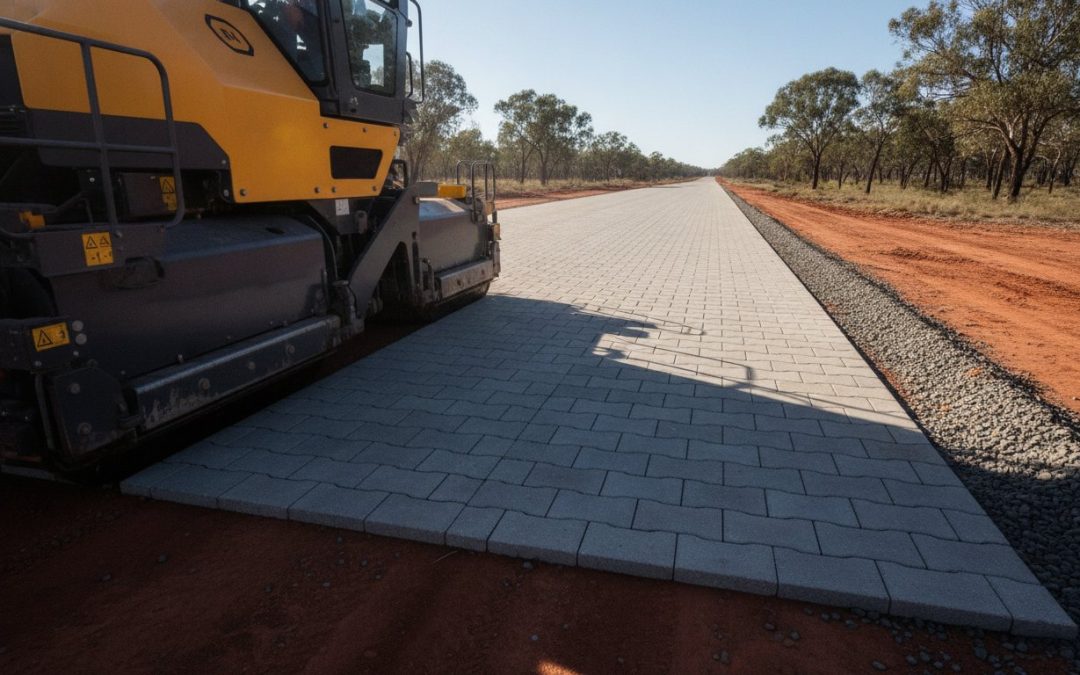
A paving surface on a large-scale civil site is not merely a finishing touch; it is a critical structural asset that determines the long-term stability and safety of the entire infrastructure. Experienced commercial paving contractors recognise that when a high-traffic zone fails, it’s rarely just a surface issue, but often a result of poor integration between the sub-grade earthworks and the final layer. You’ve likely felt the pressure of coordinating disparate sub-contractors while trying to maintain strict compliance with the National Construction Code 2025 and Australian standards like AS 3700 for masonry structures.
This guide provides a clear pathway to selecting high-performance paving solutions that meet the rigorous demands of Australian civil and mining infrastructure. We’ll help you identify durable options like Geolink for erosion control and ensure your site remains compliant with the latest slip resistance and safety regulations. We will also preview the benefits of partnering with a contractor capable of national delivery, where earthworks and paving are handled as a single, cohesive discipline to guarantee a reliable result that lasts.
Key Takeaways
- Recognise why integrated paving is a structural requirement for heavy machinery in mining and rail corridors, providing a superior alternative to unsealed surfaces.
- Explore the technical advantages of Geolink paving for slope stabilisation and heavy-duty access tracks, where structural strength and permeability must intersect.
- Learn how to select commercial paving contractors with the integrated earthworks and civil capabilities required to streamline site coordination and reduce project downtime.
- Establish a framework for comparing structural brick paving and specialised systems based on total lifecycle costs and the specific load-bearing demands of your site infrastructure.
- Ensure full site compliance by identifying the safety management systems and Australian standards necessary for high-performance paving in complex civil environments.
The Strategic Role of Paving Services in Civil Infrastructure
In the context of large-scale civil works, paving is far more than a visual finish. It functions as a critical structural component that must withstand immense pressure from heavy machinery and high-frequency traffic. For mining and rail corridors, the choice to move away from unsealed surfaces is a strategic decision rooted in safety and operational longevity. Unsealed tracks are prone to dust generation, erosion, and constant maintenance requirements that can bottleneck a site’s productivity. By contrast, engineered paving provides a predictable, stable platform that facilitates smoother logistics and safer vehicle movements.
The success of any paving project is intrinsically linked to the quality of the preceding earthworks. Professional commercial paving contractors understand that the surface layer is only as reliable as the sub-grade preparation beneath it. While asphalt concrete serves as a standard for many road networks, segmental paving solutions offer the flexibility required for industrial sites where soil movement or high-torque zones are present. This integrated approach ensures that the pavement doesn’t just sit on the ground, but works with the underlying soil to distribute loads effectively.
Load-Bearing Capacity and Surface Durability
Industrial centres demand surfaces that resist rutting and structural failure under extreme weight. Engineering these pavements requires a deep understanding of material density and compressive strength. In Australia, these materials must also remain stable through intense heat cycles and heavy seasonal rains. Selecting high-specification pavers that meet AS 3700 standards ensures the infrastructure remains functional for decades rather than years, protecting the project’s capital investment from premature degradation.
Integration with Civil Drainage Systems
Effective paving acts as a primary tool for managing site water run-off. By establishing precise falls and levels, commercial paving contractors ensure that water is directed away from critical assets like concrete foundations or limestone retaining walls. Modern civil projects increasingly rely on permeable solutions to manage high-volume rainfall without overwhelming local drainage. This proactive water management prevents the subsurface erosion that typically leads to pavement subsidence and costly site repairs.
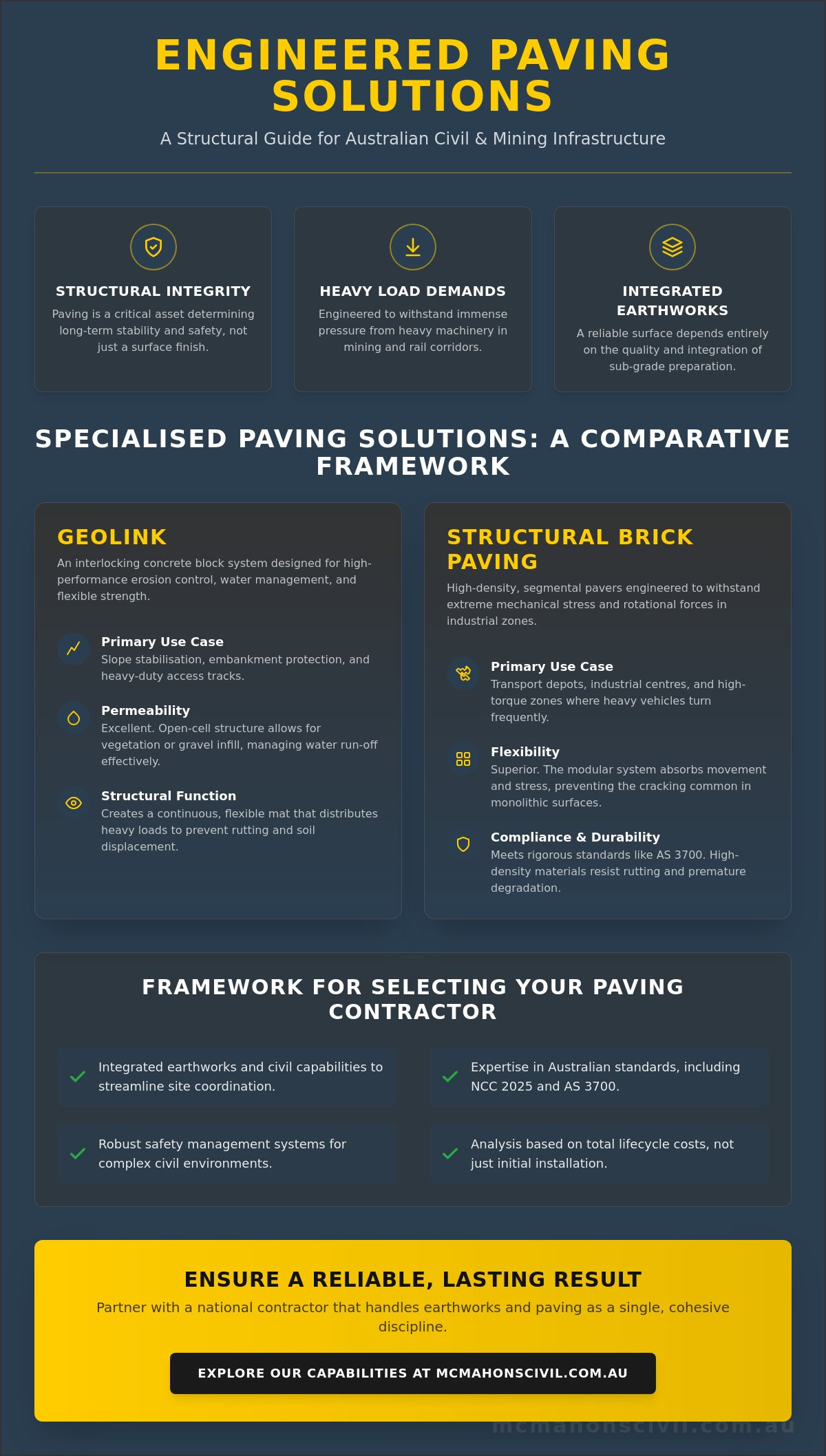
Specialised Paving Solutions: Geolink and Structural Brick Paving
Large-scale civil projects require a shift in thinking from aesthetic finishes to engineered reinforcement. While standard surfaces might suffice for light commercial use, mining and industrial logistics hubs demand materials that can withstand extreme mechanical stress without compromising site safety. Professional commercial paving contractors often recommend specialised systems like Geolink or high-density segmental brickwork to address these specific structural challenges. These solutions are chosen not just for their surface durability, but for how they interact with the environment and the underlying sub-grade over a multi-decade lifespan.
Selecting the right material involves balancing immediate installation speed with long-term maintenance requirements. In high-torque zones where heavy vehicles frequently turn, traditional monolithic surfaces often develop cracks that lead to total structural failure. Modular systems provide a flexible alternative that can absorb these movements. Whether you’re stabilising a steep embankment or surfacing a transport depot, the engineering principles remain similar to those found in Airport Pavement Design, where load distribution and material density are the primary drivers of success.
Geolink Paving for Structural Stabilisation
Geolink is a specialised, interlocking concrete block system designed for high-performance erosion control and water management. Its open-cell structure allows for vegetation growth or gravel infill, creating a permeable surface that remains incredibly strong. In mining sectors, Geolink is frequently used for heavy-duty access tracks and embankment protection where traditional concrete would be prone to cracking or washout. The units interlock to create a continuous, flexible mat that distributes the weight of heavy machinery across a wider area, preventing the deep rutting often seen on unsealed tracks. If your project involves environmentally sensitive zones or complex drainage requirements, exploring Geolink paving solutions can provide a sustainable, long-term result.
Heavy-Duty Brick Paving for Industrial Hubs
For warehouse aprons and transport depots, high-density brick paving remains a superior choice due to its modularity and compressive strength. These systems rely on specialised bedding sands and precision-engineered jointing materials to maintain their integrity under constant vibration and load. One of the primary advantages of this approach is the ease of maintenance. If a specific area is damaged by a fuel spill or extreme impact, individual pavers can be replaced without the need for large-scale demolition. This ensures that site downtime is kept to an absolute minimum, allowing your logistics operations to continue with minimal interruption. Commercial paving contractors prioritise these systems in high-traffic zones where reliability and rapid repair are essential for operational continuity.
Brick Paving vs. Geolink: A Comparative Framework
Deciding between structural brick paving and Geolink systems requires a methodical assessment of the site’s geological profile and expected mechanical loads. While both provide high-performance results, their structural behaviours differ significantly. Commercial paving contractors evaluate these differences to prevent premature failure, particularly in sectors like mining and rail where axle loads are extreme. The choice often comes down to the specific pavement design and engineering standards required for the project, balancing initial installation speed against the total cost of ownership over twenty or thirty years.
Lifecycle cost-efficiency is a primary driver in this decision. Brick paving often involves a higher initial material cost but offers exceptional longevity in transport depots. Geolink may offer faster installation on large, sloped areas where erosion control is the priority. Understanding the soil type is equally vital. On reactive clay soils common in many parts of Australia, a flexible modular system can accommodate minor ground movements that would cause a rigid concrete slab to fail. This adaptability reduces the need for frequent, expensive remedial works.
Performance Metrics in High-Traffic Environments
Interlocking bricks are the benchmark for shear resistance in high-torque zones, such as where heavy haulage trucks perform tight turns. The tight fit between units prevents horizontal shifting under stress. Geolink, conversely, excels in vertical load distribution across expansive or unstable soils, acting as a reinforced mat that prevents the sub-grade from pumping. For sites requiring frequent utility maintenance, brick paving is often more efficient. Individual units can be removed and reinstated without leaving the “patchwork” scars common in concrete or asphalt, ensuring the structural integrity remains intact after the repair.
Environmental and Drainage Considerations
Environmental compliance is now a non-negotiable aspect of civil infrastructure. Geolink is a primary solution for managing peak storm-water flow, as its open-cell design facilitates natural infiltration and reduces the burden on local drainage networks. Structural brick paving is better suited for sites where run-off must be captured and treated before entering the civil system. Additionally, the thermal properties of these materials matter. Selecting lighter-coloured pavers can significantly reduce the heat island effect in large industrial centres, improving worker safety and local environmental conditions. Experienced commercial paving contractors will help you navigate these trade-offs to ensure your site meets both performance and sustainability targets.
Selecting Commercial Paving Contractors for Large-Scale Projects
Choosing the right partner goes beyond checking a list of services. For large-scale civil works, commercial paving contractors must demonstrate an ability to manage complex logistics and high-risk environments. This is especially true in remote mining regions or active rail corridors where delays impact national supply chains. You need a partner who understands that the pavement is a structural asset, requiring deep technical knowledge of both material science and heavy-duty earthworks. A contractor capable of national delivery brings a level of established stability that smaller firms often cannot match when the scope involves thousands of square metres across challenging terrain. For project managers evaluating heavy duty paving solutions that can exceed a 25-year lifespan while minimising operational downtime, understanding the full technical scope of available systems is an essential first step.
Safety, Compliance, and Risk Management
In the current regulatory environment, compliance is a moving target. With the National Construction Code 2025 now in effect, contractors must meet more stringent standards for safety and performance. This includes adhering to national WHS regulations regarding psychosocial hazards, which became effective on 1 December 2025. A reputable contractor provides transparent documentation, including Safe Work Method Statements (SWMS) and quality assurance reporting, to ensure every square metre meets Australian Standards for slip resistance and load-bearing capacity. Verified industry accreditation and comprehensive insurance aren’t just paperwork; they’re the foundation of site safety in high-pressure industrial zones.
The Benefit of Integrated Civil Services
Project risk often lives in the gaps between sub-contractors. When one team handles the earthworks and another manages the paving, accountability can become blurred. Selecting a contractor with integrated capabilities, ranging from rock breaking and site preparation to the final installation of Geolink or brick paving, streamlines the project timeline. This cohesion ensures that limestone retaining walls, rock pitching, and gabion baskets align perfectly with paved surfaces. It also ensures that sub-grade compaction meets the exact requirements of the chosen paving system. It eliminates the friction of coordinating multiple schedules and reduces the likelihood of structural disputes later in the project lifecycle.
Managing a site’s stability requires a methodical approach where the “how” is just as important as the “what.” By choosing a partner who can self-perform these critical tasks, you ensure that the structural integrity of your infrastructure is maintained from the first bucket of soil moved to the final paver laid. If your next project requires this level of technical precision and operational reliability, you can partner with McMahons Civil for a comprehensive paving solution that meets the highest professional standards.
Partnering with McMahons Civil for Professional Paving Solutions
McMahons Civil has built a reputation based on quiet confidence and the consistent delivery of high-specification infrastructure. For 18 years, we have partnered with tier-one firms and government bodies to execute complex paving and earthworks projects across Australia. As experienced commercial paving contractors, we understand that the success of a civil project depends on a methodical approach where safety and structural integrity are never compromised. Our history in the industry provides the established stability required to manage large-scale deployments without the risks associated with less experienced firms. We take pride in a workmanship standard that feels personal, ensuring every project reflects our commitment to excellence and professional reliability.
Our expertise spans the diverse requirements of the civil, mining, and rail sectors. Whether your project requires the permeability of a Geolink system or the sheer compressive strength of industrial brick paving, we provide a service-oriented attitude that emphasises partnership. We don’t just deliver a surface; we provide a structural asset designed to meet the rigorous demands of Australian industry. This grounded approach has made us a trusted local leader, capable of scaling our operations to meet the needs of the most ambitious infrastructure programmes in the country.
National Capability and Remote Site Expertise
Mining and rail projects often present logistical hurdles that local contractors simply aren’t equipped to handle. McMahons Civil excels in these challenging environments, bringing a national capability that ensures consistent quality regardless of site location. We don’t view paving in isolation; our expertise extends to integrated civil services including rock pitching, gabion baskets, and limestone retaining walls. This allows us to deliver a cohesive solution where every element of the site’s stabilisation works in harmony. Our project teams are accustomed to the rigours of remote site management, ensuring that materials, plant, and personnel are coordinated with precision to keep your timeline on track and within budget.
Start Your Infrastructure Project with McMahons
We believe that the best results come from early collaboration between project managers and specialised civil partners. Our team works closely with you to identify the most durable paving solution, whether that involves high-density industrial brickwork or a specialised Geolink system for erosion control. By integrating our earthworks and paving capabilities, we eliminate the friction often found in multi-contractor sites. This commitment to professional standards ensures that your civil assets are built to withstand the harshest Australian conditions while remaining fully compliant with current regulations. If you are looking for commercial paving contractors who value pride in workmanship and clear communication, McMahons Civil is ready to assist. Contact our team today to discuss your national paving and earthworks requirements and discover how our dedicated approach can support your next infrastructure project.
Securing the Structural Integrity of Your Next Civil Asset
Effective paving in the civil and mining sectors requires a shift from viewing surfaces as a cosmetic finish to treating them as vital structural components. We have explored how selecting the right material, whether it’s the specialised permeability of Geolink or the sheer compressive strength of industrial brick, ensures longevity in high-torque and heavy-load environments. By choosing commercial paving contractors with integrated civil capabilities, you eliminate the operational gaps that often lead to project delays or structural failure.
McMahons Civil brings over 18 years of experience to every project, with a proven track record in the demanding mining and rail sectors. Our specialised knowledge in Geolink and rock pitching allows us to deliver dependable results even in the most remote locations across Australia. We take a methodical, partnership-driven approach to ensure your infrastructure meets the highest standards of safety and compliance. Discuss your national infrastructure project with the experts at McMahons Civil to ensure your next site is built on a foundation of professional reliability and technical precision. We look forward to helping you deliver a result that stands the test of time.
Frequently Asked Questions
What is the difference between residential and commercial paving services?
Commercial paving prioritises structural engineering and load-bearing capacity to accommodate heavy machinery and high-frequency traffic. While residential work often focuses on aesthetic appeal, commercial projects must meet stringent civil standards for durability and safety. Large-scale infrastructure requires a methodical approach to sub-grade preparation and material selection to ensure the surface doesn’t fail under industrial stress.
Why is Geolink paving used in civil and mining projects?
Geolink is a specialised solution chosen for its exceptional ability to manage erosion and stabilise steep embankments. Its interlocking design provides a reinforced surface for heavy-duty access tracks while remaining permeable to manage groundwater run-off. In mining sectors, it’s often preferred over traditional methods because it prevents soil washout and handles the weight of heavy plant machinery without cracking.
How does sub-grade preparation affect the longevity of commercial paving?
The sub-grade is the foundation of the entire pavement; if it’s not compacted and graded correctly, the surface will inevitably fail. Professional commercial paving contractors integrate precision earthworks to ensure the underlying soil can support the expected loads. Correct preparation prevents the common issues of surface rutting, subsidence, and structural cracking that lead to expensive remedial works.
Can commercial paving be installed in remote mining locations?
Yes, but it requires a partner with established national capability and the logistical expertise to manage remote site requirements. Delivering high-quality paving in these areas involves coordinating the transport of specialised plant and materials while adhering to strict mining safety inductions. It’s essential to work with a contractor who has a proven track record of maintaining professional standards in challenging, distant environments.
What are the maintenance requirements for large-scale industrial paving?
Large-scale industrial surfaces benefit from modular systems like brick or Geolink because they allow for the replacement of individual units. This is far more efficient than repairing monolithic concrete slabs, which often require total demolition for simple repairs. Regular inspections of jointing sand and drainage levels ensure the system remains stable and capable of handling heavy axle loads over its lifespan.
How do paving services integrate with other civil works like rock pitching?
Paving and rock pitching are often delivered as a single, cohesive stabilisation package for civil infrastructure. While the paving provides a stable surface for vehicle movements, rock pitching is used to protect adjacent embankments and drainage channels from water erosion. Integrating these services under one contractor ensures that transitions between different structural elements are seamless and professionally finished.
Is brick paving suitable for heavy machinery and high-traffic zones?
High-density brick paving is exceptionally durable and frequently used in transport depots and warehouse aprons. When installed by experienced commercial paving contractors, these systems offer high compressive strength and the flexibility to absorb ground movement. They are particularly effective in high-torque zones where heavy trucks perform tight turns that would typically cause rigid surfaces to shear or crack.
How do I choose between Geolink and traditional concrete for a civil project?
The choice depends on your site’s specific drainage requirements and the reactivity of the underlying soil. Traditional concrete provides a rigid, monolithic surface, but it’s prone to cracking if the ground shifts. Geolink offers a flexible, permeable alternative that is superior for erosion control and managing peak storm-water flow, making it a better fit for environmentally sensitive or unstable sites.