
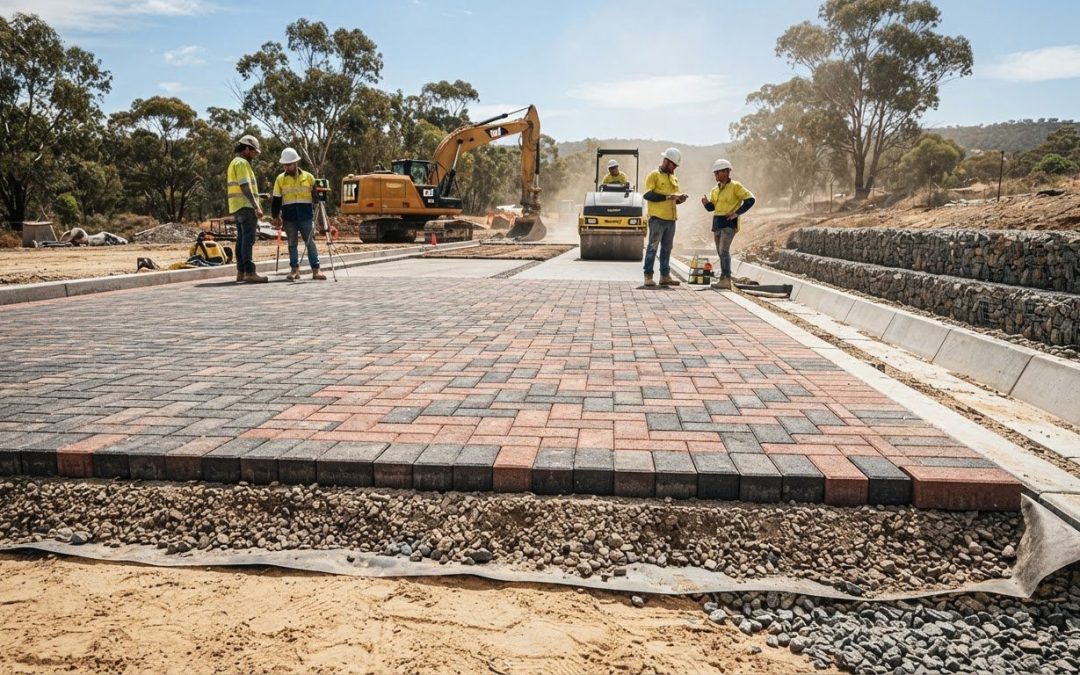
What if the strength of commercial brick paving depends as much on what lies beneath the surface as on the pavers themselves? For civil, mining and industrial sites, plan paving around vehicle loads, ground conditions and drainage, rather than treating it as a finishing detail. Surface failure can disrupt operations and lead to ongoing repairs, so the pavement structure matters from the outset.
A heavy-duty surface needs to suit the way a site operates. Achieving that depends on sound preparation, suitable materials and installation matched to the project requirements. Australian standards such as AS/NZS 4455.1 address masonry units, while AS/NZS 4456.5 sets out a method for testing paver breaking load. These standards inform material selection, but they do not replace site-specific pavement design.
This article covers the main considerations for commercial brick paving in high-traffic environments, including load performance, subgrade preparation, drainage and relevant standards. It also explains how paving can form part of a broader civil package alongside earthworks and structural concrete. McMahons Civil and Contracting brings more than 18 years of industry experience to large-scale and complex Australian projects.
Key Takeaways
- Commercial brick paving can support demanding site use when material selection and pavement design match the application.
- Paver thickness and breaking-load testing are two considerations when selecting materials for commercial and industrial settings.
- Compared with poured concrete, individual pavers can be lifted to access underground services.
- Subgrade preparation and California Bearing Ratio (CBR) are important considerations in pavement performance.
- Integrating brick paving with civil, mining and rail works can help coordinate complex project delivery.
The Role of Commercial Brick Paving in Modern Civil Infrastructure
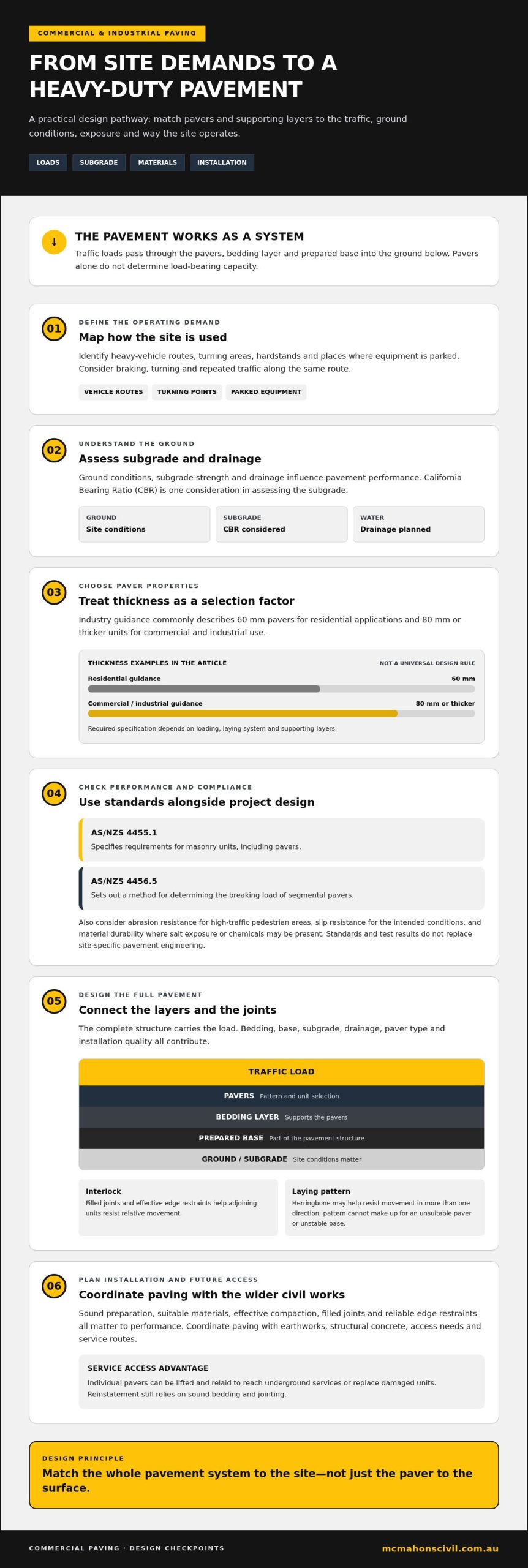
On a civil or industrial site, paving is part of the working structure, not simply a finished surface. It transfers traffic loads through the pavers, bedding layer and prepared base into the ground below. For heavy vehicle routes, turning areas and hardstands, performance depends on the whole pavement design, including the subgrade, drainage, paver type and installation quality.
Commercial brick paving can suit areas with concentrated loads, such as beneath parked equipment or at vehicle turning points, provided the pavement is designed for site conditions. Load-bearing capacity comes from the combined pavement system, not the brick alone. This distinction matters on rail, mining and industrial sites, where vehicles may brake, turn or repeatedly follow the same route.
Unlike a continuous asphalt surface, a segmental pavement can be opened up by lifting and relaying units to reach underground services. Individual pavers can be replaced without cutting out a large continuous section, although reinstatement still depends on sound bedding and jointing. A general overview of pavers and their uses describes their application in settings ranging from driveways to town centres.
At McMahons Civil and Contracting, brick paving is delivered alongside the wider civil works that support it. Coordinating earthworks and structural concrete with the paving helps make the finished surface part of a considered project scope, rather than a standalone finish. Access, ground conditions and service routes all influence how a pavement needs to perform.
Load Distribution and Interlocking Mechanics
Interlock is the ability of adjoining pavers, restrained at their edges and bound by jointing material, to work together and resist relative movement under traffic. Under a wheel load, a paver bears vertically on its bedding, while jointing sand helps transfer some load to neighbouring units through small horizontal movements. This shared action helps the surface resist displacement during braking and turning, provided joints remain filled and edge restraints are effective.
Laying pattern affects how forces travel through the surface. Herringbone arrangements are often considered for trafficked areas because their angled joints can help resist movement in more than one direction. Pattern alone cannot compensate for unsuitable pavers, an unstable base or poor compaction. Select it as part of the pavement design.
Durability in Harsh Australian Environments
Outdoor pavements experience changes in temperature and moisture. Segmental construction accommodates movement at joints rather than relying on one uninterrupted surface, but durability still depends on material choice, drainage and detailing. Industrial or mining sites may involve chemical exposure, so assess resistance against the specific paver material and site conditions rather than assuming every brick surface will perform the same way.
Long-term value also depends on repairability. Asphalt can provide a continuous flexible surface, while paving allows localised lifting and reinstatement around services or damaged areas. This may limit the extent of a repair, but it does not remove the need for maintenance or careful reinstatement. McMahons Civil and Contracting brings experience across civil, mining and rail infrastructure to paving works and their supporting earthworks.
Technical Specifications for Heavy-Duty Paving Materials
Choosing pavers for a commercial pavement involves more than selecting a size or finish. The specification needs to suit the expected traffic, ground conditions, exposure and use of the space. A surface designed for foot traffic has different demands from a hardstand used by heavy vehicles, so consider paver properties as part of the full pavement system.
Thickness is one selection factor. Industry guidance commonly describes 60 mm pavers for residential applications and 80 mm or thicker units for commercial and industrial use. These are typical categories, not a universal design rule. The required specification depends on loading, laying system and supporting layers. Paver breaking load is also relevant. AS/NZS 4456.5 sets out a method for determining the breaking load of segmental pavers, while AS/NZS 4455.1 specifies requirements for masonry units, including pavers. Neither replaces project-specific pavement engineering.
Australian Standards and Compliance
Standards help define material properties and test methods, but compliance also depends on how the pavement is designed and installed. For high-traffic pedestrian areas, consider abrasion resistance alongside breaking load, as repeated foot traffic and maintenance equipment can wear the surface. Specify slip resistance for the conditions and intended use. A P-rating should not be selected in isolation from the relevant test method and project requirements.
Exposure matters too. In coastal or high-salinity environments, material durability needs to account for salt attack and site conditions. Clay and concrete pavers may each suit different applications, but base the choice on documented product properties, exposure and engineering needs, not appearance alone. For broader context on material composition and structural design in heavy-duty paving, the Federal Highway Administration’s Advanced High-Performance Materials for Highway Applications discusses pavement materials in highway settings.
Paver Shapes and Laying Patterns
Pattern influences how units respond to traffic. A 90-degree herringbone layout is commonly selected for heavily trafficked areas because its arrangement can resist movement from more than one direction. It is not a substitute for suitable base preparation or edge restraint. Rectangular units can create more interlocking joint patterns, while square units may suit other layouts. The right choice depends on the design and loading, rather than shape alone.
Edge restraints are essential to holding the field of pavers in place. Without effective restraint, repeated traffic can push units outwards, contributing to lateral creep, open joints and disturbed alignment. Restraint details need to suit pavement edges, adjacent structures and site conditions. Complete jointing and compaction to the project specification.
For a reliable outcome, coordinate material selection with the earthworks and concrete supporting the pavement, then match testing and detailing to the project’s exposure and traffic. McMahons Civil and Contracting delivers brick paving alongside wider civil works. Explore commercial brick paving and civil contracting as part of an integrated project approach.
Brick Paving vs. Poured Concrete: A Commercial Comparison
For a commercial site, the choice between brick paving and poured concrete affects maintenance planning as well as construction. Initial expenditure depends on the project area, ground preparation, materials, access and installation requirements, so there is no universal cost winner. A more useful comparison considers the maintenance cycle: the likely scale of repairs, the time needed to reinstate the surface and whether underground services may need future access.
Poured concrete creates a continuous slab, which can be practical for some applications but may crack as the ground or slab moves. Large slabs also require planned joints to manage movement. Segmental paving has joints between individual units and can accommodate some movement through the pavement, but it still relies on a stable base, effective drainage and suitable detailing. On reactive soils, flexible construction may help the surface respond to minor movement, but the design must still account for ground conditions.
Commercial brick paving can also provide a consistent appearance across areas that may need local repairs. Where a unit is damaged or settlement occurs, the affected section can be lifted and reinstated rather than replacing a broad expanse of concrete. The result depends on matching replacement units and restoring the bedding and jointing correctly.
Maintenance and Repair Logistics
Modular paving makes service access straightforward: units can be lifted to expose underground services, then reinstated after the work without demolishing an entire slab. This can help limit the repair footprint, though reinstatement still needs care to maintain surface level and stability.
Joint maintenance is part of the system. Jointing sand can be displaced by water, cleaning or traffic, so inspections and replenishment may be needed as part of routine site upkeep. Weeds can grow where debris and organic matter accumulate in joints, so regular cleaning and maintenance help manage them. Paving does not rely on the same slab-wide expansion-joint layout as a large concrete slab, but movement joints and edge details may still be required where the design calls for them.
Operational Downtime and Curing
Poured concrete needs time to cure before it can take traffic, with the required period depending on the concrete and project conditions. Pavers do not undergo slab curing, so they may be opened to traffic after installation and compaction are complete, provided the pavement design and site requirements allow it. This can help with staging work in active civil or mining environments, where keeping routes available may matter to operations.
Neither method is maintenance-free. The practical choice weighs construction sequencing, future service access, ground movement and the consequences of taking an area out of use for repairs. Permeable paving can allow water to pass through when designed with suitable materials and a compatible base, but do not assume standard paving provides this benefit. Surface colour and material can influence heat absorption, though the heat-island effect depends on the wider site and pavement design. McMahons Civil and Contracting integrates brick paving with earthworks and structural concrete, helping align the pavement choice with the broader civil package.
Professional Installation Standards for Commercial Sites
For commercial paving, durability starts below the visible surface. A well-selected paver can still fail if the subgrade is weak, saturated or inconsistently compacted. The installation sequence needs to connect ground preparation, drainage, base construction and laying as one engineered system, with requirements matched to expected loads and site conditions.
Structural earthworks and bulk site preparation provide the platform for that system. Before paving begins, assess and prepare the subgrade to the project design, including any specified California Bearing Ratio (CBR) requirement. CBR indicates the strength of the ground supporting the pavement. The target depends on the design, traffic and ground conditions, so it should not be assumed to be the same for every hardstand.
Earthworks and Sub-Base Engineering
Base-course material and thickness need to suit the design loads and prepared subgrade. A heavy industrial area may need a different pavement build-up from a pedestrian zone, and the specification should set out the material, layer depths and compaction requirements. Geotextile may be used where the design calls for separation between subgrade and base, helping limit the mixing of fine soil into the pavement layers.
Drainage is just as important. Falls should direct surface water to intended collection points rather than allowing it to pond or infiltrate in ways that saturate the supporting layers. Compact mechanically in controlled layers and verify the result against the project specification. Consistent preparation helps reduce localised settlement and supports an even finished surface. McMahons Civil and Contracting integrates paving with earthworks and structural concrete, bringing these connected tasks into a coordinated civil package.
Finishing and Jointing Protocols
Spread and screed the bedding layer evenly to the designed profile before laying units. It supports the pavers, but it is not a substitute for a properly prepared base. Once paving is placed, work jointing sand into the gaps to help units act together and resist movement. The joint material and installation method should suit the paver system and site exposure. Poorly filled joints can be vulnerable to wash-out or loss of stability.
For large installations, mechanical vibration can help seat the pavers and work jointing sand into the joints. Equipment and technique must suit the paver material and surface. Take care to avoid damage and maintain levels. Before handover, check alignment, drainage falls and that joints are fully filled.
Sealing is not automatically required for every paved area. Where staining or intensive use is a concern, the project specification should determine whether a suitable sealer is needed, taking account of the paver material and operating conditions. Good installation is methodical, from ground assessment through to final checks. McMahons Civil and Contracting delivers commercial brick paving integrated with earthworks and concrete. Explore McMahons Civil and Contracting’s civil paving services.
Delivering Integrated Paving Solutions with McMahons Civil
Commercial brick paving performs best when planned as part of the civil works around it. McMahons Civil and Contracting delivers brick paving alongside earthworks and structural concrete, helping coordinate ground preparation and the finished surface within a broader project scope. This integrated approach is useful where site access, ground conditions and work sequencing affect how different construction activities fit together.
With more than 18 years of industry experience and a focus on mining and rail infrastructure, McMahons Civil and Contracting undertakes paving as part of complex Australian civil projects. Remote sites can bring practical challenges around access, logistics and coordinating work fronts. Planning, communication and construction sequencing help keep paving aligned with wider project requirements.
For developers and project teams managing connected work packages, comprehensive civil contracting can bring related activities into a coordinated scope. McMahons Civil and Contracting’s commercial paving services form part of that capability, with the pavement considered alongside the site works that support its performance.
A Partner for Mining and Rail Infrastructure
Mining and rail projects operate within specific site rules, safety processes and compliance requirements. Plan paving around those controls, as well as access routes, interfaces with other work and the intended use of each paved area. Clear sequencing helps teams coordinate preparation, installation and handover without treating paving as an isolated finishing task.
On rail infrastructure, platforms and access ways have distinct operational functions, so pavement design and construction must follow project requirements. Mining sites also need surfaces suited to their intended traffic and operating conditions. For remote work, mobilisation planning brings equipment, people and construction activities together around the project programme. McMahons’ civil, mining and rail experience supports a considered approach to these demanding environments.
The McMahons Standard of Professionalism
Reliable delivery comes from consistent standards and attention to interfaces. Earthworks establish the formation, concrete may form part of adjacent or supporting structures, and paving completes the surface. If levels, drainage or work sequencing are not coordinated across these elements, problems can arise at their boundaries. Managing those connections within the wider scope supports a more coherent result.
McMahons Civil and Contracting takes a practical approach to large-scale work, coordinating project stages and focusing on workmanship. That matters to Australian developers and project teams who need a contracting partner for complex sites, with paving integrated into the surrounding civil works. Learn more about commercial paving and civil works.
Plan Your Next Pavement Package with Confidence
Plan pavement delivery as part of the project, rather than leaving it until wider site works are underway. Aligning scope, sequencing and site requirements early helps project teams make informed decisions and coordinate construction with operational needs.
McMahons Civil and Contracting supports Australian infrastructure projects with capability across civil, mining and rail. Its structural earthworks and concrete services provide a practical foundation for coordinating groundworks and paving interfaces. The team takes a considered approach to commercial brick paving, focusing on clear coordination and work suited to each site’s demands.
If you are planning a new hardstand, access route or broader civil package, bring the paving and supporting works into the same project conversation. Contact McMahons Civil and Contracting about your commercial paving project.
Frequently Asked Questions
Is brick paving suitable for heavy vehicle traffic on industrial sites?
Yes, commercial brick paving can suit heavy vehicle areas when the pavement is engineered for expected loads and site conditions. A freight yard entrance, for example, may experience braking and turning forces that differ from those on a straight access road. The design needs to account for vehicle movements and the supporting ground, rather than relying on paver strength alone. Define the intended use before setting the pavement specification.
What is the minimum paver thickness for commercial applications?
Commercial and industrial pavers are commonly around 80 mm thick or more, compared with 60 mm units often used in residential settings. These are typical application ranges, not a one-size-fits-all minimum for every site. Required thickness depends on project design, expected traffic, paver properties and support layers. Specify the units and pavement system together, rather than treating thickness as the only measure of performance.
How does commercial brick paving compare to asphalt in terms of cost?
There is no universal cost winner. The overall comparison depends on site preparation, pavement design, access, installation and future repair needs. Asphalt may suit a continuous surface, while paving can allow targeted work if a small area needs attention or services require access. For a useful lifecycle comparison, assess the likely repair footprint, operational disruption and maintenance plan alongside initial project expenditure, rather than judging the options by installation cost alone.
Can brick paving be used in mining camp infrastructure?
Yes, brick paving can be considered for mining camp infrastructure, with the specification matched to each area’s function. Pedestrian paths and shared outdoor spaces have different demands from delivery routes or equipment parking areas. Separate these uses in the site plan rather than applying one pavement design everywhere. Exposure, drainage and maintenance access also matter, particularly where camp facilities need to remain usable during ongoing site operations.
What are the benefits of using a civil contractor for paving instead of a landscaper?
A civil contractor can coordinate paving with broader site works, including earthworks, concrete and access requirements. This coordination is valuable where paving interfaces with vehicle routes, drainage or infrastructure works. Landscaping may focus on outdoor presentation and amenity, while civil delivery plans pavement around site use and construction sequencing. The right capability depends on the project scope and how the paved area needs to function.
How often does commercial brick paving require maintenance?
Maintenance frequency depends on traffic, weather exposure, drainage and pavement performance, so a fixed interval does not suit every site. Include paved areas in routine site inspections and look for uneven units, open joints, ponding or sand loss. Checks after significant service work or heavy weather can help identify local issues early. Addressing a small area promptly may prevent the issue from affecting nearby paving.
Is it possible to access underground utilities after paving is installed?
Yes. A paved area can be lifted locally to reach buried utilities, then reinstated after service work is complete. Before excavation, site teams should use current service information and follow project procedures for locating and protecting underground assets. Keeping a clear record of service routes and reinstatement details can also support future maintenance. Careful relaying helps restore levels and jointing around the access point.
What laying pattern is best for high-torque vehicle areas?
A 90-degree herringbone pattern is often considered for areas exposed to braking and turning because the layout can help resist movement in different directions. It is not automatically the best choice for every vehicle area: paver type, edge restraint, pavement design and traffic direction all influence the result. Where vehicles turn repeatedly, select the pattern as part of the overall design, not in isolation.