
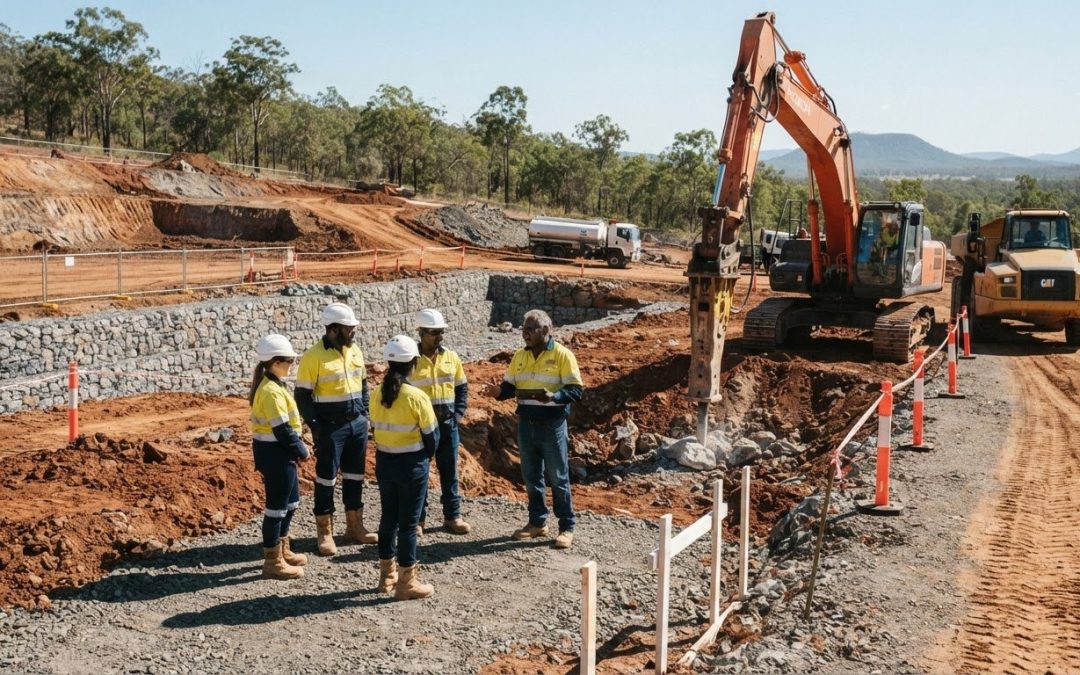
What if safety planning is judged by the documents produced rather than what happens when crews, machines and subcontractors meet on site? A folder can record hazards, but it can’t manage a changing work area by itself. For project teams comparing heavy earthworks contractors Australia wide, the difference is whether safety controls are put into practice throughout delivery.
A useful system does more than satisfy a paperwork requirement. On heavy earthworks projects, excavation conditions, moving plant and interfaces with civil, mining or rail activities make coordination and project-specific controls central to the work. This article explains how McMahons Civil and Contracting PTY LTD turns risk planning into site controls, assesses whether a system reflects the project, and prepares clear information for delivery. It also shows how risk identification, communication, coordination and review can follow the sequence of earthworks, so safety planning supports the work rather than sitting alongside it.
Key Takeaways
- Map safety planning to the scope, site conditions and work interfaces, then translate it into task-level controls crews can use.
- Assess how heavy earthworks contractors document responsibilities, communicate controls and review them as project conditions change.
- Compare practical evidence of assigned roles, current work information and review processes, rather than relying on claims about safety outcomes.
- Prepare for delivery by defining work boundaries, sharing relevant site information and agreeing how changes will be communicated.
- Understand how earthworks and rock-breaking work connect with civil, mining and rail projects, including McMahons’ work across these sectors.
Why heavy earthworks contractors need a practical safety management system
Ground conditions, equipment movements and work interfaces can change as an earthworks project progresses. An excavation may encounter different material than expected, plant routes may shift as work fronts move, and other activities may begin nearby. If safety planning stays fixed while site conditions change, controls can stop matching the work being done.
A safety management system connects the policies, responsibilities, controls and review processes used to manage work risks. Its value isn’t measured by the volume of documents it produces. It depends on whether people understand what applies to their task, know who is responsible and can respond when conditions or plans change.
What a safety management system does on an earthworks project
A working system sets consistent expectations across a project. It clarifies who plans and oversees work, how crews receive relevant information, how concerns are raised, and who reviews controls when a task or site condition changes. These arrangements help connect decisions across the project, rather than leaving each crew to interpret a broad policy on its own.
For example, a change in ground conditions could affect the excavation method, equipment positioning or work sequence. The system should prompt a review of the relevant hazards and controls, then ensure updated information reaches the people carrying out and coordinating the work. The detail needs to suit the task and site, not simply repeat generic wording.
A safety management system links hazard identification to practical controls, then checks whether those controls remain suitable as the work changes. This cycle supports risk management, but it can’t guarantee incident-free work.
Why project complexity makes coordination essential
Earthworks often sit within a wider project involving several work groups, contractors and operational requirements. Bulk site preparation may need to align with access routes, services, drainage, structures or other construction activities. On mining or rail projects, work may also interface with existing operations and project-specific arrangements. Understanding the broader scope helps teams see where activities meet. The structural earthworks and bulk site preparation reference provides further context on how this work fits into Australian projects.
Coordination depends on clear boundaries and communication. If one team assumes another is managing an exclusion area, plant movement or a change to the sequence, a control may fall between responsibilities. The system should make interfaces visible by identifying who coordinates overlapping activities, how changes are shared and how affected work groups receive current instructions.
When comparing heavy earthworks contractors, look beyond whether a safety manual exists. Consider whether responsibilities, communication pathways and review arrangements connect to the project’s actual work. This helps distinguish paperwork that records intentions from a system designed to guide decisions on site.
How an earthworks safety management system turns risk planning into site controls
A plan becomes useful on site when it shapes how work is prepared and carried out. For earthworks, that means connecting the project scope and available site information to the tasks crews perform, then checking that controls still fit as work progresses. A consistent process helps teams move from general planning to clear, practical instructions.
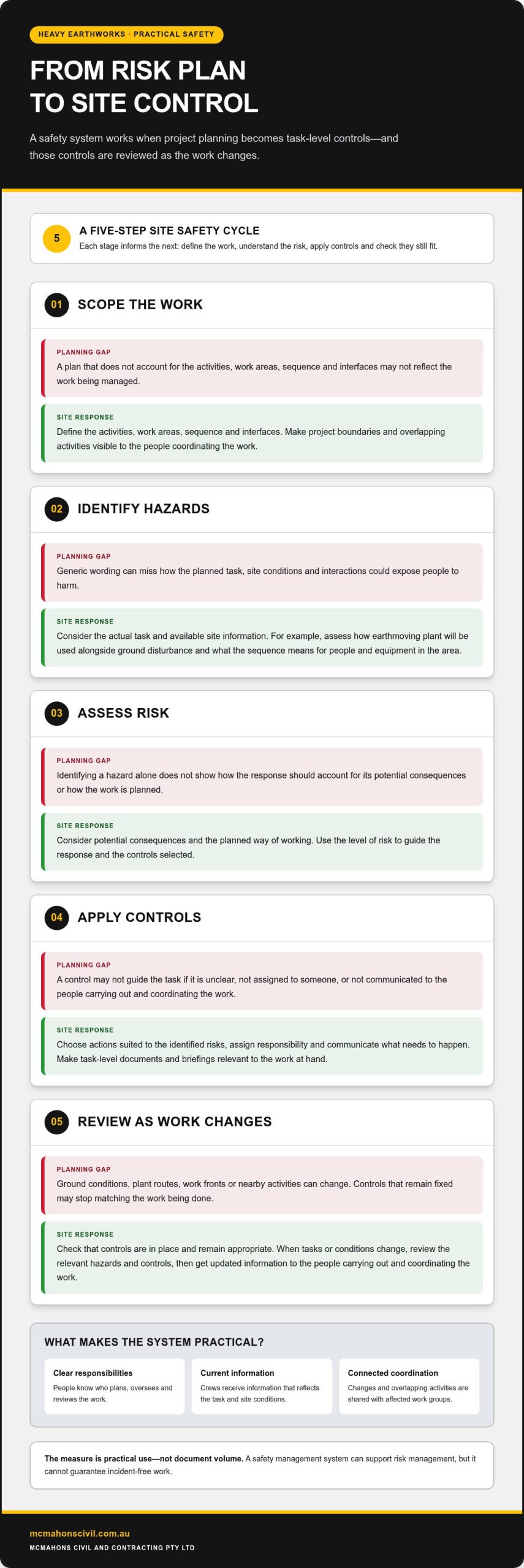
The sequence is straightforward, but each step needs to inform the next:
- Scope the work. Define the activities, work areas, sequence and interfaces to be managed.
- Identify hazards. Consider how the planned tasks, site conditions and interactions could expose people to harm.
- Assess risk. Consider potential consequences and how the work is planned, so the level of risk can guide the response.
- Apply controls. Select actions suited to the identified risks, assign responsibility and communicate what needs to happen.
- Review. Check that controls are in place and remain appropriate as the work or conditions change.
From project scope to task-level risk controls
Project planning provides the wider picture: what earthworks are required, how work is expected to proceed, and which site information and interfaces could shape delivery. That picture informs hazard identification. For instance, teams can consider how earthmoving plant will be used alongside ground disturbance, and what the sequence means for people and equipment in the area. These are prompts for project-specific assessment, not assumptions that every site presents the same hazards.
Task-level documents and briefings translate the plan into information crews can use for the work at hand. They should reflect relevant site conditions and the planned task, rather than repeat broad project statements. A control is an action that reduces people’s exposure to an identified risk. It needs to be clear enough to implement and assigned to someone who can help make it happen.
Responsibilities, communication and review
Controls need owners. Clear responsibilities help workers understand who puts each measure in place, who monitors it and who can respond if it isn’t working as intended. Before work starts, communication should cover the task, controls, interfaces and any changes from the current plan. Workers also need a clear way to raise concerns or report changed conditions, rather than relying on assumptions to pass information between crews.
Review the plan after a change that could affect the risk assessment, such as altered site conditions, a change in work sequence, an incident or a control failure. The team can reconsider the hazard, adjust the control and update the work information shared with affected people. This feedback loop keeps planning connected to what’s happening on site.
For project teams assessing heavy earthworks contractors Western Australia, a useful question is how the process connects planning, task information and site communication. McMahons delivers earthworks and civil work across civil, mining and rail projects. Explore its earthworks and civil project experience to consider how project scope and work interfaces shape delivery.
How to compare safety management systems for heavy earthworks projects
A useful comparison looks past polished statements and considers how a safety management system relates to the work being planned. For heavy earthworks, assess whether controls account for the project scope, equipment use, ground works, other activities on site and conditions that may change. The aim isn’t to predict outcomes from paperwork, but to understand how the system is intended to guide the work.
Compare how controls are applied, not merely documented. Useful evidence connects identified project risks with assigned responsibilities and the way relevant information is communicated and reviewed.
Evidence that shows how the system operates
Relevant examples may include risk registers, work procedures, induction material and records showing that work information has been reviewed. Their value depends on how closely they relate to the proposed earthworks scope and project interfaces. A generic document may describe an approach, but it won’t show by itself how that approach fits the work at hand.
| Area to compare | Practical evidence | What it helps establish |
|---|---|---|
| Documented controls | Risk registers and task procedures connected to the proposed activities | Whether controls address the work, rather than relying on broad statements |
| Assigned responsibilities | Defined roles for implementing, communicating and monitoring controls | Whether ownership is clear across crews and work interfaces |
| Communication | Induction and briefing material suited to workers and relevant activities | How project information is shared with people who need it |
| Review | Records showing relevant work information is revisited as circumstances change | Whether the approach allows controls to be checked and updated |
Read these examples together. A procedure may describe a control, while assigned roles and communication material indicate how it should reach the people doing the work. Review records can help show whether information is maintained as the project develops. No single document, or certification on its own, proves that controls are consistently implemented on site. The relationship between planning, responsibilities, communication and review gives the evidence meaning.
Comparing system coverage with project demands
Compare the system’s coverage with the activities and interfaces in the project scope. Consider how it addresses plant use, ground works and concurrent activities, and whether responsibilities are clear where work groups interact. If an activity or interface is missing from the planning information, it may be difficult to see how its risks will be managed or communicated.
Project demands differ, so make the comparison specific rather than counting documents. Look for work information that reflects the planned sequence and explains how relevant changes will be communicated and reviewed. For broader context on activities that may sit within infrastructure and mining projects, McMahons’ civil contracting services for Australian infrastructure and mining outline related project work.
For teams comparing heavy earthworks contractors Western Australia, this approach keeps the assessment grounded: examine what the system covers, who carries responsibility and how the controls connect to the proposed work. Don’t treat claims about performance as a substitute for practical evidence.
How project teams can prepare for safety management on earthworks
Good preparation gives the project team a shared picture of the work before activities begin, and a practical way to respond when that picture changes. Start with scope and interfaces, not a generic checklist. Identify the earthworks activities, planned sequence, adjacent work and known project constraints, then use that information to shape controls and communication arrangements.
Before work starts: align scope, interfaces and information
Define what the earthworks package includes and where it connects with other activities. Note relevant site information, planned plant movements, work areas, access arrangements and dependencies on other project parties. This helps the team consider how ground works will interact with the wider programme without assuming every site presents the same conditions.
Next, establish how information will reach the people who need it. Workers, supervisors and relevant project parties should understand how task instructions are shared, who coordinates an interface, and how to raise a concern or report a change. The project-specific control plan can then draw on the scope and site information, setting out responsibilities and controls that relate to the work rather than relying on generic wording.
For work connected with civil infrastructure or mining, the wider scope may include several activities that need to align. McMahons’ civil contracting services for Australian infrastructure and mining provide context for the types of project interfaces teams may need to plan around.
During delivery: monitor changes and close the loop
Plans need to stay current as delivery proceeds. A change to site conditions, work sequence, plant use or adjacent activity can affect the assumptions behind a control. Make the reporting pathway clear, assess which work and controls are affected, and communicate revised instructions to the people involved before relying on the updated approach.
Monitoring should check whether controls are being put into practice and remain suitable for the task. Record relevant review actions, including what changed, which work information was updated and how the change was communicated. This creates a practical record for coordination and helps prevent an adjustment reaching one crew but not another.
Legal requirements depend on the project and governing jurisdiction. Project teams should verify current applicable WHS requirements for the work and location rather than treating general planning guidance as legal advice or assuming one approach guarantees compliance. For teams assessing heavy earthworks contractors Western Australia, preparation means connecting project information, responsibilities and communication to the actual scope.
To discuss civil and earthworks capabilities in the context of your project, explore McMahons’ project services.
Working with McMahons on civil and heavy earthworks projects
Project requirements shape both the earthworks scope and the planning needed to deliver it. McMahons Civil and Contracting is an Australian civil, mining and rail contractor with more than 18 years of experience. Its work includes earthworks and rock breaking, supporting ground preparation and material-related work across civil and infrastructure projects.
For project teams considering heavy earthworks contractors Western Australia, it helps to discuss delivery requirements and project-specific safety planning together. The scope, site information, interfaces and sequence all affect how a project is coordinated. Planning should reflect the work at hand rather than assume one approach will suit every site.
Connecting earthworks capability with project requirements
McMahons works across civil, mining and rail infrastructure, with earthworks as part of its wider civil contracting capability. Rock breaking may be relevant where the scope involves breaking rock as part of earthworks. If the project also includes related rock placement, professional rock pitching for civil and mining infrastructure provides context for that part of the work. Each activity needs to be considered in relation to the overall scope and project interfaces.
This joined-up view helps teams describe not only the physical work, but also how it fits alongside other project activities. For example, planned earthworks and associated civil work may need to be sequenced around other contractors or operational requirements. Identifying those connections early gives the project discussion a clearer basis for considering coordination and delivery planning.
What to expect from a project-focused conversation
A useful starting point is a clear outline of the project scope, the earthworks activities involved and the relevant delivery interfaces. Include available site and project information, the intended sequence, and any constraints or dependencies that could affect coordination. This gives both parties a practical foundation for discussing the work and its requirements.
From there, project requirements can guide discussion about planning, sequencing and coordination. Safety considerations should be addressed in the context of the proposed work, without assuming a general description can replace project-specific assessment. The detail will depend on the activities and interfaces involved.
McMahons’ experience across civil, mining and rail work provides a grounded starting point for discussing earthworks as part of a broader infrastructure project. A clear scope keeps the discussion focused on the work to be delivered and how it connects with the rest of the project.
Discuss your civil project with McMahons and outline the earthworks scope and delivery interfaces you’re planning.
Set the groundwork for a well-planned project
Bring the project assumptions into one clear conversation. Before the work is scoped in detail, identify what is known, what still needs resolving and which interfaces could affect delivery. This gives the project team a practical basis for aligning earthworks planning with the wider programme, rather than leaving important questions until work is under way.
For teams considering heavy earthworks contractors Western Australia, a useful discussion starts with the project itself: its scope, intended sequence, site information and coordination needs. Sharing these details helps frame the work and the considerations that matter, without relying on generic assumptions.
McMahons Civil and Contracting works across civil, mining and rail infrastructure, with earthworks as part of its contracting work. If you’re preparing a project or refining its scope, take the next step and discuss your civil and earthworks project with McMahons. A clear starting point can help build a considered path from planning to delivery.
Frequently Asked Questions
What should a safety management system include for an earthworks project?
It should connect responsibilities, hazard identification, risk controls, communication and review to the work being planned. For example, a project involving staged excavation and fill placement may need work information that reflects the sequence, equipment activities and relevant site conditions at each stage. The exact documents and processes depend on the scope and project requirements. For heavy earthworks contractors Western Australia, a useful system guides decisions and actions on site rather than sitting apart as paperwork.
Is a safety management system the same as a Safe Work Method Statement?
No. A safety management system is the broader framework for managing responsibilities, planning, risk controls and review across work. A Safe Work Method Statement (SWMS) is a task-related document required in particular circumstances under applicable requirements. They can support one another, but a SWMS doesn’t replace the wider management framework, or vice versa. For a specific project, check the current requirements that apply to the work and governing jurisdiction.
How often should an earthworks safety management system be reviewed?
Review it when a relevant change or event could affect the work or its controls, rather than relying on an arbitrary interval for every project. A changed sequence or site condition, for example, may make existing task information outdated. An incident or control failure can also indicate that a review is needed. Record relevant changes and actions, then communicate updated controls to affected people before the changed work proceeds.
Can a contractor safety management system cover subcontractors?
Project arrangements can set out how contractors and subcontractors share relevant site information, understand their roles and coordinate work where activities overlap. For example, a change affecting access or the work sequence may need to reach each group whose tasks are affected. The arrangements should suit the project structure and applicable obligations. Coordination doesn’t remove each party’s own responsibilities, which need to be understood in the context of the project.
What evidence helps assess whether a contractor safety system is practical?
Look for work-related examples, such as procedures or risk information that reflect the proposed activities, along with communication arrangements and records of review. Consider an interface, such as earthworks occurring alongside another contractor’s activities. The evidence should help explain how relevant responsibilities and information are managed. Documents can indicate how a system is designed, but don’t show by themselves how it operates. Assess the explanation of implementation without treating performance claims as proof.
Does ISO 45001 certification prove a contractor has safe worksites?
No. Certification against ISO 45001 can indicate that an occupational health and safety management system has been assessed against the standard, but it doesn’t guarantee every task is risk-free or that every control will work in every situation. Project teams should also consider how the proposed work is planned, how controls are put into practice and how changes are reviewed. Any claim about a contractor’s certification or its current status should be independently verified.