
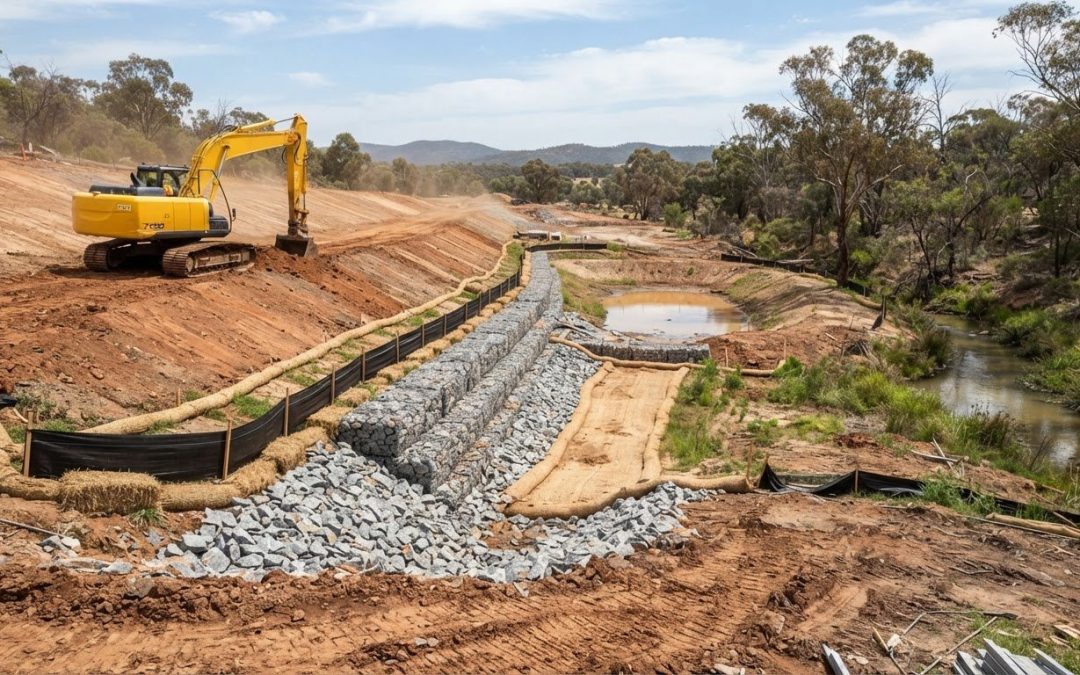
Erosion controls work best when they shape the earthworks sequence, not when they’re added as a last-minute compliance measure. Effective civil earthworks erosion control starts with the site’s soil, slopes, drainage paths and exposure to weather, then keeps pace as work areas change.
Choosing suitable measures means weighing construction activity, environmental requirements and the risk of sediment reaching waterways or neighbouring land. A control that works in one stage may need adjusting as ground is cleared, cut or filled.
This guide explains how erosion and sediment management fits into civil earthworks and how to compare controls against site risks and project stages. It covers practical planning, installation, inspection, maintenance and record-keeping, so environmental measures can be coordinated with work on the ground. The aim is to help protect surrounding land and waterways while supporting project delivery.
Key Takeaways
- Plan civil earthworks erosion control around site conditions and the sequence of ground disturbance, rather than treating it as a final compliance step.
- Match controls to the risk: preventing soil movement, directing runoff and capturing sediment address different parts of the problem.
- Check applicable approvals, permits, contract documents and site requirements, as environmental obligations can vary between projects and jurisdictions.
- Build installation, inspections, maintenance and record-keeping into the work programme, and review controls when weather or construction stages change.
- Consider rock pitching, gabion baskets or reno mattresses where they suit the project scope. McMahons Civil and Contracting PTY LTD delivers civil and earthworks projects with related infrastructure solutions.
Why civil earthworks erosion control matters before ground is disturbed
Planning controls before work starts gives the project team time to consider how soil may move as the site changes. Clearing, excavation and filling can expose soil that was previously protected by vegetation or stable ground cover. Once exposed, it can be loosened by rain or carried by flowing water towards drains, waterways or adjoining land.
In plain terms, erosion and sediment control means keeping soil in place where possible and managing the muddy water that could carry it away. Erosion prevention reduces the amount of soil that becomes detached or mobile; sediment capture aims to intercept soil already moving in runoff. Because prevention can’t remove every risk, and capture measures don’t stop soil being disturbed, projects may need both. The broad distinction is also explained in Erosion control.
How earthworks can change runoff and sediment movement
Earthworks alter the ground surface and can change where rainwater flows. Clearing removes cover, excavation exposes and loosens soil, while stockpiles create concentrated areas of bare material. Temporary access routes can also become runoff channels, particularly where vehicle movement compacts the surface or tracks soil towards site exits.
The pattern depends on the site. Rain landing on a slope may flow downhill and gather speed, while water moving across flatter ground may collect in low points or follow existing drainage paths. A new cut, fill area or temporary bund can redirect that flow. Staged disturbance matters too: one work area may be stabilised as another is opened, so likely pathways and exposed surfaces can shift during delivery. Assess the risk against site topography, soil, drainage and the planned sequence rather than assuming a general rating will apply.
Why prevention is more than a compliance document
Unmanaged sediment can clog or reduce the performance of drainage assets, settle in waterways and spread onto adjoining land. It can also cause practical problems within the work area, such as muddy access or sediment building up where runoff needs to pass. These effects are easier to manage when the team considers them before disturbance begins, rather than relying on a response after soil has moved beyond the intended work area.
A plan is a useful reference, but it doesn’t install, inspect or maintain controls by itself, and one measure won’t suit every flow path or construction stage. Coordinate the measures with clearing, excavation, stockpiling, access and stabilisation, then keep responsibilities clear as work areas change. The team should know who checks the controls, who acts when a problem is found, and how changes to the sequence affect runoff management. This connects environmental requirements to daily construction decisions and helps keep controls relevant as the ground is reshaped.
How environmental requirements shape erosion control for civil earthworks
There isn’t one national checklist that applies unchanged to every Australian earthworks project. Requirements can depend on the state or territory, approvals and permit conditions, contract documents, site characteristics and the work being undertaken. A project may also have commitments specific to its environmental management plan or other approved documents. Before disturbance begins, distinguish project commitments from legal duties and identify which requirements apply to the work.
Check applicable environmental controls against current approvals and project documents before earthworks start. This keeps planning tied to the actual site and its requirements, rather than relying on a generic plan. For an Australian overview of construction-site practices and the importance of managing sediment, see Best practice erosion and sediment control in Australia.
What project teams should review before earthworks begin
Bring the relevant documents together, then check what they require for the proposed work stages. Review approval conditions, permits, environmental management plans, contract requirements and relevant regulator guidance. Verify legal references and guidance against current, project-specific information, as requirements can change and differ across jurisdictions.
- Map waterways, drainage infrastructure, adjoining land and other sensitive areas that could be affected by runoff or sediment.
- Identify planned disturbance areas, access routes, stockpile locations and drainage paths, including how these may change as work progresses.
- Assign responsibility for installing, inspecting and maintaining controls, and for keeping the required records.
Clear responsibility matters. If an inspection identifies a damaged control or a change in runoff, the team should know who will assess the issue, organise corrective action and record what was done. Responsibilities may be shared across project roles, so set them out in a way that reflects the contract and applicable requirements.
Turning requirements into clear site actions
Documents become useful on site when their requirements are translated into practical instructions. Show controls and sensitive areas on site plans, align them with the earthworks sequence, and brief crews on the measures relevant to their work area. A control shown on a plan may need to move or be adjusted as access, drainage or the extent of disturbance changes.
- Link each relevant condition or commitment to a site location, work stage or control measure.
- Set an inspection and record-keeping process, including who documents observations and corrective actions.
- Review the arrangements when the work sequence, site conditions or applicable requirements change, and brief affected personnel.
Civil earthworks erosion control requires coordination between environmental requirements and construction activity. McMahons Civil and Contracting PTY LTD delivers civil and earthworks projects, with associated infrastructure works planned around project scope and site requirements. Learn more about civil and earthworks delivery.
Comparing erosion and sediment controls for different earthworks risks
Start control selection with the risk to be managed. Some measures limit soil exposure or disturbance; others direct runoff, capture sediment or stabilise vulnerable surfaces. On many sites, these functions need to work together, and the right combination can change as earthworks progress.
Choose controls to suit site conditions, work stages and the maintenance the project can reliably carry out.
Preventing soil disturbance and managing runoff
Where project conditions allow, staged clearing and limiting the area of exposed soil can reduce how much ground is vulnerable at once. Stabilised access can help manage soil tracked by vehicles. Diversion measures may direct clean water away from disturbed areas, reducing the volume of runoff that could pick up sediment. Assess their alignment, capacity and discharge points for the site, including how redirected water may affect land or drainage downstream.
Source controls and diversion don’t remove the need to manage water leaving active work areas. They are part of a considered system, not a substitute for assessing where runoff will go and what it may carry.
Capturing sediment and stabilising vulnerable areas
Sediment barriers are intended to slow or intercept sediment-laden runoff in suitable locations; sediment basins provide a place for sediment to settle from collected water. Stabilisation measures, such as covering or establishing ground cover on exposed areas, aim to reduce soil movement at its source. Each has limits: barriers can be undermined or overwhelmed, basins need room and upkeep, and stabilisation may need to be staged around construction access and timing.
Rock pitching, gabion baskets and reno mattresses may form part of a broader civil solution where the project design and site conditions call for them. They aren’t automatic erosion-control choices. Their role depends on factors such as ground conditions, water flow and hydraulic design, as well as how they connect with drainage and surrounding works.
| Control approach | Purpose and suitable context | Limitations | Typical maintenance considerations |
|---|---|---|---|
| Source control | Reduce exposed or disturbed soil through staged work, surface cover or stabilised access. | May not be practical across all active work areas or stages. | Check that covers, access surfaces and stabilised areas remain effective as work advances. |
| Runoff diversion | Separate clean water from disturbed areas where site layout and design allow. | Requires suitable routing and discharge points; poor placement can shift impacts elsewhere. | Inspect flow paths and check for blockages, scour or changes caused by site activity. |
| Sediment capture | Intercept or settle sediment in runoff before it moves beyond the intended area. | Performance depends on location, flow conditions and available capacity. | Remove accumulated sediment as needed and repair damaged or bypassed controls. |
| Surface stabilisation | Protect vulnerable soil where disturbance is complete or temporarily paused. | May need to be coordinated with access, further earthworks and project design. | Check for bare patches, movement or damage and restore protection where required. |
For civil earthworks erosion control, the useful comparison is not simply which measure is strongest. Consider whether it addresses the site’s specific pathway for soil and water movement and can be maintained through the relevant work stage.
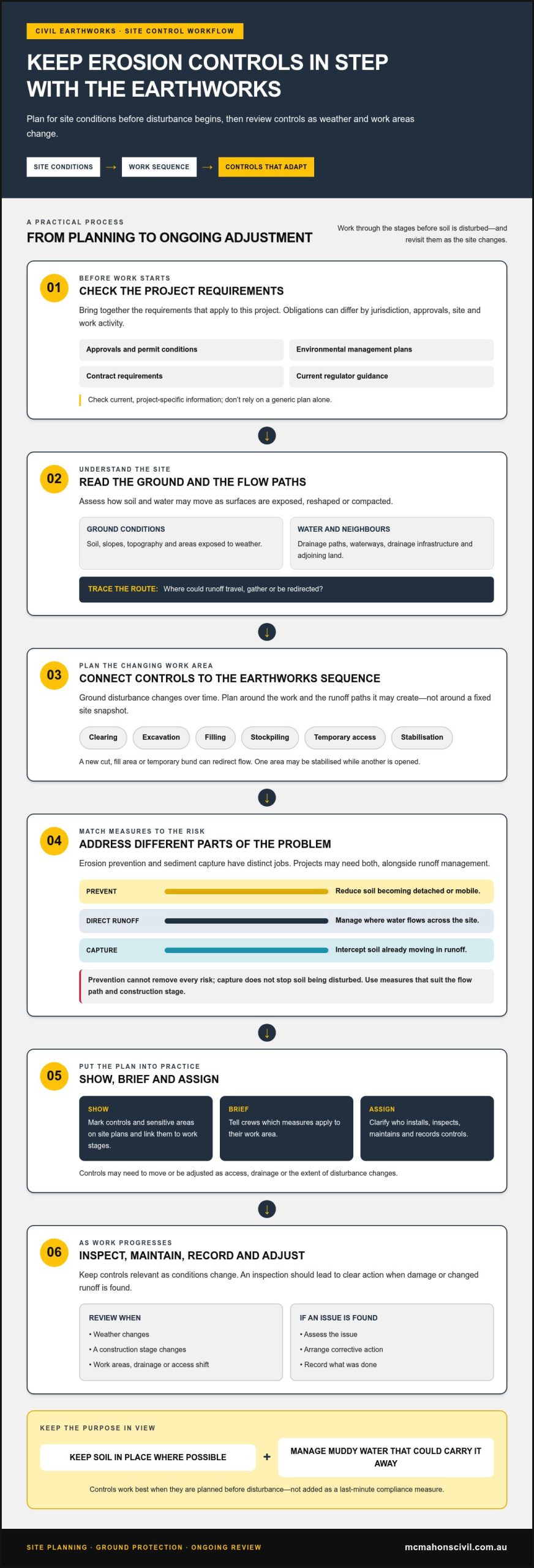
A practical workflow for implementing and maintaining site controls
Controls need to keep pace with the work. A clear sequence helps the team prepare before disturbance, respond as work fronts move and leave the site in an appropriate condition at close-out. It also turns project requirements into tasks that can be assigned, checked and recorded.
Before and during earthworks
Before work starts, bring site requirements, control locations, drainage paths, access routes and responsibilities together. Check these against the planned earthworks sequence, then brief the people carrying out the work. Install relevant controls before clearing, excavation, stockpiling or access activities create the risk they’re intended to manage.
- Prepare the work area. Confirm control locations against current site conditions, mark sensitive areas and establish agreed access routes before ground disturbance.
- Coordinate installation and staging. Put controls in place ahead of activities that could generate runoff or sediment. If the work front shifts, review whether the existing arrangement still suits the new layout.
- Inspect as conditions change. Include checks after relevant weather changes, when construction stages or drainage conditions change, and whenever crews observe damage, bypassing or other control failure.
Inspection timing should reflect project requirements and site conditions. A change in the work sequence can alter flow paths or expose a new area, even if no defect has been reported. Connect inspections to changing work fronts, and make it clear who is responsible for raising and responding to observations. As bulk preparation progresses, the sequencing principles in Structural Earthworks and Bulk Site Preparation: The Complete Australian Reference can also help frame how ground preparation and control tasks fit together.
Maintenance, corrective action and close-out
A control that’s damaged, bypassed or holding accumulated sediment may no longer perform as intended. Record the location and observed issue, the action required, the person responsible and the follow-up check. After repairs or sediment removal, inspect the area again to verify the action addressed the problem, rather than treating the work order as proof of completion.
- Note the inspection date, site area, control condition and any changes in runoff or exposed ground.
- Document defects, agreed corrective actions, the responsible person and when follow-up will occur.
- Record the follow-up result, including whether further work or escalation is needed.
Progressive stabilisation helps bring completed or temporarily inactive areas into a more stable condition while other work continues. At close-out, review remaining exposed areas and confirm the conditions for removing temporary controls against project requirements. Don’t remove a measure simply because the main earthworks have finished; check whether it’s still needed to protect the site during remaining activities or stabilisation.
McMahons Civil and Contracting PTY LTD delivers civil and earthworks projects alongside related infrastructure works. Details about civil earthworks delivery provide further context for coordinating ground preparation with project requirements.
How McMahons Civil and Contracting PTY LTD supports earthworks delivery
Effective civil earthworks erosion control depends on how environmental measures fit with the work being delivered. Ground preparation, access, drainage and associated civil works can affect the same areas, so planning them together helps project teams consider interfaces and sequence tasks with fewer surprises on site.
McMahons Civil and Contracting PTY LTD delivers civil and mining earthworks and related infrastructure works. Project requirements guide the approach: the right method depends on the design, site conditions, construction stages and applicable environmental documentation.
Coordinating earthworks with associated civil solutions
Considering earthworks alongside related civil works can help clarify where ground is disturbed, how access is maintained and how adjacent work areas are sequenced. Depending on the project scope, this may involve earthworks alongside rock pitching, gabion baskets, reno mattresses or concrete works. These are project-specific civil solutions, not automatic substitutes for erosion and sediment planning. Their role needs to align with the design and the conditions at the work location.
For example, a project may include a designed structure or surface treatment near a drainage feature, while other areas still need separate controls during excavation and reinstatement. The work package should account for those interfaces, including access for construction and the sequence for completing and stabilising disturbed ground. Teams considering gabion structures can also refer to The Comprehensive Guide to Gabion Baskets in Australian Civil Infrastructure for further context on their civil applications.
For a broader view of how earthworks fit within infrastructure and mining delivery, Comprehensive Civil Contracting Services for Australian Infrastructure and Mining is a useful related resource. The central consideration remains the same: coordinate the construction scope with site-specific controls, rather than assuming one civil measure will address every erosion or sediment risk.
Moving from project requirements to a delivery discussion
A project evaluation is more productive when the scope and site context are clear. Project teams can outline the work areas, proposed staging, access needs and related civil components, along with relevant environmental plans, approval conditions or contract documents. This gives the delivery discussion a practical basis and helps identify where coordination between earthworks and associated works needs attention.
Useful information to have on hand includes:
- The intended earthworks scope and the current or proposed construction sequence.
- Site plans showing drainage routes, sensitive areas, access and planned disturbance.
- Relevant project documents and the environmental requirements that shape delivery.
McMahons Civil and Contracting PTY LTD brings civil, mining and rail infrastructure capabilities to project planning. For a project discussion, share the scope, site context and relevant project documentation to establish a practical basis for considering delivery requirements.
Set your project up for a considered start
Bring the site picture and intended work sequence into the same conversation. That gives the project team a practical starting point for considering how civil earthworks erosion control can fit the scope, rather than treating it as a separate task once work is under way.
For an initial project discussion, have the scope, site plans, proposed staging and relevant environmental documents ready. These details keep the conversation grounded in the actual work and its constraints. McMahons Civil and Contracting delivers civil earthworks and infrastructure works, including rock pitching, gabion baskets and reno mattresses, as part of project-specific scopes.
Start a project discussion with McMahons Civil and Contracting to discuss your earthworks and infrastructure requirements.
Frequently Asked Questions
What is erosion and sediment control in civil construction?
It combines measures that limit soil movement with measures that manage sediment once it enters runoff. For example, reducing exposed soil addresses erosion at its source, while capturing sediment in runoff tackles material already moving across the site. Civil earthworks erosion control may use both, depending on ground conditions and work stages. Check current approvals, contract documents and regulator guidance to understand the requirements for a particular project.
Is an erosion and sediment control plan required for every earthworks project?
No single requirement applies to every Australian earthworks project. Whether a specific plan is needed depends on the jurisdiction, approvals, project scope and site conditions. Before mobilisation, review the documents governing the work and identify how controls will be shown to crews. Even without a requirement for a separate plan, a clear site record of control locations, inspection responsibility and agreed actions can help prevent uncertainty once several work fronts are active.
Can rock pitching prevent erosion on every civil earthworks site?
No. Rock pitching can be considered for suitable project applications, but it isn’t a universal treatment for every slope, channel or water flow. Its suitability depends on the design intent, ground conditions and how water behaves at the location. For instance, a detail designed for one flow path may not address runoff arriving from another direction. Consider the treatment alongside the wider drainage and stabilisation design, not as a stand-alone guarantee against erosion.
How often should erosion controls be inspected on a construction site?
Follow the inspection frequency set by project requirements and control design, and reassess after relevant changes. A new excavation, altered drainage route or heavy rainfall may change what needs attention. Site personnel should also raise visible damage, sediment bypassing a barrier or water ponding where it wasn’t expected. Keep a dated record of observations and maintenance, then check that repairs have worked. The inspection process should reflect actual site activity, not just a fixed calendar.
What happens if sediment controls fail during earthworks?
Act in line with the project’s environmental procedures and applicable requirements. First, assess what has failed and where sediment or runoff may have travelled. The responsible site personnel can arrange practical containment or repairs, notify relevant project roles and record the response. Then consider why the failure occurred: the control may need maintenance, a different position or a review against changed site conditions. Check project-specific notification or reporting obligations rather than assuming one rule applies everywhere.
Who is responsible for maintaining erosion controls on a civil construction project?
Responsibility should be allocated in project documents and site procedures, with clear handovers between the people doing the work. For example, a subcontractor may notice damage while working nearby, while a designated site role coordinates repair and records the outcome. The exact allocation depends on contract arrangements and project governance. Clear briefings help each crew understand how to report a defect, who acts on it and how to confirm the issue has been resolved.
When can temporary erosion controls be removed from a project site?
Remove temporary controls only when project requirements allow and the relevant area is stable enough for the conditions that remain. Check for unfinished work, exposed soil and drainage changes that could make the control necessary again. For example, completing earthworks in one area doesn’t necessarily mean adjacent works or runoff pathways are settled. Record the decision and removal where required, and retain controls wherever the project documents or site conditions indicate they’re still needed.