
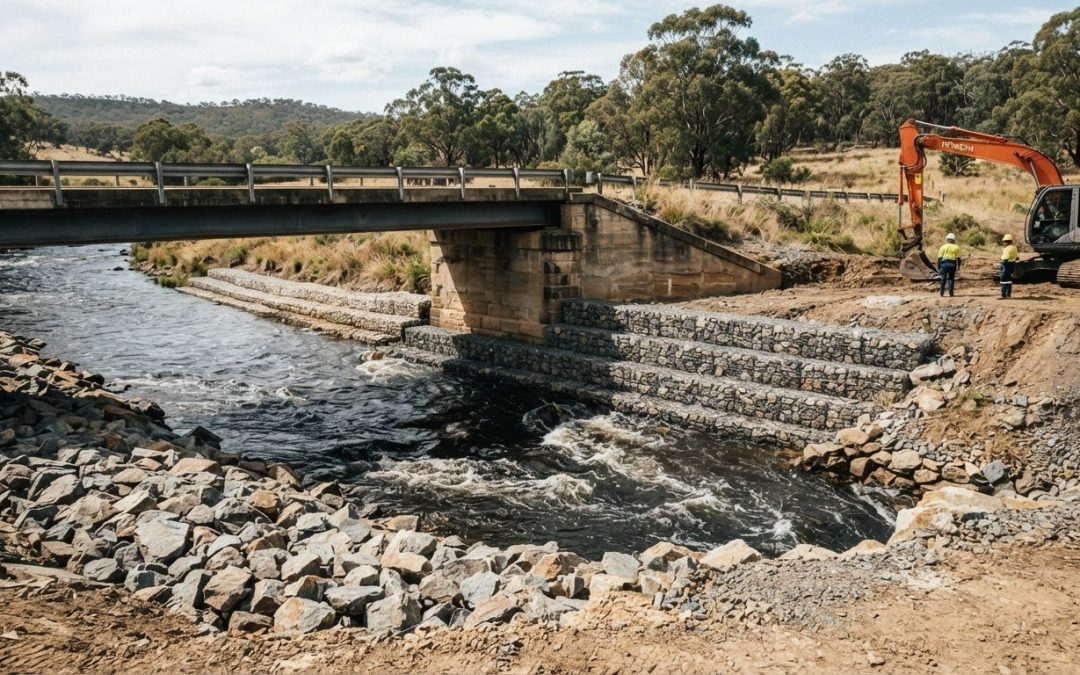
The most substantial-looking protection isn’t always the right choice for a bridge abutment. Scour protection for bridge abutments needs to account for how water moves around the structure, the sediment it carries, and the condition of the ground and foundation. A treatment suited to one site may be poorly matched to another.
It’s understandable to find the options difficult to compare. Rock pitching, gabion baskets and Reno mattresses can each form part of an engineered response, but the right approach depends on site conditions, design requirements and how the work can be built and maintained. This guide explains how long-term channel degradation, contraction scour and local scour threaten abutments, then compares practical protection methods in the context of flow, channel geometry, soil and foundation conditions. It also covers how site preparation and construction planning contribute to a durable outcome. The aim is to help you assess the trade-offs and understand why an effective solution starts with the conditions at the bridge, not a one-size-fits-all material.
Key Takeaways
- Distinguish local abutment scour from contraction scour and wider channel degradation to clarify the risk being addressed.
- Effective scour protection for bridge abutments depends on hydraulic behaviour, ground conditions and bridge geometry, not material choice alone.
- Compare rock pitching, gabion baskets and Reno mattresses by their design fit, constructability and maintenance needs.
- Plan site preparation, access, water management and material handling alongside engineering design to support practical installation.
- Rock pitching isn’t automatically the right answer. Weigh the protection approach against the asset’s design life and future maintenance access.
What causes scour at bridge abutments, and why does protection matter?
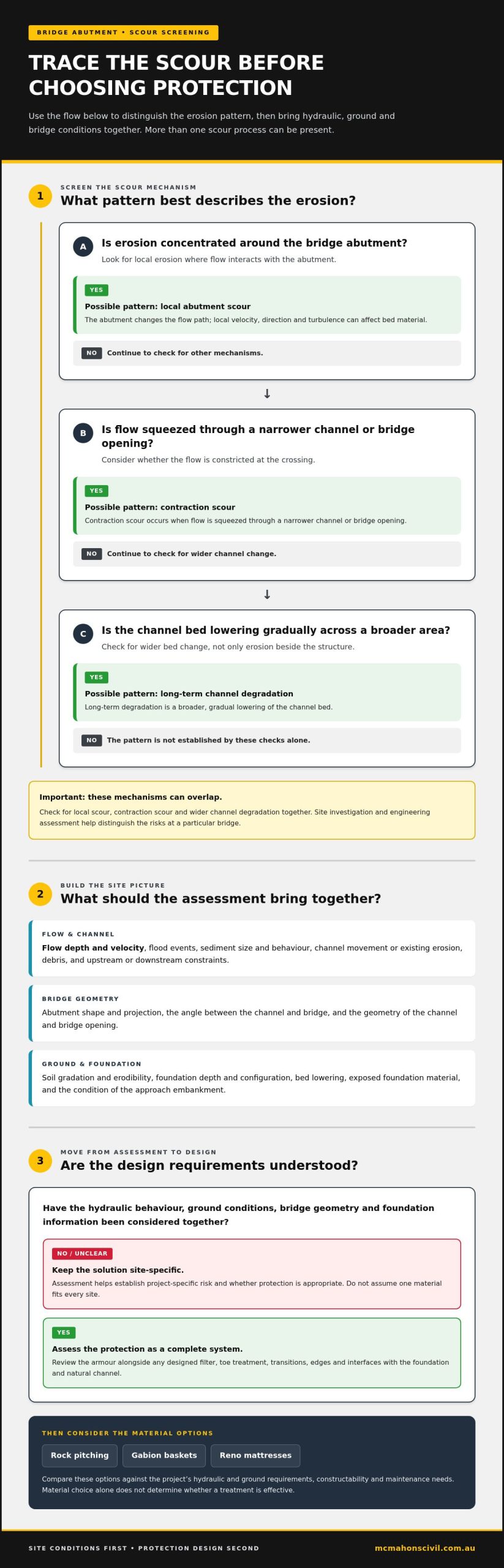
Water flowing past a bridge can erode the bed and banks, while the abutment and adjacent approach embankment change the flow path. Abutment scour is local erosion of bed material caused by flow interacting with a bridge abutment. It’s one of three related mechanisms: local scour forms around a structure; contraction scour occurs when flow is squeezed through a narrower channel or bridge opening; and long-term degradation is a broader, gradual lowering of the channel bed. These processes can overlap. The overview of What is bridge scour outlines these mechanisms and their relationship to bridge structures.
If erosion lowers the bed beside an abutment, foundation material may become exposed and support conditions can change. Erosion may also undermine the approach embankment, affect bridge access and add to the demands on the asset. Scour protection for bridge abutments is therefore a site-specific engineering response, not simply a layer of material placed near the waterline. Understanding the flow and ground conditions is central to identifying the risk.
How bridge abutment geometry changes local flow
An abutment and its adjoining embankment occupy part of the channel, redirecting water around the bridge opening. Depending on flow conditions, this can alter local velocity and direction, creating turbulence or swirling flow near the structure that may dislodge bed material. The effect varies with abutment shape and projection, the angle between the channel and bridge, and the channel’s geometry. Hydraulic assessment helps determine how these features interact at a particular site.
What site conditions can increase scour exposure?
Scour exposure depends on the flow and the material it can move. Assessment considers flow depth and velocity, flood events, sediment size and behaviour, and whether the channel is shifting or already eroding. Existing evidence of bed lowering or foundation exposure can add to the picture. Upstream and downstream constraints may also influence how water passes through the bridge opening.
These factors shouldn’t be considered in isolation. Site investigation and engineering assessment bring together channel conditions, bridge geometry and foundation information to establish project-specific risk. This helps distinguish a local problem at the abutment from wider bed change or flow constriction, providing a sound basis for deciding what protection, if any, is appropriate.
How hydraulic and ground conditions shape scour protection design
A reliable design starts with the site, not a preferred material. Scour protection for bridge abutments must respond to expected water movement and the ground it acts on, while fitting the bridge geometry and foundation. A treatment can be well constructed yet perform poorly if its design doesn’t account for concentrated flow, erodible soil or how the protection meets the existing bed and banks.
Hydraulic assessment: flow paths, floods and channel behaviour
Hydraulic assessment considers the flows the bridge is expected to experience, how velocity is distributed through and around the opening, and how floodwater may change direction or concentrate near an abutment. Debris can affect flow paths, while channel instability may shift the areas exposed to erosion. These influences vary by site, so design relies on assessment rather than assuming past flow patterns will remain unchanged.
A sound assessment brings together hydrology, hydraulics, geotechnical conditions, channel geometry and foundation information. These inputs help the engineering team determine how proposed protection should fit the bridge and surrounding ground. Design decisions should also reflect the Australian requirements and project documentation applicable to the asset.
Geotechnical conditions, filters and foundation interfaces
Ground investigation helps establish soil gradation, erodibility, and the depth and configuration of the foundation. These details influence how the protection is designed and how it must connect to the abutment and surrounding ground. Loose or readily eroded material, for example, can make the interface and edges especially important to review.
Protection is a system, not just an armour layer. Depending on the design, a filter layer beneath or behind the armour may help retain the underlying soil while allowing water to pass. The filter must be compatible with the base material. Transitions and edges also need attention so flow doesn’t remove material from underneath or around the treatment. Filter type, placement and extent are project-specific, not universal rules.
Settlement, undermining and erosion at the protection’s edges are key engineering considerations. They affect how the treatment meets the foundation and natural channel, and whether movement in the bed could compromise its continuity. Material selection comes after these design inputs. Rock pitching, gabions or Reno mattresses can only be assessed properly once the hydraulic and ground requirements are understood.
Construction planning translates the design into site preparation, material handling and installation. McMahons’ rock pitching and civil works capabilities support the practical delivery of project-designed treatments.
Rock pitching, gabions or Reno mattresses: comparing abutment protection
Each option has a different form, but material choice alone won’t make a treatment effective. The hydraulic design also needs to specify the filter, toe treatment and transitions to the abutment and channel. The Federal Highway Administration’s Evaluating Scour at Bridges provides broader guidance on scour assessment, which underpins the selection and design of protection measures.
| Option | Typical application and design dependencies | Constructability and maintenance considerations |
|---|---|---|
| Rock pitching | Placed rock armour where the design allows suitable rock placement. Grading, layer arrangement, filter, toe and edge details depend on site conditions and engineering design. | Requires suitable access and careful placement to the specified profile. Inspection should consider displaced rock, exposed filter and changes at edges or the toe. |
| Gabion baskets | Stone held within wire baskets, used where the design specifies a confined protection form. Basket layout, foundation preparation and connections need to suit the abutment and ground. | Assembly, filling and secure placement affect installation. Maintenance planning should account for visible basket condition and any movement or damage. |
| Reno mattresses | Low-profile, stone-filled wire units that may suit designs requiring a continuous mattress-like layer. Foundation preparation, transitions and extent are project-specific. | Handling and placement depend on site access and the prepared surface. Check for settlement, edge disturbance and signs of lost stone as part of asset maintenance. |
When rock pitching may suit an abutment protection design
Rock pitching can be considered where the design supports an armour layer that follows the abutment and channel profile. The specified rock grading, underlying filter, toe arrangement and edge detailing all influence how the treatment is built and integrated. McMahons delivers rock pitching for civil infrastructure, with installation coordinated to the project design. Explore professional rock pitching for civil infrastructure.
How gabions and Reno mattresses differ from rock pitching
Unlike loose-placed rock, gabions confine stone in baskets, while Reno mattresses provide a flatter, mattress-like arrangement. Confinement, flexibility, foundation preparation and access for handling are useful comparison points, but they don’t establish a universal preference. Either system still relies on suitable interfaces and project-specific design. For further context on their civil applications, see the gabion basket and Reno mattress guide.
The appropriate choice is the one that meets the assessed hydraulic and ground requirements and can be constructed and maintained as designed. Rock pitching isn’t suitable for every abutment, and baskets or mattresses aren’t substitutes for sound filter, toe and transition detailing.
Planning scour protection works: from assessment to construction
A sound construction plan turns the engineered design into a clear sequence of site activities. For scour protection for bridge abutments, access, water management and material placement need to be considered alongside the treatment itself. Planning these details early helps align site preparation and installation with the design, bridge operations and project controls.
What to establish before works begin
Bring the available bridge drawings, foundation information, hydraulic assessment and geotechnical records together before setting out the work. These documents help the delivery team understand the protection limits, interfaces and requirements in the design, and identify where site conditions need careful coordination.
Next, consider how the work can be carried out safely and in sequence. Access for plant and materials may be constrained by the bridge, channel or surrounding ground. Staging may need to account for live traffic interfaces, environmental sensitivities and the way water is managed during construction. The construction methodology should align with the approved engineering design and project controls, rather than relying on assumptions made once work is under way.
Earthworks and site preparation can form an important part of this planning. For related context on ground preparation and bulk earthworks, see the structural earthworks and site preparation reference.
How installation quality supports protection performance
Installation should follow the design sequence and specified details. This may involve preparing the foundation surface, placing the designed filter, installing the protection material and forming the required transitions at the abutment, toe and edges. The exact method and order depend on the selected treatment and project drawings.
During the works, checks can record whether the prepared surface, filter and placed materials match project specifications, and whether interfaces are being completed as detailed. If site conditions differ from the design assumptions, raise the issue through the project’s established engineering and control processes before proceeding on a changed basis.
- Coordinate access: plan routes and working areas for plant, crews and materials around bridge and site constraints.
- Manage water and staging: sequence activities to suit the project’s water-management approach and construction controls.
- Track materials and placement: keep relevant inspection and delivery records alongside the work sequence.
- Document completed details: record interfaces and any approved changes to support traceability and future asset management.
McMahons’ earthworks and civil construction capabilities support practical site preparation and installation coordinated with engineering design. Discuss civil works for bridge scour protection.
Selecting and maintaining a scour protection solution for the asset
A suitable treatment needs to fit both the conditions at the abutment and how the bridge will be managed over time. Compare hydraulic fit, ground and foundation interfaces, filter requirements, design life, construction access, and the practicality of future inspection and repair. Rock pitching is not automatically appropriate for every abutment. The choice should follow the project’s engineering design and asset requirements.
A project-team checklist for comparing options
Use a consistent set of questions to compare proposed treatments and record the basis for the decision:
- Does the option suit the assessed flow conditions and channel behaviour?
- How does it connect to the foundation, abutment and surrounding ground, and what filter or transition details are required?
- Can it be installed with the available site access, plant and material-handling arrangements?
- Can the asset owner inspect it and access it for maintenance or repair?
- Are design assumptions, responsibilities and project-specific acceptance requirements clearly documented?
This keeps material selection in context. A treatment that suits the hydraulic design may still present construction or maintenance challenges if access is restricted or key interfaces are difficult to inspect.
What to monitor after construction and significant flows
Post-construction and post-flood inspections can help identify changes before they’re overlooked. Look for displaced or missing protection, exposed filters, settlement and erosion at the treatment’s boundaries, including the toe and connections to the abutment. These observations don’t, on their own, determine the cause or required response, but they provide useful evidence of how the treatment is performing.
Set inspection timing through the project inspection plan and relevant asset-owner requirements. Record the location and nature of any observed change, and escalate concerns for appropriate engineering assessment. Consistent records can support maintenance decisions and help the asset team compare conditions over time.
Civil delivery capabilities for scour protection works
McMahons Civil and Contracting delivers rock pitching, earthworks, gabion baskets and Reno mattresses for civil infrastructure works. These capabilities support site preparation and construction of project-designed scour treatments, coordinated with engineering requirements and site constraints. The right scope depends on the asset’s design and delivery needs.
For project teams planning scour protection for bridge abutments, bring the design information, site constraints and intended construction sequence together. Discuss civil and infrastructure contracting requirements with McMahons.
Build a scour response around your bridge’s conditions
Durable scour protection for bridge abutments starts with understanding the site. Flow behaviour, channel and foundation conditions, and the treatment’s interfaces all shape the design. Rock pitching, gabions and Reno mattresses each have a place, but none is a universal solution. The right option must also be practical to construct, inspect and maintain.
Planning matters as much as material selection. Coordinating the engineering design with site preparation, access, installation sequence and inspection records helps project teams deliver work that fits the asset and its conditions.
McMahons Civil and Contracting brings rock pitching, earthworks, gabion and Reno mattress capabilities to civil infrastructure projects. These construction capabilities can be coordinated with project design and site requirements.
Have a bridge project to plan? Discuss your civil infrastructure project with McMahons Civil and Contracting. A considered, project-specific approach is a practical step towards protecting the asset over time.
Frequently Asked Questions
What is scour protection for bridge abutments?
Scour protection for bridge abutments is a project-designed treatment intended to reduce erosion risk around the structure and its foundation. Depending on hydraulic and ground conditions, it may use rock pitching, gabion baskets or Reno mattresses. Performance depends on more than the surface material: the design must also address filter layers, foundation interfaces, toe protection and transitions to surrounding ground. No single option suits every bridge.
What causes scour around a bridge abutment?
Scour around an abutment occurs when water flowing past the structure changes direction or accelerates, creating local turbulence that can remove bed material. This differs from contraction scour, which relates to flow through a narrowed bridge opening, and wider channel degradation, which lowers the bed across a broader area over time. Flow, sediment, channel movement, abutment geometry and foundation conditions all contribute to site-specific risk, so assessment should consider the whole bridge setting.
Is rock pitching suitable for every bridge abutment?
No. Rock pitching may suit an abutment where the design confirms that the rock, placement and protection details match the assessed conditions. The design needs to account for hydraulic forces, bed material, foundation interfaces, the filter layer and transitions at the toe and edges. Construction access and placement also matter. Gabion baskets or Reno mattresses may be considered where their form better fits the project requirements.
Which is better for abutment scour protection: rock pitching or gabions?
Neither is universally better. The preferred option depends on the engineering design and site conditions. Rock pitching uses placed rock, while gabions confine rock within mesh baskets. Reno mattresses use a lower-profile, mattress-like form. Compare how each option suits the foundation, filter details, access, installation sequence and inspection needs. A project-specific assessment may select one treatment or combine approaches where the design supports it.
How is scour protection installed around a bridge abutment?
Installation follows the approved project design and typically includes preparing the work area and foundation interface, placing any specified filter, positioning the protection material and forming the designed edge transitions. The method and sequence depend on the treatment, access, staging and water conditions at the site. Quality checks should be carried out against the project drawings and specifications, rather than relying on generic assumptions about material placement or construction.
How do you inspect bridge abutment scour protection after a flood?
Follow the asset owner’s inspection plan and applicable project requirements after a flood. Check for displaced rock or units, exposed filter material, settlement, undermining and erosion around the upstream, downstream and toe transitions. Record observations and changes over time, including their location, to support asset records. If movement or damage is identified, arrange an appropriate engineering assessment before deciding whether repair or further protection is needed.
Can scour protection prevent all erosion around a bridge abutment?
No. Scour protection is designed to manage identified erosion risks under the conditions considered in the project design, not to guarantee that all erosion will stop. Flow patterns can change, and erosion may occur at protection edges or in nearby areas. Ongoing inspection and maintenance remain important parts of asset management. Monitoring can help identify displacement, settlement or boundary erosion so changes can be assessed appropriately.