
What if the lowest quote you receive for erosion control is actually the most expensive decision your project team makes this year? We understand that calculating a reliable rock pitching cost for large-scale civil or mining infrastructure is rarely a straightforward task, especially when you are balancing immediate capital expenditure against the long-term structural integrity of the asset. It’s a common frustration to face unpredictable site variables, or to struggle when justifying the upfront premium for hand-placed stone to stakeholders who remain focused solely on the immediate bottom line.
McMahons Civil and Contracting PTY LTD believes that a well-informed budget is the foundation of a successful build, and this guide provides the clarity needed to navigate the complex pricing landscape of 2026. You will gain a thorough understanding of the primary factors driving expenses, including material density, specialised labour rates, and the logistical challenges inherent to remote Australian sites. By examining how these variables influence your final investment, we ensure you have the insights required to forecast accurately and secure your infrastructure against future structural failure.
Key Takeaways
- Identify the primary variables, such as stone density and project scale, that determine your overall rock pitching cost to ensure your budget remains realistic.
- Learn why site-specific challenges like steep gradients and remote rail corridors require specialised anchoring and safety measures that impact your bottom line.
- Evaluate the financial and structural benefits of rock pitching compared to alternatives like gabion baskets or reno mattresses for diverse erosion control needs.
- Understand how investing in professional, hand-placed stone today prevents expensive repairs and structural failures on critical mining and civil infrastructure in the future.
- Discover the essential requirements for securing a transparent quote, from detailed site surveys to precise engineering specifications.
What is Rock Pitching and Why Does Cost Vary?
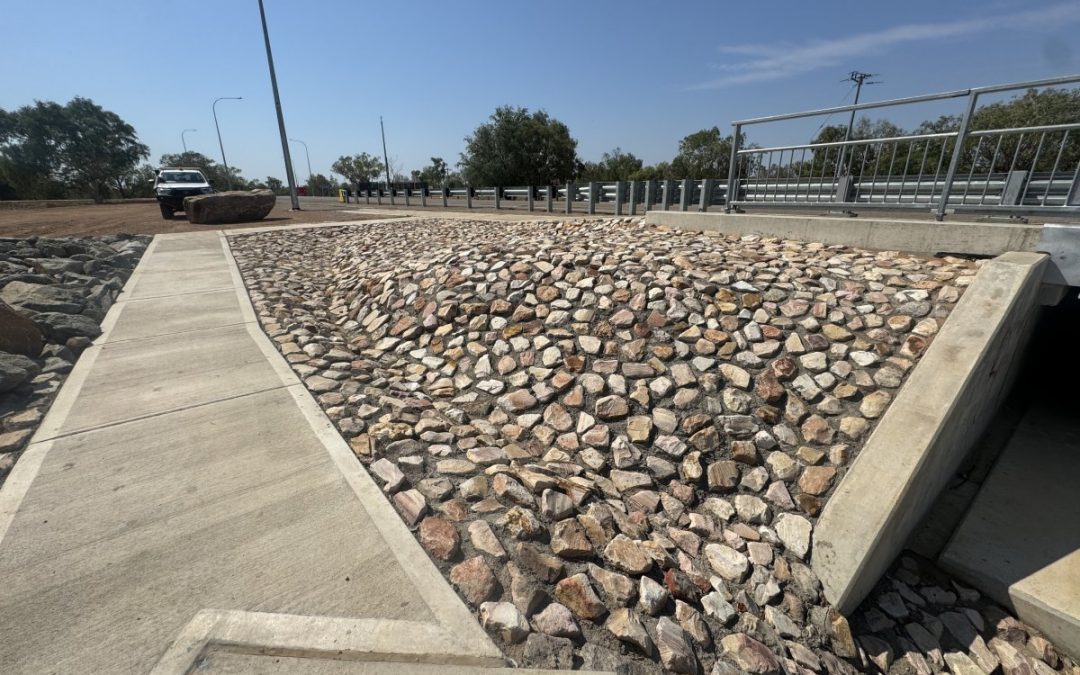
Rock pitching is a specialised engineering technique used to protect soil surfaces from the abrasive forces of water and wind. Unlike simple stone dumping, it involves the deliberate, often hand-placed arrangement of stones to create a durable, interlocking shield. This method is frequently employed across Australia’s civil and mining sectors to secure embankments, culverts, bridge abutments, and high-flow drainage channels. While the initial rock pitching cost might appear higher than simpler alternatives, the investment reflects a commitment to structural permanence rather than a temporary fix.
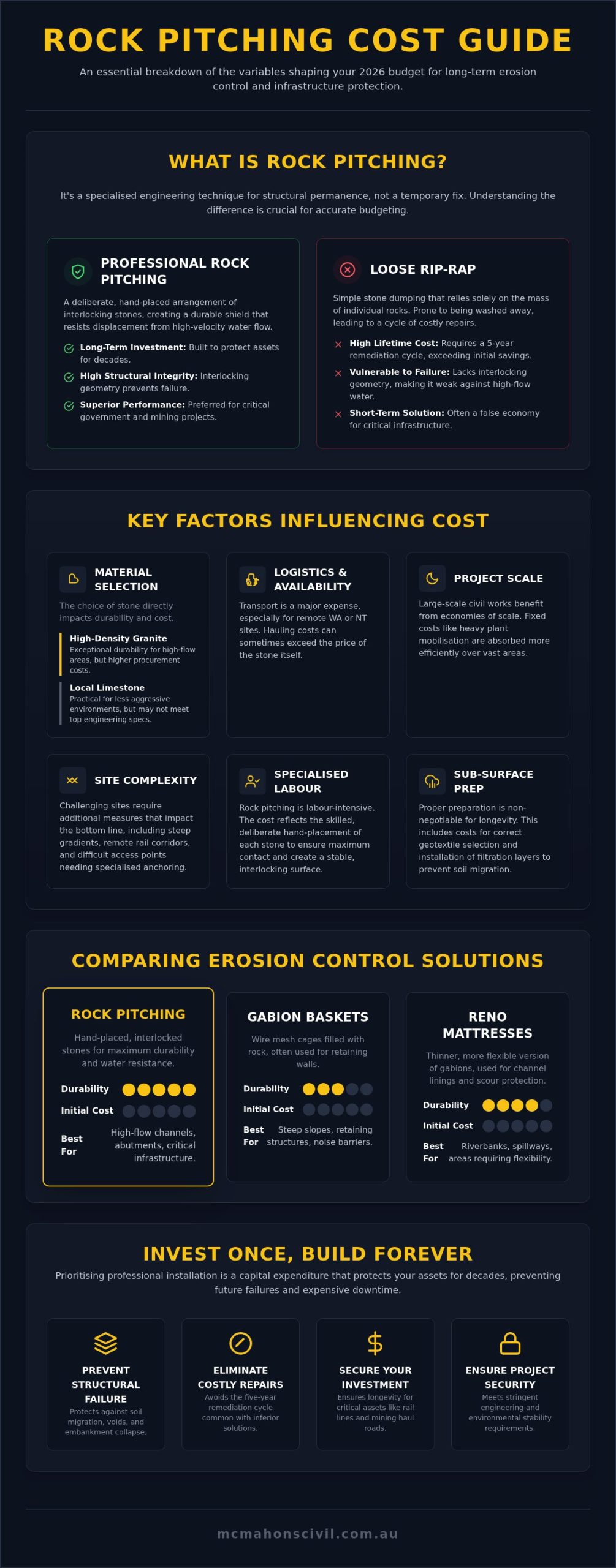
The core principle behind this pricing is the balance between material durability and intensive labour. Every stone must be selected and positioned to ensure maximum contact with its neighbours, creating a surface that resists displacement even during heavy tropical downpours or flash flooding. When teams cut corners with loose rock, they often face a five-year remediation cycle where the cost of repeated repairs quickly exceeds the original quote for a professional pitched solution. It’s a matter of doing the job once and doing it right.
Rock Pitching vs. Loose Rip-Rap
Understanding the distinction between these methods is vital for accurate budgeting. While What is Riprap (Rock Pitching) provides a foundation for erosion control, standard loose rip-rap relies purely on the weight of individual stones. In contrast, rock pitching uses an interlocking geometry that prevents stones from being washed away during high-velocity water flow. This structural integrity means that pitched surfaces require significantly less frequent intervention. This makes them a preferred choice for government and commercial projects where visual appeal and long-term environmental stability are non-negotiable requirements.
The Role of Erosion Control in Project Longevity
For critical infrastructure like rail lines and mining haul roads, erosion isn’t just a cosmetic issue; it’s a threat to the asset’s foundation. Soil migration can lead to voids beneath pavements or the collapse of embankments, resulting in catastrophic failure and expensive downtime. Professional installation ensures that the underlying geotextile and stone layers work in harmony to manage drainage without sacrificing soil stability. Rock pitching is a precision-engineered erosion solution designed to withstand the unique rigours of Australian conditions. By prioritising a high standard of workmanship, project managers can ensure that the rock pitching cost is a one-time capital expenditure that protects their civil assets for decades to come.
Key Factors Influencing Rock Pitching Cost
Developing a realistic budget for civil works requires an understanding of several interlocking variables. While the area of coverage is the starting point, the final rock pitching cost is largely determined by the specific requirements of the site and the materials selected. High-density granite, for instance, offers exceptional durability in high-flow environments but typically involves higher procurement costs compared to locally sourced limestone. Limestone is often a practical choice for less aggressive environments, yet it may not meet the stringent engineering specifications required for heavy-duty mining or rail infrastructure.
Project scale also plays a significant role in determining value. Large-scale specialised civil services delivered by McMahons Civil and Contracting PTY LTD often benefit from economies of scale, particularly when bulk earthworks are integrated into the pitching schedule. Mobilising heavy plant and establishing site facilities represents a fixed cost that is more easily absorbed over vast embankments than on smaller, isolated culvert repairs. Beyond the stone itself, the quality of the sub-surface preparation is a vital component. Proper geotextile selection and the installation of filtration layers are essential to prevent soil migration; while these add to the initial outlay, they are critical for the long-term integrity of the structure.
Material Availability and Logistics
Transport logistics are a major driver of expense, especially for remote mining projects across Western Australia or the Northern Territory. The cost of hauling high-quality rock spalls over hundreds of kilometres can sometimes exceed the price of the stone itself. Sourcing materials that meet Australian engineering standards requires a thorough knowledge of local quarries and their output capacities. When professionals organise these logistics, they must account for rock size and density, as these factors directly influence cubic metre pricing and the number of truck movements required. A University of Kentucky study on Rock Scaling highlights how administrative oversight and methodology choices are critical when managing the risks and costs associated with rock-related infrastructure projects.
Labour Methodology: Hand vs. Machine
The choice between hand-pitched and machine-set rock is often dictated by the project’s accessibility and aesthetic requirements. Hand-placing is a meticulous process that ensures a tight, interlocking finish, which is often necessary for bridge abutments or urban civil works where space is limited. This level of detail requires specialised contractors who understand how to maintain structural stability through manual placement. Conversely, machine-placed rock is far more efficient for vast embankment projects where speed and volume are the priorities. While machine placement reduces the immediate labour hours, it still requires a high degree of operator skill to ensure the rocks are properly keyed into the slope to prevent future displacement.
Site Complexity and Engineering Requirements
The physical characteristics of a project site often dictate the complexity of the engineering required, which in turn reflects in the final rock pitching cost. A primary factor is the slope gradient. Steeper inclines don’t just require more stone; they demand advanced anchoring techniques and stringent safety measures to protect personnel and equipment. For embankments exceeding a 1:2 ratio, the production rate often drops as crews must work more methodically to ensure every rock is securely keyed into the subgrade. This technical necessity is a major reason why hand-placed pitching on steep terrains commands a higher price point than machine-set rock on flatter surfaces.
High-velocity water discharge areas, such as those found near large culverts or spillways, require a higher level of precision. In these environments, the stones must be larger and more tightly interlocked to resist immense hydraulic pressure. This often necessitates a move from machine-placed bulk work to more time-intensive hand-pitched detail. While machine placement is efficient for broad, shallow slopes, it often lacks the precision needed for complex hydraulic transitions where the risk of stone displacement is high. When these conditions are present, the investment in precision labour is the only way to prevent future washouts.
Access and Mobilisation Costs
Mobilising heavy plant to remote Australian mining sites or active rail corridors involves significant logistical planning. In rail environments, work is often restricted to specific “windows” or shutdowns, which can compress the schedule and increase the rock pitching cost due to overtime or night-shift requirements. Safety protocols in these high-risk areas are non-negotiable. While these systems ensure every worker returns home safely, they naturally impact daily production rates compared to a greenfield site. Project managers must account for these site-specific constraints when forecasting their infrastructure budgets.
Subgrade Preparation and Drainage
A rock-pitched surface is only as stable as the ground beneath it. Successful installations rely on comprehensive bulk earthworks to create a uniform foundation that resists settling. Without proper subgrade preparation, hydrostatic pressure can build up behind the rocks, leading to structural bulging or total failure. Ensuring the foundation is correctly prepared is a critical step that cannot be overlooked if the asset is to last its intended lifespan.
The three essential components for a resilient subgrade include:
- Geotextile fabric: This acts as a filtration layer to prevent soil fines from washing through the rock gaps.
- Crushed rock bedding: This provides a stable, level surface for the pitching stones to rest upon.
- Sub-soil drainage: These systems manage groundwater to prevent saturation and the loss of subgrade strength.
Integrating these elements with other solutions, such as gabion baskets or reno mattresses, creates a comprehensive erosion control system. While adding these layers increases the initial investment, it’s the only way to guarantee the long-term performance of the infrastructure.
Comparing Rock Pitching to Alternative Solutions
Selecting the most effective erosion control method requires a clear understanding of the environmental stresses at play and the available capital. While the initial rock pitching cost is a primary consideration for any procurement officer, it’s often more productive to compare this method against alternatives like gabion baskets or concrete lining to see where the true value lies. Rock pitching serves primarily as surface protection; it’s an armouring layer that shields the soil from the elements. In contrast, gabion baskets are gravity structures designed to retain earth, making them more suitable for vertical or near-vertical applications where slope stability is a concern rather than just surface erosion.
Concrete lining was once a standard choice for drainage, but it’s increasingly falling out of favour for both environmental and technical reasons. Concrete is non-permeable, which means hydrostatic pressure can build up behind the lining and cause it to crack or heave. Rock pitching allows the ground to breathe and water to permeate, which naturally reduces these pressures. Similarly, while limestone retaining walls provide excellent structural support for tiered landscapes or building platforms, they represent a different category of engineering than the specialised slope protection provided by pitched stone.
When to Choose Gabions and Reno Mattresses
For projects involving high-stress soil areas or where a gravity wall is required to hold back a bank, Gabion Baskets and Reno Mattresses for Erosion Control are often the preferred choice. Reno mattresses offer a thinner profile than standard gabions, making them a cost-effective alternative for wide, shallow drainage channels. They provide a flexible, permeable lining that can adapt to minor ground movements, which reduces the labour costs associated with hand-placed stone over vast, flat areas. These solutions are particularly effective when the engineering goal is to combine weight with flexibility in high-flow environments.
Long-term Maintenance and ROI
When you look at the lifecycle of an asset over 20 years or more, the rock pitching cost often proves to be the most economical path. “Cheap” alternatives, such as loose rock or poorly applied vegetation, often require extensive remediation after just a few seasons of heavy rain. Professional rock pitching is a “set and forget” civil solution. By investing in high-quality materials and skilled installation from the start, you avoid the recurring expenses of maintenance and the high price of structural failure. The cost of failure in a mining or rail context far exceeds the upfront investment in a professionally pitched embankment.
If you’re unsure which method suits your site’s specific hydraulic conditions or soil profile, we recommend consulting with an experienced partner. Talk to the team at McMahons Civil and Contracting PTY LTD to discuss a tailored solution that ensures your next project remains both budget-compliant and structurally sound.
Securing an Accurate Quote for Your Project
Securing a precise figure for your rock pitching cost requires more than a simple over-the-phone estimate. It’s a process that begins with a thorough review of your site’s unique characteristics and engineering requirements. At McMahons Civil and Contracting, we believe that transparency is the bedrock of a successful partnership. By prioritising detailed site surveys and comprehensive engineering drawings from the outset, we minimise the risk of “unforeseen” variations that often plague complex infrastructure builds. Our team draws on deep-seated knowledge of Australian geology to ensure that the proposed solution isn’t just budget-compliant but also perfectly suited to the local soil and hydraulic conditions.
Moving from a preliminary budget estimate to a firm contract price is a critical milestone. This transition relies on a shared understanding of the project’s technical scope. We work closely with procurement officers and project managers to refine these details, ensuring every cubic metre of stone and every hour of specialised labour is accounted for. This methodical approach provides the certainty needed to move forward with confidence. We understand that in the civil and mining sectors, reliability is just as important as the bottom line.
Essential Information for Your Contractor
To provide the most accurate assessment, your contractor will need access to several key documents. Providing clear site access plans and recent geotechnical reports allows us to identify potential logistical hurdles before they impact the schedule. It’s also helpful to specify any particular material preferences or environmental requirements, such as the use of locally sourced stone or specific geotextile grades. Finally, clear timeline expectations are vital. Mobilisation costs can vary depending on whether the work is part of a standard project rollout or requires an accelerated schedule within a strict rail shutdown window.
Why Partner with McMahons Civil and Contracting?
With over 18 years of industry experience, we’ve established ourselves as a dependable partner for the mining, rail, and civil sectors across Australia. Our specialised expertise allows us to handle the most complex infrastructure challenges, from remote site logistics to high-precision hand-placed stone. We take immense pride in our workmanship and maintain a steadfast commitment to safety and Australian quality standards. We don’t just deliver a service; we provide a durable asset that protects your investment for the long term. When you choose to work with us, you’re choosing a partner invested in the success and stability of your project.
Enquire about your rock pitching project with McMahons Civil
Build a Resilient Foundation for Your Next Infrastructure Project
A successful build depends on balancing immediate capital constraints with the long-term structural integrity of your site. The final rock pitching cost is influenced by variables ranging from material density to the logistical hurdles of remote mining corridors. By prioritising precision-engineered solutions over temporary fixes, you ensure your asset remains secure against the harshest Australian conditions while avoiding the recurring expense of frequent remediation. It’s about making an informed investment that protects your infrastructure and your budget for decades to come.
With over 18 years of civil contracting excellence, McMahons Civil and Contracting provides the specialised mining and rail infrastructure experience required for complex builds. We offer comprehensive erosion control solutions that meet the highest Australian standards, ensuring your project is delivered with transparency and professional care. Our team is ready to help you navigate the technical requirements of your site to deliver a result that is both functional and enduring.
Request a Professional Quote for Your Civil Infrastructure Project
We look forward to partnering with you to deliver a result that stands the test of time.
Frequently Asked Questions
How much does rock pitching cost per square metre in Australia?
The total rock pitching cost per square metre is determined by several project-specific variables, including material selection, site accessibility, and the required depth of the stone layer. Factors such as the distance from the quarry and the complexity of the slope gradient play a significant role in the final quote. Every civil project is unique, so we recommend a detailed site assessment to provide a precise and transparent budget for your infrastructure needs.
Is hand-placed rock pitching more expensive than machine-placed?
Hand-placed rock pitching typically involves a higher initial investment compared to machine-set methods due to the intensive labour required for precision interlocking. While machine placement is efficient for broad embankments, hand-placing is essential for bridge abutments or tight-access areas where structural integrity is paramount. This meticulous approach ensures a superior finish and long-term durability, which often reduces the lifecycle costs by minimising future maintenance requirements on complex civil sites.
What is the difference between rock pitching and rock armour?
Rock pitching is a specialised method where stones are carefully fitted together to create a smooth, interlocking surface for erosion control. In contrast, rock armour, often referred to as rip-rap, typically involves larger, more irregular stones placed in bulk to absorb the energy of waves or high-velocity water. While both protect against erosion, pitching provides a more stable, finished surface that is less prone to individual stone displacement during heavy weather events.
Does rock pitching require a concrete base?
Professional rock pitching does not usually require a concrete base; instead, it relies on a well-prepared subgrade consisting of geotextile fabric and a crushed rock bedding layer. This permeable structure allows water to drain naturally, which prevents the build-up of hydrostatic pressure that can lead to structural failure. In specific high-velocity drainage scenarios, a cement mortar grout might be applied between the stones, but the foundation remains a flexible, engineered earthwork.
How long does professional rock pitching installation take?
The duration of an installation depends heavily on the project’s scale and the chosen placement method. While machine-set rock can cover vast embankments relatively quickly, hand-pitched detail work is naturally more time-consuming due to the precision required. Site constraints, such as working within active rail corridors or remote mining locations, also influence the daily production rate. A clear schedule is typically established after reviewing the engineering drawings and site access plans.
Can rock pitching be used for residential retaining walls?
While rock pitching is primarily used for large-scale civil and mining erosion control, the technique can be adapted for residential applications such as embankments or landscaping features. However, for vertical soil retention in a domestic setting, limestone retaining walls or gabion baskets are often more suitable structural choices. These alternatives provide the necessary gravity support for tiered gardens or building platforms while offering a clean, professional aesthetic that complements residential property designs.
What maintenance is required for rock pitching?
One of the primary benefits of a professionally installed pitched surface is its minimal maintenance requirement. We recommend periodic inspections to check for significant silt build-up or the growth of deep-rooted vegetation that could eventually displace the interlocking stones. If the subgrade was prepared correctly with high-quality geotextile fabric, the structure should remain stable for decades. This “set and forget” nature makes it a highly cost-effective choice for long-term infrastructure management.
Are there environmental benefits to choosing rock pitching over concrete?
Rock pitching offers several environmental advantages, most notably its permeability, which allows groundwater to recharge naturally rather than creating rapid runoff. Unlike solid concrete linings, stone surfaces dissipate the energy of flowing water more effectively and can even provide small habitats for local fauna. Using natural, locally sourced materials also reduces the carbon footprint associated with concrete production, making it a more sustainable choice for sensitive environmental zones near waterways.